
House Painters in Annandale, Virginia
Almost every street in 22003 was laid out between about 1950 and 1968, and the houses on them have never been torn down. That is unusual around here, and it means Annandale is a town of sixty and seventy year old ramblers, split levels and colonials under trees that have had all that time to grow. Fredy Vargas has been painting houses like these since 2002. 703-869-0593.
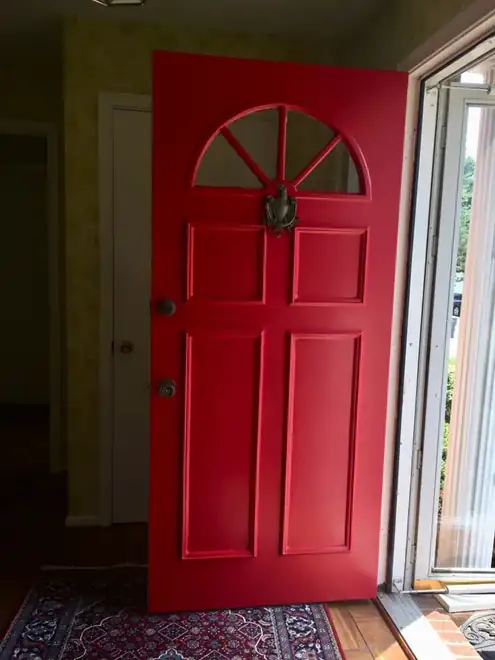
How Annandale got the houses it has
The land was part of Ravensworth, the Fitzhugh tobacco holding that ran to more than 24,000 acres after 1685. The Little River Turnpike, now Route 236, was finished through here in 1806 and connected Alexandria to Fairfax. For the next century and a half this was farm country with a crossroads on it.
Then the postwar building happened, and it happened fast. M.T. Broyhill and Sons bought 90 acres in 1951 and put up Broyhill Crest, roughly 1,500 houses finished by 1954 along Gallows Road and Annandale Road. Holmes Run Acres went up in three phases between 1951 and 1960, about 355 houses. Sleepy Hollow Woods added 377 houses between 1959 and 1961, bounded by Columbia Pike, Sleepy Hollow Road, Chanel Road, Rose Lane and Holmes Run. Canterbury Woods, Ravenwood Park, Hillbrook-Tall Oaks, Camelot, Woodburn, Wakefield Chapel Woods, Long Branch, Lincolnia Hills and Bristow Village all belong to the same twenty-year stretch.
What that history means for a painter is simple. Annandale is not a mix of eras. It is one era, repeated, with sixty-odd years of repaints, additions and replacement siding layered on top. We can usually guess what is under a coat before we get the ladder out, and we are usually right.
Kitchens that were never gutted
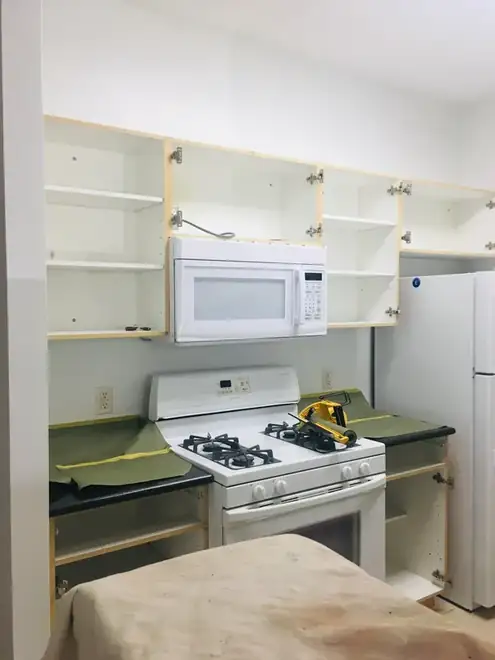
A surprising number of Annandale kitchens still have their original or first-replacement cabinets: solid wood boxes, real face frames, and doors that are heavier than anything sold at a big box store now. Ripping those out to buy thinner ones is a poor trade.
We degrease them, sand, apply a bonding primer and lay two coats of cabinet enamel. Doors and drawer fronts come off, get numbered and get sprayed flat so the faces are smooth. Boxes are done in place. Where a door has a warped stile or a hinge has torn out, we fix it while it is off the wall, because we do the carpentry anyway.
We will also tell you when refinishing is the wrong answer. Particleboard boxes swollen at the sink base do not come back, and we would rather say that than take the job.
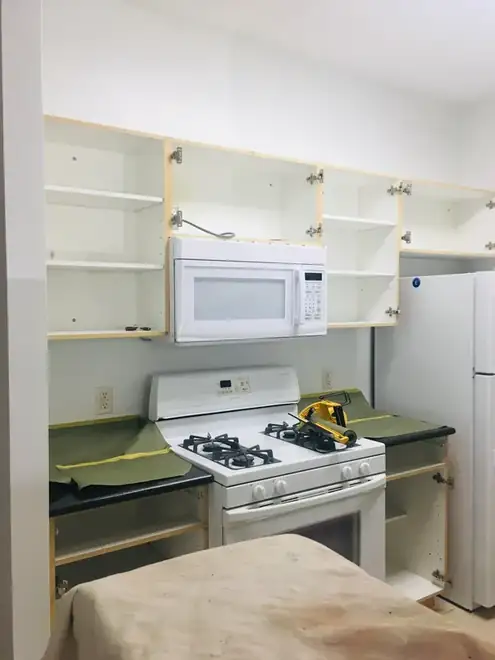
Three house shapes, three different jobs
The rambler
Low, long, often brick on the front and painted wood or aluminum on the sides and back. The paint work is concentrated in a narrow band: fascia, soffit, rake boards, shutters, the front door, the carport posts. There is not much square footage but almost all of it is trim, and trim is slow. Ramblers also sit low to the ground, so the bottom courses of siding and any wood skirting take splashback off the beds every time it rains. That is where we look first.
The split level and bi-level
The half-story jump gives you an awkward tall face on one gable end and an entry wall that runs two levels inside. Outside, that gable is often the most weathered wall on the house because nobody has reached it in fifteen years. Inside, the stair wall is the piece homeowners give up on. We stage those properly rather than leaning a ladder across the treads.
The colonial
Two full stories, a symmetrical front, usually brick or brick veneer with painted trim, shutters and sometimes a painted portico. Colonials here carry more caulk joints than any other shape in town, and caulk is what fails. We cut out failed joints instead of laying new caulk over old.
The contemporaries in Holmes Run Acres
Worth their own paragraph. Nicholas Satterlee and Francis Lethbridge designed the early phases, and the houses show their post-and-beam frame on purpose, with flat or very low roofs and a lot of exposed wood. Painting one is a different exercise. Exposed beam ends drink water at the end grain. Flat roof edges and fascia take standing water. Wide unbroken plank siding shows every lap in the coating, so it gets brushed and back-rolled rather than sprayed and left.
The trees are the biggest single factor in a paint job here
Annandale's canopy is the thing everybody likes about it and the thing that shortens paint life. Holmes Run and Accotink Creek run through the middle of the area, Mason District Park and Wakefield Park hold big stands of hardwood, and the residential lots themselves are wide with oaks and tulip poplars that were planted or spared in the fifties.
Here is what that does to a house:
- Mildew and algae film on the shaded elevations. North and east walls under a canopy stay damp for hours after the sun is up. Paint applied over that biological film releases early, no matter how good the paint is. We wash and treat before anything else happens.
- Tannin and sap staining. Oak and poplar drop enough over a season to leave brown weeping streaks down light-colored siding. Those need a stain-blocking primer, not a second topcoat.
- Pollen in April and May. A film of yellow on wet paint is permanent. In heavy pollen weeks we wash again the morning we coat, or we move the exterior work to later in the season.
- Branches on the siding. If a limb is resting against a wall it will abrade the coating and hold moisture there forever. We will point it out. Trimming it is not our trade, but it needs doing before we paint.
- Wet ground. Shaded lots stay soggy. We plan ladder footings and staging so we are not sinking into your lawn or crushing beds that took years to establish.
Nobody in Annandale is going to tell you what color to paint
This is one of the real differences between here and the newer parts of Fairfax County. There is no county-wide architectural board for ordinary Annandale streets and no dominant homeowners association covering the area. Most people can pick a color and paint it.
There are exceptions worth knowing about. Broyhill Crest has a community association covering Broyhill Crest and several neighborhoods folded into it, including Annagrove, Beverly Manor Park and Oliver Park. Sleepy Hollow Woods runs an architectural committee working from covenants written in 1959, and it does review renovation plans. Holmes Run Acres has an active civic association and its own recognized historic district with hundreds of contributing houses in it, which is a matter of pride rather than a permitting hurdle for a repaint. If you live in one of those pockets, ask your association before you settle on a color. Everywhere else, the only approval you need is your own.
Freedom cuts both ways. Without a fixed palette people get stuck. We bring Sherwin-Williams and Benjamin Moore fan decks, we brush out real samples on your actual wall rather than asking you to judge from a chip, and we look at them in morning and afternoon light. A color that reads soft gray under an oak canopy can read blue in the open. Two hours spent on this saves a repaint.
Where houses of this age give out
After twenty-four years of working on 1950s and 60s stock, the failure points are predictable. On an Annandale exterior we typically find:
Original wood trim at the roof line. Fascia behind a leaking gutter joint goes soft first, then the rake board, then the soffit corner. It is almost always the same corner of the house, the one downhill from the gutter run.
Door and window sills. Sixty years of water sitting on a flat sill with no drip edge left. We replace the sill rather than filling it.
Carport posts and breezeway framing. Ramblers and split levels here often have a carport or a covered walk to the door. The post bases sit on concrete that stays wet, and they rot from the bottom up while the top looks fine.
Garage door jambs and the trim behind downspouts. Both hidden, both consistently the worst wood on the house.
We replace all of that ourselves. Carpentry and rot repair are part of the same job for us, so you are not hiring a carpenter, waiting for him, then hiring us. If a board can genuinely be saved we save it and say so.
Some of these houses also carry cementitious or asbestos-cement shingle siding from the original build. It is stable if left alone and it takes paint well after a careful wash and the right primer. What it does not tolerate is sanding or blasting. We work around it rather than into it, and if you have it we will talk it through with you before we start.
Inside a house that has been lived in for sixty years
Interiors here are their own kind of work. Rooms are smaller than in a modern build, so there is more cut-in per square foot of wall and more furniture to move. Plaster and plaster-over-lath shows up in the earlier phases. Later fifties and sixties houses are drywall, but drywall that has taken decades of settlement cracking at the door corners.
Common jobs we get called for in 22003:
- Repainting a whole house between owners, which is the single most common call we take here.
- Removing dark 1960s and 70s wood paneling, or, if the paneling is staying, priming and painting it so the grooves do not read as shadow lines.
- Popcorn ceiling removal in the family room and bedrooms, then skimming and finishing flat.
- Wallpaper stripping in kitchens, dining rooms and bathrooms, followed by proper wall sealing before any color goes on.
- Crown molding and chair rail added to rooms that were built without any.
- Repainting original wood trim and doors, which in these houses is usually solid stock worth keeping.
- Drywall repair around old settlement cracks and past leaks.
Decks, fences, concrete and the parts of the yard people forget
Most Annandale decks are pressure-treated pine added in the eighties or nineties onto a house built decades earlier. Those get cleaned, brightened and stained, and we check the ledger connection while we are down there because that is where an older retrofitted deck fails.
We also work on Brazilian hardwood decking, mainly Ipe and Cumaru. Those need penetrating oil rather than a film finish, and they need the surface opened up first. It is a job Fred is known for and one that gets done wrong often.
Beyond the deck, we stain and paint board fences, refinish front doors and shutters, wash and seal concrete, do stained and epoxy-coated garage and basement floors, patch and paint stucco on the newer additions, and paint pools. If it is outside and it takes a coating, ask.
Who turns up, and how to get a number
Fredy Vargas founded this company in 2002 and still works on site. He is not a salesman who hands you off. He is at the house, he checks in every day the crew is working, and he is the person you call if something is not right. There are four of us, and it is the same four at your house from start to finish.
We hold a 5.0 rating on Google from 40 reviews and 93 five-star reviews on Thumbtack, where we have been hired 150 times and named a Top Pro every year from 2021 through 2025. Some of the people who call us now have been calling for over fourteen years.
We carry Virginia contractor license 2705098145 and we are licensed, bonded and fully insured. We work Monday to Friday, 8 to 5, and take weekend appointments when that suits you better. There is a 10 percent discount for veterans and for anyone aged 65 or over. No minimum job. Our shop is at 8040 Trevor Place in Vienna, a short run down Gallows Road, though Annandale sits toward the edge of the area we cover so our first available start date there can be a week or two further out than in Vienna. We will tell you the real date when you call: 703-869-0593.
Our work around Northern Virginia
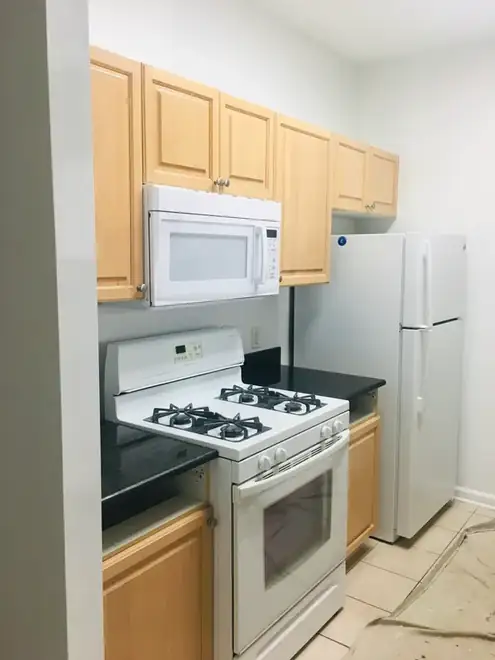
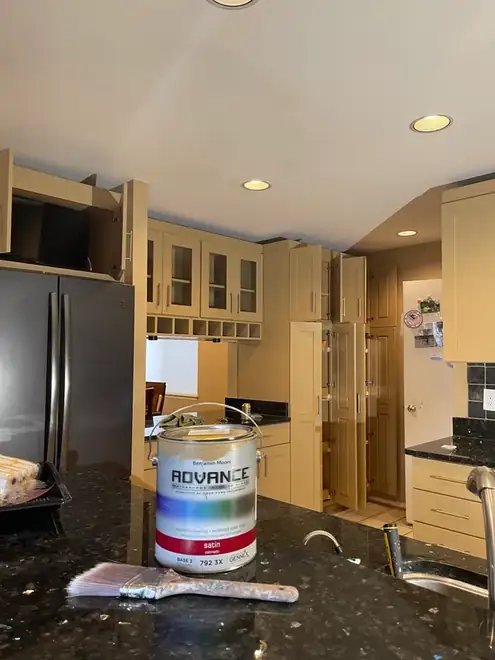
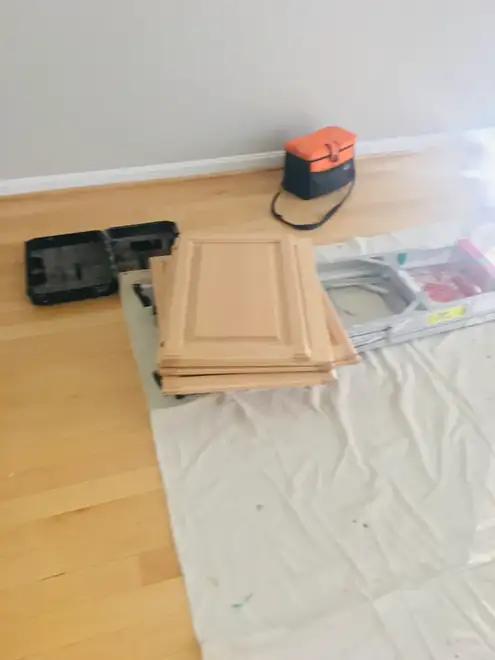
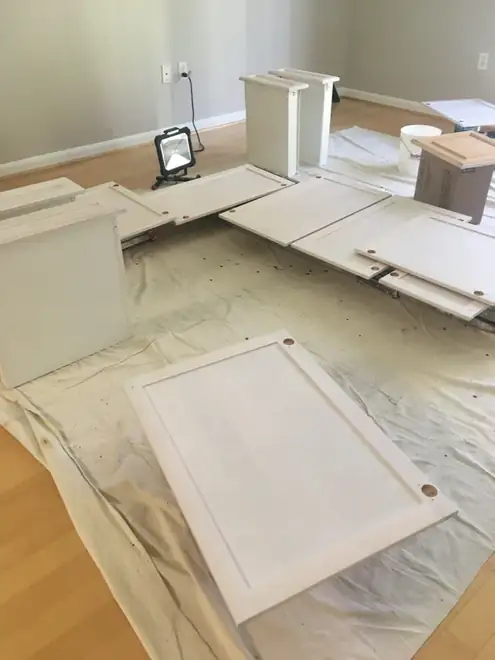
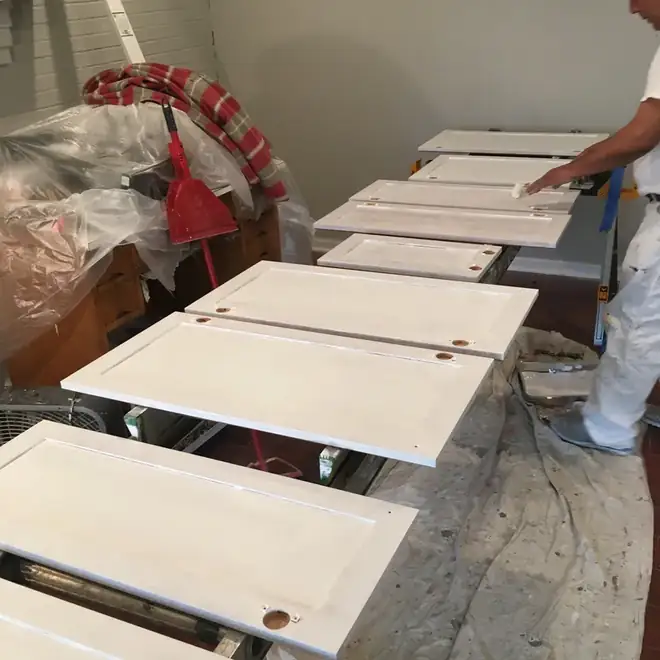
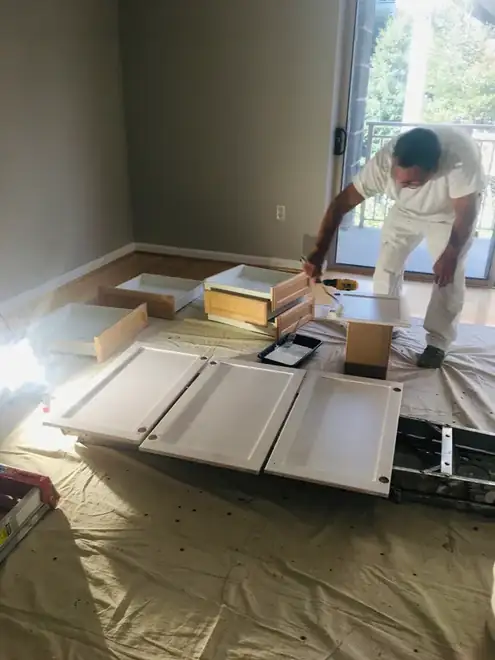
Our own photographs, from jobs across Northern Virginia. See all the project photos.
Where we work in Annandale
Serving Annandale, VA and the surrounding streets, out of the shop at 8040 Trevor Place, Vienna, VA 22182.
- 22003
Annandale, VA on Google Maps ↗opens in a new tab Get directions to the shop ↗opens in a new tab
What we do in Annandale
Questions about painting in Annandale
My street has no homeowners association. Do I need permission for a new exterior color?
In most of Annandale, no. There is no overarching association here and you are free to choose. The exceptions are pockets like Sleepy Hollow Woods, which has an architectural committee working from 1959 covenants, and Broyhill Crest, which has a community association. If you are in one of those, a quick call to them first is worth it. Everywhere else, the decision is yours.
How do you reach the tall stairwell wall in a split level?
With staging, not a ladder balanced on the steps. We set up proper platforms so the crew can work standing level, which is safer and produces a straighter cut line at the ceiling. The same applies to the tall gable end outside. It takes longer to set up than to paint, and that setup is why those walls come out clean.
The shaded side of my house grows mildew every year. Will painting fix it?
Painting over it will not. The film has to come off first or the new coat releases early. We wash the house and treat mildew where it has set into the surface, let everything dry properly, then prime and paint. On a heavily shaded north wall we may also suggest a paint with a mildew-resistant additive. It is a maintenance issue under trees, not a defect.
My 1950s house has the old cement shingle siding. Can it be painted?
Usually yes. That siding is generally stable when left undisturbed and it takes paint well after a gentle wash and the correct primer. What matters is that nobody sands, grinds or blasts it. We work over it, not into it. If your house has it, tell us when you call and we will walk you through how we would approach it on site.
Do you take on older homes with pre-1978 paint layers?
We work on them constantly, since nearly every house in 22003 predates that. We do not advertise any certification we do not hold. What we do is treat older surfaces carefully, avoid dry sanding and open scraping where it is not needed, keep the site contained, and discuss the approach with you before we begin so you know exactly what we plan to do.
Can you paint over dark wood paneling in the family room?
Yes, and it is one of our regular Annandale jobs. The paneling gets cleaned to remove decades of polish and smoke residue, then a bonding primer, then two finish coats. If you want the grooves to disappear rather than read as shadow lines, we can fill them first. That adds a day or two. We will show you both options before you decide.
Which neighborhoods in Annandale do you cover?
All of 22003 and the streets around it. We have worked in Broyhill Crest, Holmes Run Acres, Sleepy Hollow Woods, Canterbury Woods, Ravenwood Park, Camelot, Woodburn and the areas around Wakefield Park and Mason District Park. If your address is Annandale, we will come out and look at it. Smaller jobs are welcome as well as whole-house repaints.
When is the best time of year for exterior work in Annandale?
Late April through October, with two cautions. Heavy tree pollen in April and May can settle into wet paint, so in those weeks we wash again on the morning we coat. And in October we watch overnight lows rather than the daytime high, because a coat applied at 60 degrees that drops to the low 40s overnight will not cure the way it should.
Other towns we paint in
More on this from Fred
- What Actually Drives the Cost of Painting a House in Northern VirginiaHomeowners want a number. What they usually need first is an understanding of why two honest painters can quote the…
- The Best Time of Year to Paint the Outside of a Virginia HomeLate spring and early fall are the sweet spots, but the reason has less to do with the daytime high…
- Painting Your Kitchen Cabinets vs Replacing ThemRefinishing is the cheaper path most of the time. But there are kitchens where it is the wrong answer, and…
Painting in Annandale? Let us take a look.
Fred answers his own phone. If he is up a ladder he calls back the same evening.