
Painting Advice for Homeowners
Twenty-four years of answering the same good questions, written down. None of this is a sales pitch. It is what we would tell a neighbor over the fence.
How to pick a sheen without guessing
Sheen is how much light the dried film bounces back. More sheen means a harder, tighter film that resists moisture and scrubbing, and it also means every flaw in the wall underneath shows up in raking light. Less sheen hides flaws and takes abuse poorly. That trade is the entire decision.
Flat and matte belong on ceilings and on walls in rooms that do not get touched much - formal living rooms, adult bedrooms, and any ceiling anywhere. Flat on a ceiling is not a style choice, it is the only finish that keeps a long ceiling plane from showing every joint.
Eggshell is the everyday wall finish for most of a house. It has enough film to wipe and little enough shine to forgive an old wall. Satin sits one step up and earns its place in kitchens, hallways, kids' rooms, laundry rooms and anywhere a wet hand lands.
Semi-gloss goes on trim, doors, window casing, railings and bathroom walls that see real steam. The harder film survives being cleaned and gives the trim a visual edge against the wall. Gloss is rare inside a house. It looks striking on a front door or a built-in and unforgiving on anything larger.
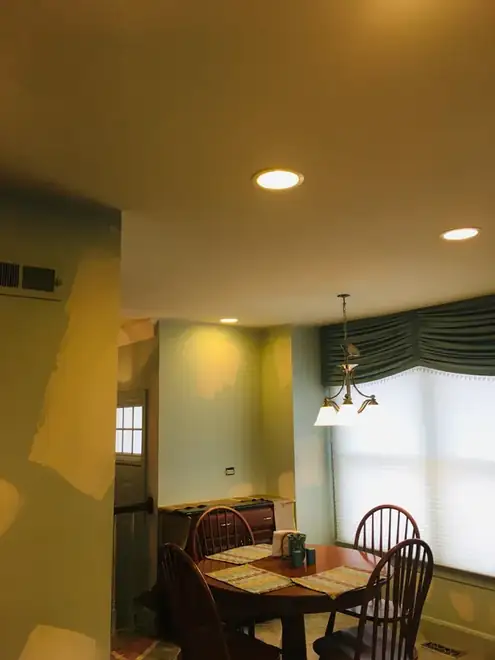
One warning worth more than the rest: a higher sheen on a wall that has been patched will show every patch. If your walls have history, go down a step in sheen and up a step in prep.
How often a house here actually needs repainting
Ranges you read online are national. Northern Virginia has its own answer, because our summers are humid, our winters freeze and thaw, and our sun angle punishes south and west walls.
Interior walls in a normal room hold up five to ten years, and the number is driven by traffic rather than time. Hallways, stairwells and kids' rooms wear first. Kitchens and baths get dirty before they get faded. Trim and doors often need attention sooner than the walls next to them because they get touched constantly.
Exterior wood siding and trim in this area generally want repainting every five to seven years, and the exposed elevations get there first. Fiber cement holds paint longer, often ten years or more. Stucco depends heavily on whether its cracks were sealed. Brick that has been painted is a lifetime commitment and wants attention every seven to ten years.
Decks are the shortest cycle of anything on your property. A horizontal surface takes sun and standing water at the same time. Two to three years for a transparent or semi-transparent stain, longer for a solid, and shaded decks under a heavy tree canopy trade sun damage for mildew.
The real signal is not the calendar. It is chalking, hairline cracking, dull color that no longer cleans up, caulk joints that have opened, and paint that has begun to lose its grip at edges. Repainting while the film is still intact costs less than repainting after it fails, because you are buying paint instead of paint plus carpentry.
Telling wood rot apart from a finish that just failed
Homeowners often call about peeling paint on trim and are surprised to learn the paint is the symptom. Here is how to sort it out yourself in five minutes with a screwdriver.
Press the tip of a screwdriver into the wood at the bottom edge of a trim board, at a miter joint, at the ends of window sills, and anywhere a horizontal surface meets a vertical one. Sound wood resists. If the tip sinks in with light pressure, or comes out with damp fibers, that is rot, and no coating will fix it.
Finish failure without rot looks different. The paint flakes off in sheets or chips and the wood underneath is dry, hard and clean. Common causes are moisture that got in from behind, a coat applied over a dirty or glossy surface, or too many layers built up over decades until the bottom one let go. That is a prep problem, and it is solvable with scraping, sanding and priming.
Things that point to rot: dark staining that does not sand out, soft spongy corners, a sill that holds a puddle after rain, visible fungus, and paint that bubbles in the same spot every year no matter how many times it is repainted. That last one is the classic. If a spot keeps failing after two repaints, water is getting to it from somewhere and you are treating the wrong problem.
Rot spreads. Wet wood invites more moisture and insects follow. Cutting out a bad section and replacing it with primed new wood is a small job today and a structural one in three years.
Getting your house ready before the painters arrive
None of this is required, and we will handle whatever you do not get to. But an hour of your time before day one makes the job faster and cheaper and reduces the chance of anything of yours getting bumped.
- Take down pictures, mirrors, curtains and curtain rods in the rooms being painted, and put the hardware somewhere you will find it later.
- Clear small and fragile items off surfaces - lamps, electronics, collectibles, anything you would hate to see moved.
- Empty closets that are being painted. This is the step people underestimate.
- Pull furniture a few feet off the walls if you can. We will move the heavy pieces and cover them.
- Point out problem spots you already know about - the crack that reopens, the ceiling stain, the door that sticks.
- Decide colors before the crew arrives, and get a sample on the actual wall in the actual room.
- Plan for pets. Tell us which room the cat hides in and which door the dog can open.
- For exteriors, unlock gates, move cars off the driveway, cut back shrubs touching the siding, and turn off automatic sprinklers for the week.
Choosing color, and why it looks different at home
A color chip under store lighting is nearly meaningless. Paint reads differently depending on the direction your windows face, the color of your floor, the temperature of your bulbs, and the trim next to it.
North-facing rooms get cool, indirect light all day and push colors toward gray and blue. A soft warm beige can go flat and cold in one. South-facing rooms get warm strong light that intensifies everything, so a saturated color chosen there will feel louder than the chip promised. East rooms are warm in the morning and cool by afternoon. West rooms do the reverse and can go orange at dinner time.
Test properly. Get a real sample, paint two coats onto a two-foot square of poster board rather than directly onto the wall, and move that board around the room. Look at it in daylight, at night under your own lamps, and against your trim color and your flooring. Living with it for two days beats deciding in ten minutes.
Two practical notes. Whites are not interchangeable - a warm white next to a cool white trim looks like a mistake, not a choice. And large fields of color read three or four shades stronger than the sample. Nearly everyone who regrets a color went one step too saturated.
Caring for a new finish
Dry and cured are two different things, and confusing them is the most common way a good paint job gets damaged in its first month.
Latex paint is dry to the touch within hours and recoatable the same day. It is not fully cured for two to four weeks, and during that window the film is still hardening and is soft enough to mark, scuff or lift if you scrub it. Wait a few days before hanging anything on a fresh wall. Wait a month before washing it.
Cabinets need the most restraint. Give the doors and drawer fronts a couple of days before normal use and several weeks before you treat them like an old kitchen. Do not stack heavy dishes against a freshly painted interior. Do not put shelf liner or contact paper on new painted shelves for at least a month - it can bond to a soft film and pull it off.
Cleaning a cured wall is simple: a soft sponge, warm water, mild dish soap, no abrasives, no magic erasers on flat paint. Those sponges are fine sandpaper and will burnish a shiny spot into a flat wall permanently.
Keep your leftover paint. Label the can with the room, the color name, the sheen and the date, and store it somewhere that does not freeze. A garage in Virginia is usually fine, an unheated shed is not. A quart of the right paint on a shelf turns a future scuff into a five-minute repair.
Outside, the maintenance that adds years is unglamorous. Rinse the siding once a year, keep gutters clear so water is not running down the fascia, cut shrubs back off the walls so air can move, and re-caulk joints as soon as they open. Fixing one failing caulk line in the fall costs nothing and prevents the water intrusion that rots a window sill.
Small things that make a finish last longer
A few habits separate the houses that look good for eight years from the ones that need work in four.
Do not let a downspout dump against the house. That single detail causes more siding and trim failure than any paint product on the market. Keep mulch and soil below the bottom edge of the siding. Wood that touches wet ground is wood that will rot, no matter what is painted on it.
Inside, run the bath fan during a shower and for fifteen minutes afterward. Bathroom paint fails from steam sitting on the ceiling, not from age. Wipe kitchen walls near the stove a few times a year so grease does not build a film that the next coat of paint will refuse to stick to.
And touch up early. A chip on a door edge is a two-minute job while it is a chip. Left alone through a winter it takes on moisture, spreads, and turns into sanding and priming.
Common questions
What sheen should I use on my walls?
Eggshell for most rooms, satin for kitchens, baths, halls and kids' rooms, flat on ceilings, semi-gloss on trim and doors. Older or patched walls do better in a lower sheen.
How do I know if I need primer?
Prime bare wood, bare drywall, patches, water stains, anything glossy, and any large color change. Self-priming paint does not replace a stain-blocking or bonding primer where the situation calls for one.
Can I paint over wallpaper?
You can, and we generally advise against it. Moisture in the paint loosens the adhesive and the seams telegraph through. Removing the paper and priming the wall is the finish that lasts.
How long before I can wash a newly painted wall?
About a month. The paint is dry in hours but keeps curing for two to four weeks, and scrubbing it early can burnish or lift the film.
Is it worth paying for premium paint?
Usually yes on walls you will look at for years and on exteriors. Better resins mean better coverage, better color retention and a film that cleans up instead of wearing through.
What temperature is too cold to paint outside?
It depends on the product, but the surface temperature matters more than the air, and the overnight low matters most. We watch dew point and stop early in the day in fall for that reason.
How do I tell if my trim is rotten?
Press a screwdriver into the bottom edges, miters and sill ends. Sound wood resists. If the tip sinks in or the fibers are damp, it is rot and needs cutting out, not caulking.
Should I store my leftover paint?
Yes. Label the can with room, color, sheen and date, seal it well, and keep it somewhere that will not freeze. It makes future touch-ups trivial.
Every service we offer
Every town we cover
More on this from Fred
- What Actually Drives the Cost of Painting a House in Northern VirginiaHomeowners want a number. What they usually need first is an understanding of why two honest painters can quote the…
- The Best Time of Year to Paint the Outside of a Virginia HomeLate spring and early fall are the sweet spots, but the reason has less to do with the daytime high…
- Wood Rot on Trim and Siding, and the Price of WaitingRot is not an event. It is a slow process that begins somewhere you cannot see, and the paint failing…
Ready when you are.
Fred answers his own phone. If he is up a ladder he calls back the same evening.