
House Painters in Springfield, Virginia
Springfield was farmland with a railroad stop until the Shirley Highway went through. Then a developer named Edward Carr worked out it was the last easy commute inside twelve miles of Washington, and between 1950 and 1970 the population went from about a thousand people to more than twenty-five thousand. Nearly everything we paint here came out of that boom and the two decades after it. Fredy Vargas, on site himself since 2002. 703-869-0593.
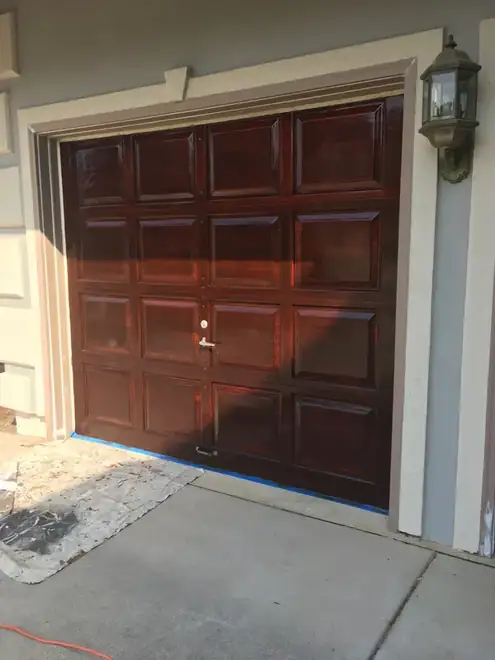
A town built in one long push, and what that leaves behind
Four ZIP codes carry the Springfield name. 22150 is the older central area, 22151 covers North Springfield, 22152 is West Springfield and 22153 runs south and west into Newington Forest and the Burke edge. Between them you get roughly twenty-five years of continuous house building, and you can date a street by looking at the roofline from the curb.
The early work sits closest to Backlick Road and the old rail line. Springfield Forest was planned in the early fifties and built through the middle of that decade. Loisdale Estates was largely finished by 1960. Springfield Estates, Edsall Park and North Springfield belong to the same wave, and North Springfield is neatly bounded by the Beltway and the Norfolk Southern line to the south, Flag Run to the west, Braddock Road to the north and Backlick Road to the east.
Push west along Old Keene Mill Road and the dates move forward. Cardinal Forest, Monticello Forest, Monticello Woods, Kings Park, Rolling Valley, Hunt Valley, Orange Hunt, Pohick Hills, Keene Hill Manor and Westview Hills mostly went up through the sixties and seventies, with Newington Forest later still.
Here is the thing that matters to a homeowner. Houses built in the same year fail in the same year. Whole Springfield streets come due for exterior work simultaneously, and if you have watched three neighbors get scaffolding up in one spring, that is why.
The split foyer, which is the house we paint most in Springfield
If you have ever opened a front door onto a half-flight of stairs going up and another going down, you have a split foyer. Springfield has thousands of them and they create four specific problems.
The entry wall. That foyer runs the full height of both levels with nothing to stand on but stair treads. Homeowners paint every other room and leave this one, sometimes for twenty years, until it is the only wall in the house still wearing the builder color. We stage it properly. Platforms, level footing, no ladder wedged against a handrail.
The front elevation. Because the house is raised, the front door sits up a flight of exterior steps and the whole facade is taller than it looks from the street. Handrails, step risers, the storm door frame and the trim around a raised entry all take heavy wear and none of them are quick.
The lower level walls. Half below grade, so they hold moisture from the outside. Interior paint on those walls needs a properly sealed and dry substrate, and if there is efflorescence or a damp patch, painting over it just hides the problem for a season.
The rear. Split foyers on a sloping lot end up two full stories tall at the back with a deck or a walkout underneath. That back wall is usually the least maintained face of the house.
Ramblers, Cape Cods and the 1950s core
The oldest Springfield stock is low and simple: ranches and ramblers with wide eaves and a long horizontal line, minimal traditional boxes, and Cape Cods with dormers. Brick or partial brick fronts are common, with painted wood or metal on the remaining elevations.
On a house like this the painted surface area is small but almost all of it is fiddly. The list runs fascia, soffit, frieze board, rake, window trim, shutters, front door, storm door frame, and whatever is holding up the carport. Two things we watch for:
- Low eaves and shallow overhangs. A rambler has less roof protecting its walls than a colonial does, so the top of the siding and the frieze board weather harder than you would expect.
- Ground clearance. These houses sit low. The bottom siding course, any wood skirting and the base of the carport posts take splash off the beds and the drive every time it rains, and they go first.
- Dormer cheeks on the Cape Cods. Small, awkward, above the gutter and almost never reachable from a stepladder, which is exactly why they are the worst paint on the house.
- Original steel or aluminum windows. Some of the 1950s houses still have them. They can be painted, but they need degreasing and a metal-suitable primer, and the frames are usually where condensation has been sitting for decades.
The 1960s and 70s colonials west of the Beltway
Cardinal Forest, Rolling Valley, Orange Hunt, Hunt Valley and the neighborhoods off Old Keene Mill Road and Rolling Road are mostly two-story colonials, side-hall and center-hall, brick veneer front with siding on the sides and back, attached or projecting garage, and a deck out the rear.
These are the houses where caulk is the whole story. A colonial of this type has hundreds of feet of joint: siding to corner board, trim to brick, window to casing, garage door to jamb. Caulk is the first thing to fail and it fails invisibly, wicking water behind the trim while the paint on the surface still looks fine. We cut out and replace failed joints rather than running a fresh bead over a dead one, which is a very common shortcut and the reason some houses need repainting again in four years.
The other consistent finding on this era is finger-jointed pine trim. Fascia, garage jambs, window sills and corner boards were built up from short pieces, and every joint eventually opens and swallows water. We replace those sections rather than filling them. Because we do carpentry ourselves, that happens as part of the same job rather than becoming a second contractor and a second delay.
Siding: what you have and what it needs
Springfield has essentially every siding material of the last seventy years, sometimes three of them on one house after an addition or two.
Painted aluminum
Very common on the fifties and sixties houses. Old aluminum goes chalky: rub it and your hand comes away white. It absolutely can be repainted and it comes out well, but the chalk has to be washed off completely and the surface needs a bonding primer. Skip that step and the new coat peels off in sheets within two years.
Vinyl
Mostly retrofitted or on the later houses. Paintable with the right primer and an acrylic rated for vinyl. The real constraint is heat: a color significantly darker than the original absorbs more sun and can distort the panels. We steer you to vinyl-safe shades and explain the limit rather than taking the order and hoping.
Hardboard and plywood panel siding
Widespread on the seventies houses. Sound panels take paint well and last. Panels that have swelled at the bottom edge or delaminated at a nail head do not, and no amount of paint saves them. We will tell you honestly which boards are worth coating and which need replacing, and we replace them.
Brick
Most Springfield brick fronts are best left as brick. If yours has already been painted at some point, repainting it is straightforward with a masonry-appropriate product. If it never has been, we will usually advise against starting.
Living near the interchange
The Springfield Interchange, the Mixing Bowl, is where I-95, I-395 and the Capital Beltway meet, and a good part of 22150 sits within earshot of it. Springfield Town Center and the Franconia-Springfield Metro station, open since 1997, are on the same side of town.
Proximity to that much traffic has real effects on an exterior finish. Road film accumulates on the elevations that face the highway corridor: a fine gray deposit of brake dust, tire rubber and exhaust residue that does not rinse off with rain. Paint applied over it does not bond properly. On houses near the interchange, near Backlick Road or along the Franconia Road corridor, our wash step is genuinely doing work rather than being a formality, and we use a detergent rather than plain water.
The same film builds up on white or light trim and makes a house look tired years before the paint has actually failed. Sometimes the honest recommendation is a wash and a trim repaint rather than a full exterior, and we will say so.
It also affects our working day. Traffic through the interchange means we plan arrivals outside the worst of the commute so the crew is on your house at eight, not sitting on the ramp.
Decks, and what a sloping Springfield lot does to them
A lot of Springfield sits on rolling ground, which is why so many split foyers and colonials here have a deck sitting one or two full stories above a walkout. Height changes the job. It means proper access, tie-offs where needed, and finishing the underside and the outer face of the rim joist, which are the parts a homeowner with a brush never reaches.
Pressure-treated pine is the standard material and it wants cleaning, brightening and a penetrating stain rather than a film that will peel. If your deck has been peeling every couple of years, the usual cause is a solid film coating on a horizontal surface that sees full sun and standing water. Stripping that back and switching approach is the fix.
We also do Brazilian hardwood, Ipe and Cumaru in particular. Those are dense and oily, they reject film finishes completely, and they need a penetrating hardwood oil applied thin and wiped back after the surface has been opened up. It is one of the things people seek us out for.
While we are under a raised deck we check the ledger, the post bases and the stair stringers. Post bases sitting directly on soil or on a footing that holds water are the classic failure on a thirty-year-old Springfield deck, and if we find it you will hear about it before we coat anything.
Inside: ceilings, paneling and the rooms nobody has touched
Springfield interiors have a few recurring jobs.
- Popcorn ceilings. Standard in the late sixties and seventies houses. We scrape them, skim the ceiling flat, prime and finish, and we contain the mess while we do it. It is the single change that makes an older house read as current.
- Wood paneling in the lower level. Family rooms and rec rooms in split foyers are full of it. It cleans, primes and paints beautifully. We can fill the grooves first if you want a flat wall rather than shadow lines.
- Settlement cracking. Sixty and seventy year old drywall and plaster cracks at the same points, usually the upper corners of door openings. We cut, tape and finish properly rather than smearing compound into a live crack.
- Wallpaper. Kitchens, powder rooms and dining rooms from the eighties. Stripped, wall sealed, skimmed where the face tore, then painted.
- Trim and doors on their own. Sometimes the walls are fine and it is just decades of scuffed woodwork. That is a legitimate small job and we are happy to take it.
- Crown molding. We fit and finish it, which suits the plain rooms in a lot of these houses.
Kitchen cabinets
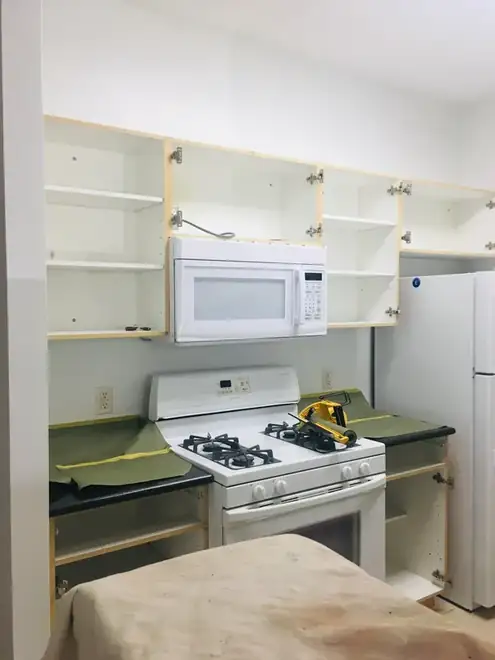
Springfield kitchens tend to be either original to the house or replaced once in the nineties. Either way you are usually looking at solid wood doors on decent boxes, and refinishing them beats replacement on both cost and time.
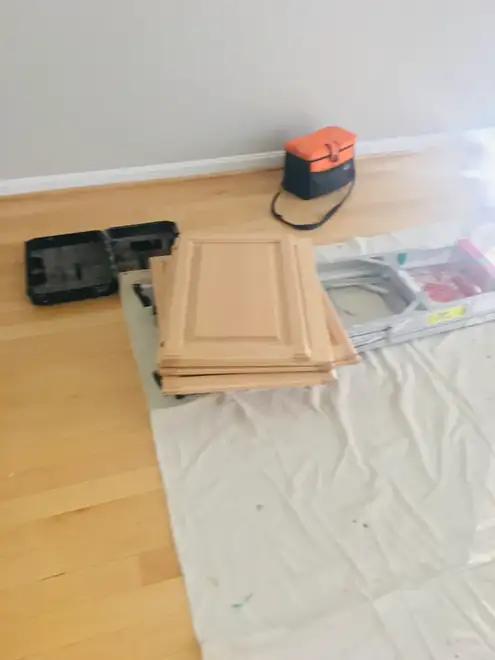
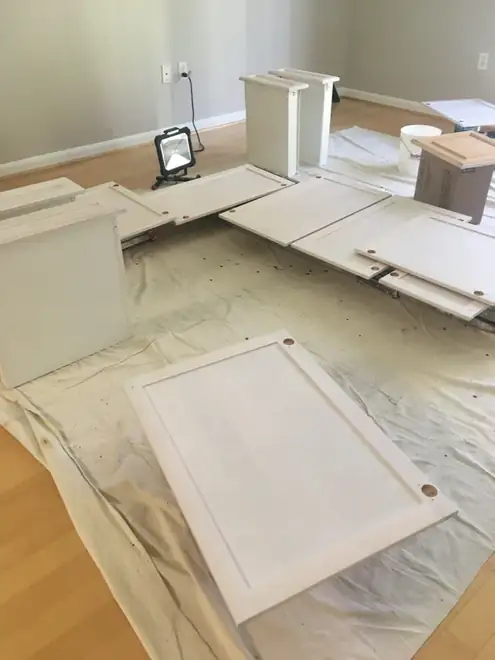
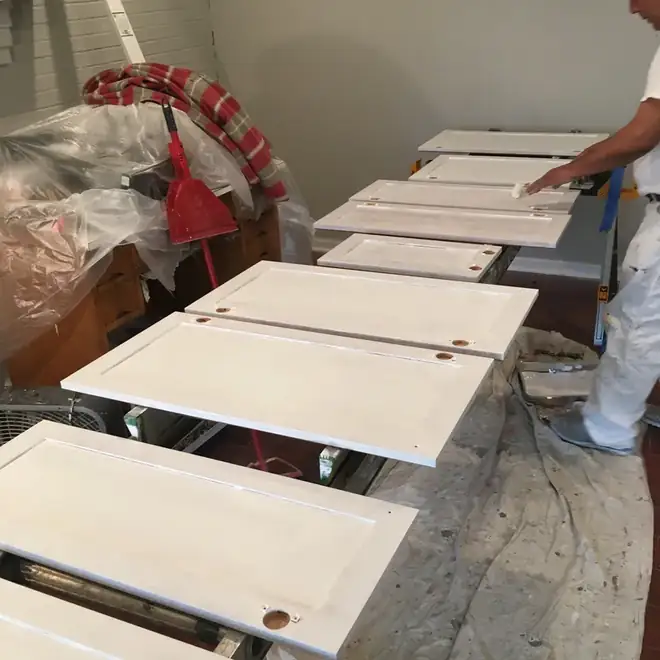
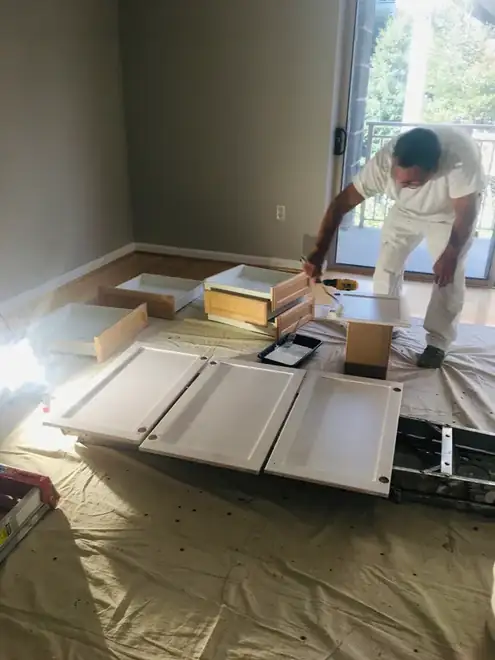
Doors and drawer fronts come off, get labeled and get sprayed lying flat so the faces are smooth with no runs. Everything gets degreased first, because a kitchen that has been cooked in for thirty years has grease in places you would not think to look. Then sanding, a bonding primer and two coats of cabinet enamel. Boxes and face frames are done in place. Loose hinges and split stiles get repaired while the doors are off.
If your boxes are particleboard and swollen under the sink, we will tell you refinishing is money badly spent. We would rather lose the job than do that one.
Booking, and a straight answer about our schedule
Fredy Vargas started Fred General Painting in 2002 and has run it for twenty-four years. He is on site himself and checks in on every job daily. There are four of us and it is the same four people at your house each day, start to finish, which is why the last room matches the first.
We have a 5.0 rating on Google from 40 reviews, and on Thumbtack we hold 93 five-star reviews, have been hired 150 times and have been named a Top Pro every year from 2021 through 2025. A good number of our clients have been with us for more than fourteen years.
Virginia contractor license 2705098145. Licensed, bonded and insured. Monday through Friday, 8 to 5, with weekend appointments available. Veterans take 10 percent off, and so does anyone aged 65 or over. There is no minimum job size.
We work out of 8040 Trevor Place in Vienna, so Springfield sits toward the far end of our service area and our next available start there can run a bit later than it would closer to home. That is worth knowing if you are planning around a move or a sale. Call 703-869-0593 and we will give you a real date and a real number.
Our work around Northern Virginia
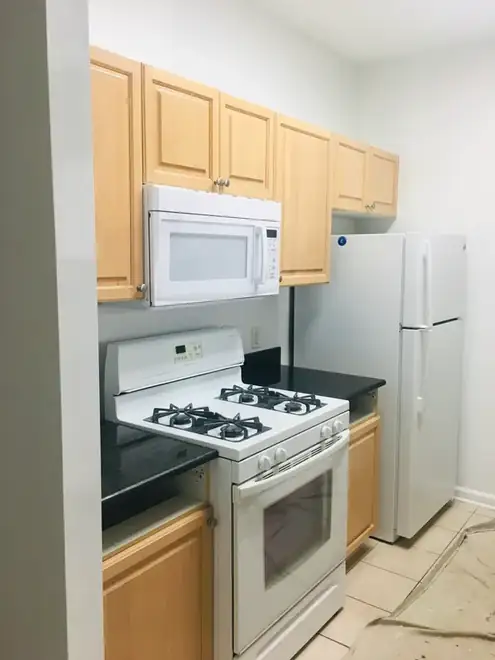
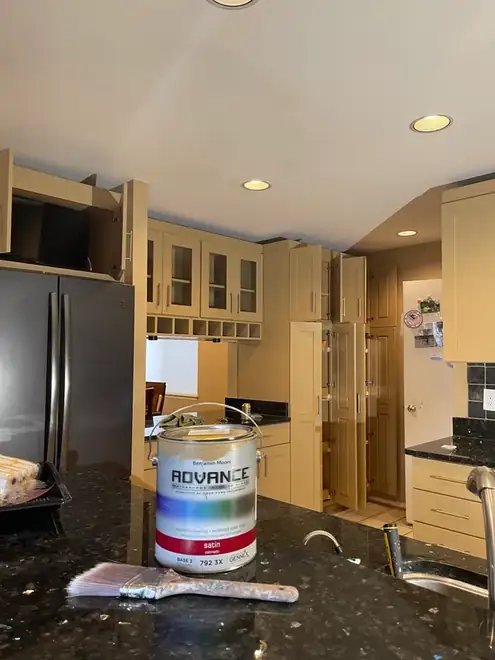
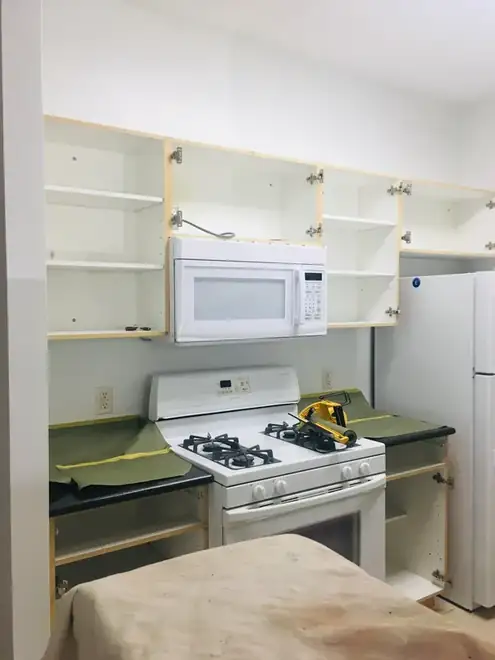
Our own photographs, from jobs across Northern Virginia. See all the project photos.
Where we work in Springfield
Serving Springfield, VA and the surrounding streets, out of the shop at 8040 Trevor Place, Vienna, VA 22182.
- 22150
- 22151
- 22152
- 22153
Springfield, VA on Google Maps ↗opens in a new tab Get directions to the shop ↗opens in a new tab
What we do in Springfield
Questions about painting in Springfield
Nobody can reach the tall wall in my split foyer entry. Can you?
Yes, and it is one of the most common calls we get in Springfield. We set up staging so the crew works from a level platform rather than balancing a ladder on stair treads. That is safer and it is the only way to get a straight cut line at the ceiling. Setting it up takes longer than the painting does, and that setup is what makes the wall look right.
My aluminum siding is chalky. Is it worth painting?
It usually is, and old aluminum takes a new finish very well once it is prepared correctly. The chalk has to come off completely with a proper wash, then the surface needs a bonding primer before any color. If someone paints straight over chalk, the new coat has nothing to grip and peels within a year or two. That prep is most of the labor on an aluminum house.
I live close to the interchange. Does the traffic really affect my paint?
It affects adhesion more than durability. Elevations facing the highway corridor collect a film of brake dust, tire rubber and exhaust residue that rain does not remove. Paint applied over it will not bond properly. On houses near the Mixing Bowl, Backlick Road or Franconia Road we wash with detergent rather than plain water, and sometimes a wash plus trim repaint is all a house actually needs.
My deck is two stories up off a sloped back yard. Can you still refinish it?
Yes. Raised decks are normal here given the terrain, and we set up the right access to reach the outer rim joist and the underside, which are the parts homeowners never get to. We also inspect the ledger, post bases and stair stringers while we are down there. If we find structural rot we tell you before we put any finish on it.
My community has an architectural committee. Will that slow things down?
Not usually, as long as you start the approval before you book us. Several of the newer Springfield communities, Newington Forest among them, run color approval, and townhouse rows often have a set palette. Send us the approved color and we will match it exactly from Sherwin-Williams or Benjamin Moore. We do not submit applications on your behalf.
Do you cover 22153 and the streets that shade into Burke?
We do. Our Springfield coverage runs across 22150, 22151, 22152 and 22153, including Newington Forest and the western neighborhoods off Old Keene Mill Road and Rolling Road. The boundary between a Springfield and a Burke address is a postal line rather than a real one, and it makes no difference to us. Give us the address and we will come and look.
Is removing a popcorn ceiling worth the disruption?
In a seventies Springfield house it is probably the highest-impact thing you can do to an interior. We scrape the texture, skim the ceiling flat, prime and finish, containing dust as we go. The room is out of use for a couple of days. What you get back is a ceiling that reflects light properly and an interior that stops reading as forty years old.
How long does a whole-house exterior take on a Springfield colonial?
For a typical two-story colonial, plan on the better part of a week to ten days of working time, weather permitting. Washing and drying is the first day or two on its own. Carpentry and rot repair, which we do ourselves, adds time depending on what we find. We give you a schedule at the estimate and tell you promptly if rain moves it.
Other towns we paint in
More on this from Fred
- What Actually Drives the Cost of Painting a House in Northern VirginiaHomeowners want a number. What they usually need first is an understanding of why two honest painters can quote the…
- Wood Rot on Trim and Siding, and the Price of WaitingRot is not an event. It is a slow process that begins somewhere you cannot see, and the paint failing…
- The Best Time of Year to Paint the Outside of a Virginia HomeLate spring and early fall are the sweet spots, but the reason has less to do with the daytime high…
Painting in Springfield? Let us take a look.
Fred answers his own phone. If he is up a ladder he calls back the same evening.