
Cabinet Refinishing in Falls Church, VA
Falls Church kitchens are small, and that cuts both ways: fewer doors to finish, and no room in the house to finish them in. We settle both before quoting.
A 1950 kitchen is eleven feet of wall
Pimmit Hills broke ground in 1950 and went up as more than 1,600 small houses with three bedrooms and one bath. Greenway Downs, Virginia Forest and most of the streets off Broad Street are the same generation, laid out for a family cooking on a thirty-inch range.
In practice that is one run of base and wall cabinets along an exterior wall, a short return by the back door, and a broom closet. Count the faces and you are often at sixteen to twenty-four doors and drawer fronts for the whole kitchen.
Cabinet work is priced off door and drawer count rather than floor area, so these are the smallest kitchens we quote. What does not shrink is the prep. Degreasing and sanding every edge takes the same care here as in a large kitchen.
Seventy years of coats on a 1950 cabinet
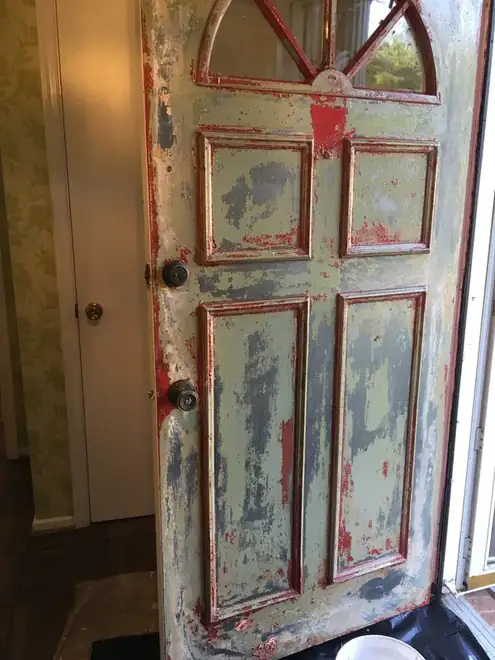
Most original kitchens in these houses were painted from new rather than stained, in an oil enamel, and painted again two or three times since. So we are rarely working on a factory finish here, but on a stack of films of different ages, old oil under newer latex.
That stack causes two specific problems. The film is thick, glossy in places and chalky in others, so it gets deglossed and a bonding primer goes on rather than a coat of enamel straight over the top. And the build-up lands in the hinge rabbet on the back edge of a lipped slab door, which is why half the doors in these kitchens bind, sit crooked or will not close flush. We sand that edge back to a clean line instead of adding two more coats to it.
These houses predate 1978, so we handle the old coatings accordingly: scraped and sanded wet, no open power sanding of aged paint, the work area contained with plastic, and the floor vacuumed and wiped down daily.
The 1990s reface, and what is under the new skin
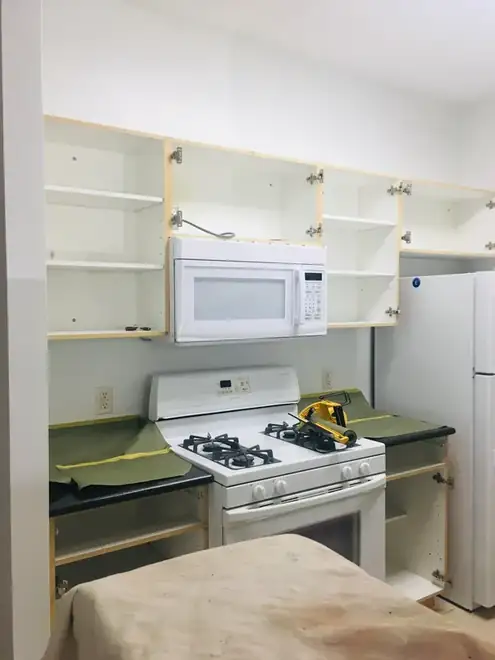
A lot of kitchens here were refaced rather than replaced between about 1988 and 2005. The original boxes stayed in the wall, the face frames were covered with a thin wood veneer or a rigid vinyl laminate, and new doors were hung on them.
It matters because a reface veneer can be a thirty-second of an inch thick. Put a machine on that and you go through to the glue line at the first corner. We scuff refaced frames by hand with a fine pad and go straight to a bonding primer.
Two things we look for at the estimate: vinyl laminate lifting at the stile beside the dishwasher, which is a heat and steam failure that paint will not reattach, and a seam opening where two pieces of veneer meet at an inside corner. Both get glued and clamped first or the finish telegraphs the seam within a season. If the skin is curling badly, the frames need stripping or the doors need replacing, and we say so before anybody signs.
One window, no hood, and the grease that comes with it
Kitchens this small carry a heavier grease film than large ones, which is the opposite of what people assume. The same frying happens in a quarter of the air volume, most of these houses have a recirculating fan over the range or nothing at all, and the one window stays shut five months a year.
The film ends up everywhere: the underside of the wall cabinets over the range, the side of the tall cabinet beside it, the inside face of the door above the cooktop. We wash twice on these kitchens and let them dry fully. If primer crawls anywhere, we clean that area again rather than bury it.
Thirty years of aerosol furniture polish leaves silicone residue, which makes a finish pull away from itself in small craters. That comes off with solvent, not soap.
Where the doors go when there is no spare room
The postwar houses here sit on slab or shallow crawl space. No basement, usually no garage, sometimes a carport. There is nowhere inside to rack twenty-four doors flat and leave them undisturbed for three days while coats go on and harden enough to handle.
So the doors leave. They come off on the first morning and get numbered on the hinge edge, hinges and pulls go into bagged sets mapped to the same numbers, and everything is wrapped and loaded. Degreasing, sanding, priming and finish coats happen off site in a space we control for dust and temperature. They come back at the end with every hinge adjusted so the reveals line up.
The upside is that your kitchen is only a working site for part of the job. Face frames, box sides and exposed end panels get finished in place with the counters, backsplash, range and floor masked. In a house with one kitchen and one bathroom, shortening that window matters.
Condo kitchens on the county side
Plenty of Falls Church addresses are not in the city at all. The 22041 and 22044 ZIP codes cover Seven Corners, Bailey's Crossroads and the garden apartment stock around them, much of it built in the sixties and converted to condominium later.
Those kitchens are interior rooms. No window, no exterior wall, one recirculating hood, and a door you can close. Finishes need air movement to flash off properly, so we run a fan toward the unit door and use low odor waterborne cabinet products rather than anything solvent heavy. In a stacked building your air is partly your neighbors.
The cabinets are usually a renovation layer rather than original: melamine boxes with thermofoil or vinyl-wrapped doors. Boxes coat well with the right bonding primer. Thermofoil is a film heat-wrapped over a fiberboard core, and where it has peeled back at the corner beside the oven, paint does not put it back.
Buildings here also set work hours and usually want a certificate of insurance, and some have a freight elevator to book. We protect the corridor and elevator floor when the doors go out.
Calling us about a small kitchen
There is no job minimum, and here that matters more than in most towns we cover, because these kitchens are genuinely small. A sixteen-door kitchen is real work to us, and so is one bathroom vanity or the built-in beside a Cape Cod fireplace.
Fredy Vargas comes out himself, counts the doors, works out whether the frames have been refaced, checks the grease around the range, and gives you a number for that kitchen rather than a rate per linear foot. He has been doing this since 2002 and is on site every day a job runs.
We are at 8040 Trevor Place in Vienna, fifteen minutes up Route 7. Licensed, bonded and insured, Virginia contractor license 2705098145. Ten percent off for veterans and for anyone 65 or older. Call 703-869-0593.
Every service we offer
Every town we cover
More on this from Fred
- What Actually Drives the Cost of Painting a House in Northern VirginiaHomeowners want a number. What they usually need first is an understanding of why two honest painters can quote the…
- The Best Time of Year to Paint the Outside of a Virginia HomeLate spring and early fall are the sweet spots, but the reason has less to do with the daytime high…
- Refinish or Replace? How to Judge the Real Condition of Your DeckA gray, splintery deck usually looks worse than it is. A deck that looks fine can be the one with…
Ready when you are.
Fred answers his own phone. If he is up a ladder he calls back the same evening.