
Cabinet Refinishing in Great Falls, VA
Kitchens in Great Falls are large and were usually built by a cabinet shop rather than a factory. Both facts change the job: more doors than anywhere else we work, and an original finish that was sprayed and catalyzed to be permanent.
Counting doors before anyone talks about the room
A kitchen in 22066 is frequently two kitchens. There is the main run with an island, and then a butler pantry, a beverage run, a baking station, a second sink in a prep area, and a pantry with cabinetry in it.
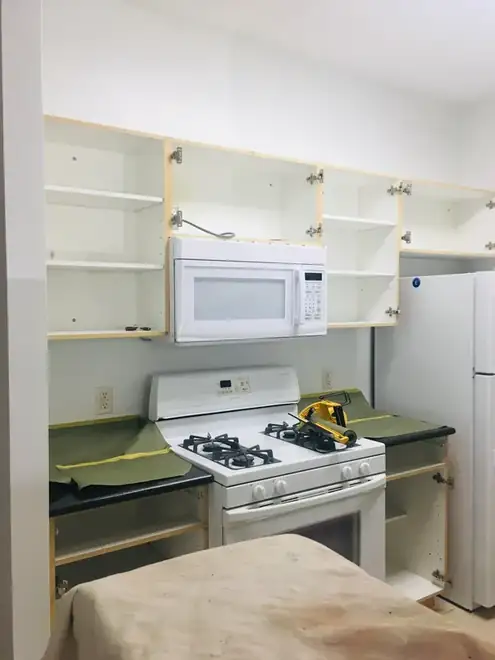
Totals out here land between forty and seventy doors and drawer fronts, and we have counted higher. That is the number that sets the schedule, not the floor area. Seventy faces means seventy pieces to number, degrease, sand, prime, sand again and coat several times, each handled individually, plus the frames and end panels.
Islands are a category of their own. A furniture-style island with applied moldings, a corbelled overhang, beaded panels on three sides and a bookshelf on the end is more linear feet of profile than the whole wall cabinet run, so we count it separately.
Shop cabinets and the finish that was catalyzed in 1999
Custom cabinetry from a millwork shop almost always left there under a catalyzed finish: conversion varnish or a precatalyzed lacquer, sprayed onto bare wood and chemically cured into a hard closed film. It is why these doors still look decent after twenty-five years.
It is also the hardest substrate in cabinet work. Nothing bonds to a cured catalyzed film until it is properly abraded, and the film is slick enough that a light scuff just polishes it. We sand every face and profile by hand where the shape requires it, check the door under a raking light for glossy spots, then prime with a bonding primer chosen for that film rather than a general purpose one.
Before any of it we test. One door, out of sight, gets cleaned, sanded, primed and coated, and the next day we try to lift the coating with tape and a blade. Ten minutes on a seventy-door kitchen is what separates a finish that survives fingernails from one that peels at the pull in eight months.
Glazed profiles, and what they do to a light color
Glazing was everywhere in custom kitchens from the late nineties into the late two thousands. A dark pigmented glaze was wiped over the stain and then wiped off the flats, so it stayed in the profile corners, in the bead around the panel, and in any distressing the shop added on purpose.
Paint over it and the glaze comes back through. It sits where the film is thinnest, the inside corner of every profile, and reads as a dirty shadow line in what is supposed to be an off-white door. Another finish coat does not fix it, because the problem is bleed, not coverage.
The fix is a stain-blocking primer, often shellac based, and enough of it in the corners. We prove that on one door, under your own kitchen lights, before touching the rest. Red mahogany and red-toned cherry stains bleed pink through white for the same reason.
Cherry that has gone dark in a stripe
Cherry darkens with age and light. It does not do it evenly. The door next to the window has moved further than the door at the end of the run, the panel centers have moved more than the stiles the hinges shaded, and the section behind a stand mixer has barely moved at all.
This is why partial work on a cherry kitchen rarely works out. Refinish the perimeter and leave the island in natural cherry and the two will not sit right together, however carefully the sample was matched, and a year later the untouched wood has moved further.
So we talk it through first. Usually the answer is the whole run including the island, or a deliberately different island color so nothing is pretending to match. If you want natural cherry kept, it works in a separate room the kitchen cannot see into.
Using a garage bay as the finishing room
One practical advantage out here: these houses have three and four car garages, and that is a better place to finish seventy doors than anywhere else. It is on site, so nothing gets loaded into a truck twice, and a door that needs a touch-up is thirty feet from the kitchen rather than across the county.
What we need is one or two bays cleared, cars parked outside for the duration, and the door into the house sealed. We build racks, sheet the walls and floor, move and filter the air, and hang plastic with a zipper at the entry. Concrete dust is the enemy in a garage, so the floor is vacuumed and damp wiped before any door is set out.
Temperature decides it. An unconditioned garage in January is too cold for a waterborne cabinet coating to cure and one in August is humid enough to stall it, so we either condition the space or take the doors off site.
Three cabinet runs in three rooms, one color
Houses this size have cabinetry outside the kitchen: mudroom lockers, laundry cabinets upstairs, a lower level bar, a powder room vanity, built-in desks in a back hallway.
Matching across those rooms is harder than matching within one kitchen, because the light in each is completely different. The kitchen has cans, pendants and a window. The lower level bar has warm fixtures and no daylight. The same off-white goes cool in one and yellow in the other.
We set sample doors in each room and look at them in daylight and at night, and sometimes the answer is a slightly different color per room rather than one specification across the house. Where rooms see each other, the coating comes from one batch, because two mixes of the same color are not identical and a cabinet finish shows that in a way a wall does not.
The case for new doors on your old boxes
Sometimes refinishing is not the answer. If your doors are a heavy cathedral arch or a layered traditional profile and what you want is a clean shaker, no amount of finish work gets you there.
On shop-built cabinets the boxes are usually excellent: plywood carcasses, dovetailed drawer boxes, frames still plumb. So the route is new doors and fronts made to the existing openings, with us finishing them and bringing the frames, end panels and island to match. You keep the layout, the counters and the storage.
Fredy Vargas walks every kitchen himself before quoting. He counts the faces, identifies the original finish, looks for glaze in the profiles and checks how the cherry has moved. Fred General Painting has been at this since 2002, fifteen minutes away in Vienna. Virginia contractor license 2705098145, licensed, bonded and insured. Ten percent off for veterans and anyone 65 or older. Call 703-869-0593.
Every service we offer
Every town we cover
More on this from Fred
- What Actually Drives the Cost of Painting a House in Northern VirginiaHomeowners want a number. What they usually need first is an understanding of why two honest painters can quote the…
- The Best Time of Year to Paint the Outside of a Virginia HomeLate spring and early fall are the sweet spots, but the reason has less to do with the daytime high…
- Refinish or Replace? How to Judge the Real Condition of Your DeckA gray, splintery deck usually looks worse than it is. A deck that looks fine can be the one with…
Ready when you are.
Fred answers his own phone. If he is up a ladder he calls back the same evening.