
Cabinet Refinishing in McLean, VA
The first thing we work out in a McLean kitchen is what the cabinets are actually made of. In this town that answer ranges from pressed steel to paper-thin veneer to a factory painted door, and each one wants a different coating system.
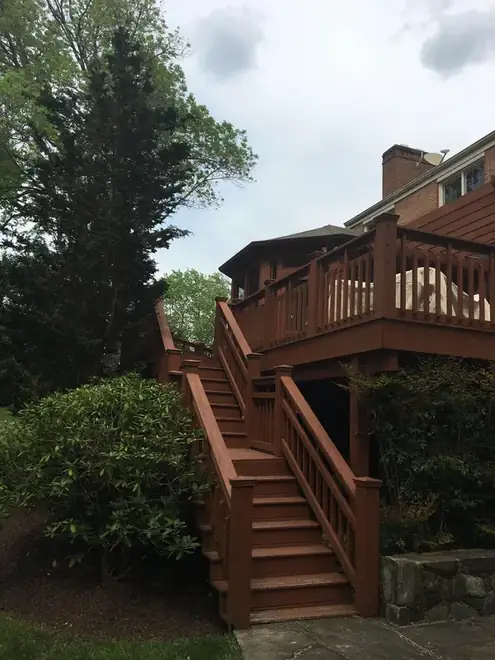
The steel cabinets in a 1950s kitchen
A fair number of the postwar capes and small colonials in Chesterbrook, Kent Gardens and Salona Village still have their original steel kitchen cabinets: pressed metal boxes, flush slab doors with a rolled edge, chrome pulls, a one-piece sink base. They were built to outlast everything around them.
They refinish well, and they are not a wood job. Metal gets washed, degreased and scuffed, then every bare spot and scratch takes a rust inhibiting primer. Surface rust is taken back to sound metal rather than coated over, and the place to look is the sink base floor and the back corner under the drainboard.
Metal also shows everything. A steel door is dead flat with no grain to hide behind, so any texture in the film reads across the whole face. These get coated thinner, in more passes, than a wood door would.
Frameless boxes in the 1970s contemporaries
The contemporaries and split levels tucked into the wooded lots off Georgetown Pike and down toward Scott's Run often have European style frameless cabinets: no face frame, full overlay doors, cup hinges, and a flat slab door in a walnut or teak toned veneer over particleboard.
Frameless cabinets put all the wear on the edges, because the door edge is all you see when the kitchen is closed up. Those edges are usually a thin edge band, and on a forty-five year old kitchen the band has lifted beside the dishwasher and under the cooktop. Banding gets reglued or replaced first, because a coating will not hold a loose edge down.
The other trait is that there is no face frame to hide a bad line. A framed cabinet gives you a quarter inch of forgiveness around every opening. Here the box edge is the reveal, so box edge and door have to match exactly in color and sheen or the kitchen looks patched, which is why we spray those edges rather than brush them.
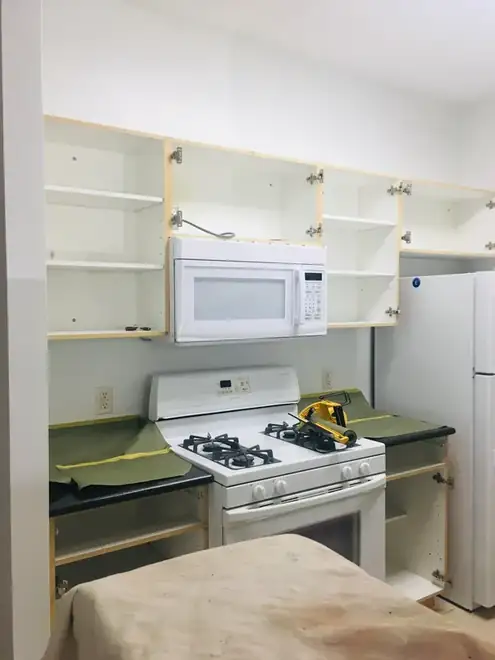
Veneer, and telling it from solid wood before you sand
Plenty of cabinets in this town are veneered rather than solid, and that decides how aggressively anything can be sanded. Modern veneer can be under a millimeter thick. Go through it at a corner and you have a dark glue line or bare particleboard, and there is no filling your way out of that on a door face.
How we check: look at the door edge for a grain pattern that does not continue around the corner, look for a thin contrasting line under the pull where hardware has worn it, and look at the raw panel edge inside a drawer opening. Stiles are often solid while the panel is veneered, so one door can need two approaches.
On a veneered panel we sand by hand, with the grain, at a fine grit, and keep machines off it. The goal there is adhesion and nothing else. Where someone has already sanded through, we show you, because that gets dealt with before primer rather than after.
Factory painted doors on a ten-year-old kitchen
The rebuild wave from the late nineties left a lot of McLean kitchens with factory painted shaker doors, MDF panels in a maple frame under a catalyzed white. Nobody wants those refinished. What they want is the three doors by the trash pull-out to stop looking beaten.
That is a harder request than a full repaint and we are straight about it. A factory catalyzed finish has a particular sheen and an off-white that has shifted slightly with years of light, so a field coating gets close but it is a match, not a continuation. The options are doing the whole visible run so everything is consistent, or doing the damaged doors and accepting that in raking light you may see a difference.
Where an MDF panel has swollen at the bottom edge under a dishwasher, that is water in a fiber core. Paint does not reverse swelling, so those doors get replaced and finished to match.
Glass front doors and the mullions around them
Glass fronted uppers are common in the bigger McLean kitchens and they take real time. A divided light door has twelve small panes, and every one of those edges is a hand cut line.
Where the glass is held by a removable wood stop on the back, it comes out, the door gets finished as a door, and the glass goes back in. That is always the better result. Where the glass is bedded in compound or permanently stopped, it gets masked precisely and the muntin faces and inside returns are cut in by hand. The inside return is what you see when the cabinet light is on, and it is the part other crews skip.
Leaded and seeded glass we treat as fragile. If a door is worth more than the labor to finish it, we say so before carrying it anywhere.
Getting the doors out of a high-rise
The 22102 side of McLean is towers and stacked units, and the kitchen in one of those has constraints a detached house does not.
- The doors have to leave the building and come back. That means a service elevator reserved, the elevator pads in place, and the lobby and corridor floor protected on both trips.
- Management usually wants a certificate of insurance before anyone starts. We carry the insurance and send it over.
- Work hours are set by the building, not by us. Many will not allow a start before eight or any work on a Sunday.
- There is no window and no real exhaust in most of these kitchens, so we use low odor waterborne cabinet coatings, move air toward the unit door, and keep the corridor door closed.
- Unit kitchens are small, so the work in place is usually a single day, which matters when you live there.
We have no job minimum, so a fourteen door condo kitchen is a job we take. Not every company set up for estate work will.
Booking a kitchen in McLean
Fredy Vargas comes out himself and takes the time to identify the cabinets before quoting, because in McLean the identification is the quote. Steel, solid wood, veneered panel, frameless particleboard, thermofoil and factory catalyzed MDF are six different jobs and they do not cost the same.
He counts the doors and drawer fronts, checks the edges for banding and veneer wear, looks for rust in a metal sink base, checks the grease beside the range, and asks what you want the box interiors to look like. Then you get a number for that kitchen.
Fred General Painting is ten minutes away at 8040 Trevor Place in Vienna, working in McLean most weeks since 2002. Virginia contractor license 2705098145, licensed, bonded and insured, the same crew every day. Ten percent off for veterans and for anyone 65 or older. Call 703-869-0593.
Every service we offer
Every town we cover
More on this from Fred
- What Actually Drives the Cost of Painting a House in Northern VirginiaHomeowners want a number. What they usually need first is an understanding of why two honest painters can quote the…
- The Best Time of Year to Paint the Outside of a Virginia HomeLate spring and early fall are the sweet spots, but the reason has less to do with the daytime high…
- Refinish or Replace? How to Judge the Real Condition of Your DeckA gray, splintery deck usually looks worse than it is. A deck that looks fine can be the one with…
Ready when you are.
Fred answers his own phone. If he is up a ladder he calls back the same evening.