
Cabinet Refinishing in Oakton, VA
Oakton built out between about 1970 and 1995, so we see the same few builder kitchens over and over here. That is useful: we know what is behind the finish before we open a door.
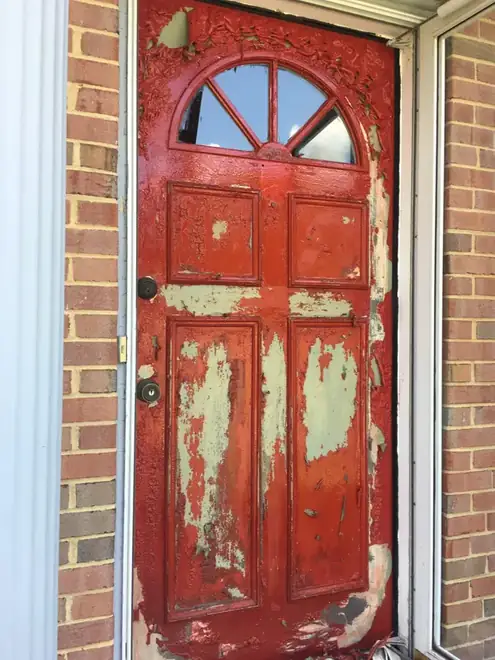
The same kitchen, several hundred times over
Waples Mill Estates, Oakton Village, Oakton Terrace, Oakton Forest, the streets off Blake Lane. Unlike Vienna or Arlington, 22124 did not build out slowly. It went up in one run of center-hall colonials, split foyers and townhouse clusters, so the kitchens came from a short list of suppliers and are all the same age.
Practically, we can usually tell you over the phone roughly how many doors and drawer fronts you have, because the layout repeats. We also know the weak points before we arrive: which builder used a veneered panel in a solid frame, which stapled a thin skin on the cabinet ends, and which houses got the amber topcoat that has gone orange.
None of that replaces looking. It does mean the estimate confirms rather than guesses.
Golden maple and birch, which are not oak
Oak gets the attention, but a good share of Oakton kitchens are golden maple or birch, which changes the job for the better. Both are close grained, so they sand smooth and take a sprayed finish flat with no grain filling.
What they bring instead is color. These doors were finished with an amber-toned lacquer over a light wood, and that topcoat has yellowed under thirty years of sun through a breakfast bay. Sand the sheen off one and the wood underneath is far paler than the cabinet looks. The yellowed layer is a bleed risk under white, so it gets blocked rather than just primed.
Maple has one other trait: it blotches. If any part of the kitchen is going back to a stained finish rather than paint, maple will not take stain evenly, and that is settled before anything is sanded.
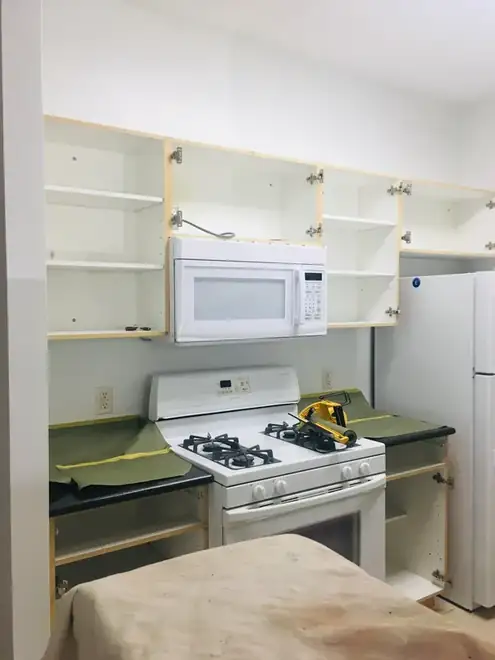
A kitchen that opens into the family room
The center-hall colonials here put the kitchen and the family room in one space, split by a half wall, a peninsula or nothing at all. So cabinet color in an Oakton house is not a kitchen decision.
The family room usually has its own woodwork in the line of sight: bookcases flanking a brick fireplace, a mantel, a wet bar, stained handrails just beyond. Paint the cabinets white and leave that millwork in 1987 oak and the room splits in half visually. Often the answer is to finish the bookcases and the bar at the same time, which is cheaper per door than a second visit.
The open layout also changes the work. There is no door to close on the job, so a masking wall goes up across the opening, the family room furniture moves and gets covered, and dust and air movement are managed for two rooms rather than one.
The desk nook, the microwave shelf and the cabinet ends
These kitchens came with built-ins nobody uses now: a desk nook with a drawer bank and a telephone cubby above it, a microwave shelf sized for a 1991 microwave, a scalloped open shelf at the end of the uppers.
With the doors off and the kitchen masked, those pieces are the cheapest change available. We can finish them with everything else, or cut out the desk, cap the opening and finish the adjoining cabinet so the run reads continuous. Pulling a microwave shelf leaves a gap in the face frame that needs a filler strip made and finished to match, which is carpentry we do ourselves.
Worth checking at the same time: the finished end panel where the run stops. On builder cabinets from this era that is often a thin vinyl-faced skin rather than wood. It coats fine with a bonding primer, but a corner a chair back has been hitting for twenty years gets repaired first.
When someone has already painted them once
We get called into a lot of Oakton kitchens where the cabinets were painted eight or ten years ago and are now chipping at the pulls and along the base cabinet edges.
The first thing to establish is why it failed, and the chips tell you. A film that peels away in a sheet with clean finish underneath was never bonded, because no primer went on over the factory topcoat. A film you can dent with a fingernail is wall paint that never hardened. Craters and lifted rings around the pulls are contamination, meaning nobody degreased.
What we do follows from that. Where the old coating is sound except at the wear points, we sand the failures back, feather them and build a proper system over the top. Where it is lifting across whole doors it has to come off, and stripping a set of doors is slow work we price on its own line. Either way it is in writing before we start.
Townhouse kitchens in the clusters off Jermantown Road
Oakton has a lot of attached housing, from Hunters Branch near the Metro out to the clusters off Jermantown Road. Those kitchens are narrow, eight or ten feet of counter on one wall, with a pass-through to the dining side and no window.
A kitchen that size is a logistics problem more than a painting one. There is no floor to stage on, the refrigerator cannot move out of the way, and the stacked washer and dryer are often in the same room. We finish doors and drawer fronts off site for that reason, then do frames and box sides in place in one pass.
Two details particular to these units. The pass-through has a finished edge that reads as part of the cabinet run, so we decide up front whether it takes the cabinet color or the wall color. And lint from a dryer running in the same room settles into a wet finish, so the dryer stays off on the days we coat in place.
How the week runs, and what you lose access to
Plan on a few days rather than weeks. Doors and drawer fronts come off on the first morning and the kitchen keeps working: you keep the sink, the fridge and the range. What you lose is doors on the openings, so pull out what you use daily before we start.
The finish is dry to the touch quickly and fully cured in two to three weeks, and that gap is where cabinets cause trouble. Two freshly coated surfaces pressed together while hardening will stick and tear. Leave doors slightly ajar for the first few days, wait a week before stacking heavy plates on a coated shelf, and clean with a damp cloth only for the first month.
Fredy Vargas started Fred General Painting in 2002 and is on site every day a job runs. He counts your doors, identifies the wood, and tells you what the old topcoat will do under a light color. We are fifteen minutes away at 8040 Trevor Place in Vienna. Virginia contractor license 2705098145, licensed, bonded and insured. Ten percent off for veterans and anyone 65 or older. Call 703-869-0593.
Every service we offer
Every town we cover
More on this from Fred
- What Actually Drives the Cost of Painting a House in Northern VirginiaHomeowners want a number. What they usually need first is an understanding of why two honest painters can quote the…
- The Best Time of Year to Paint the Outside of a Virginia HomeLate spring and early fall are the sweet spots, but the reason has less to do with the daytime high…
- Refinish or Replace? How to Judge the Real Condition of Your DeckA gray, splintery deck usually looks worse than it is. A deck that looks fine can be the one with…
Ready when you are.
Fred answers his own phone. If he is up a ladder he calls back the same evening.