
Cabinet Refinishing in Vienna, VA
Vienna kitchens are either small and original, built for 1956 appliances, or large and opened up on a rebuilt lot. The two are almost opposite jobs, and a handful of the old ones still have steel cabinets.
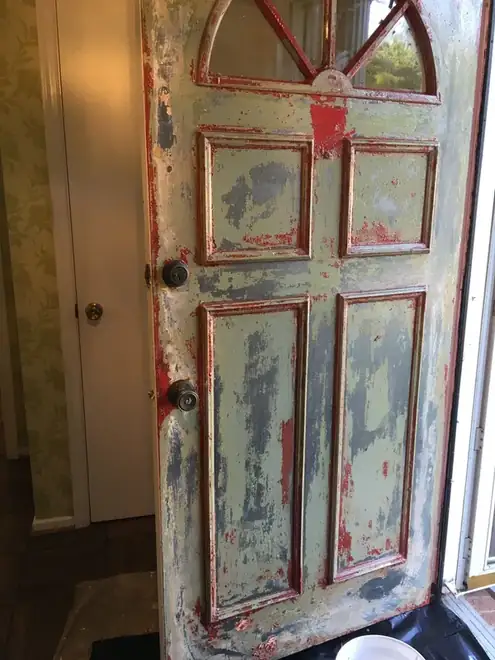
Kitchens laid out around 1956 appliances
The ranchers and split levels off Nutley Street and Cedar Lane have a kitchen built to a standard nobody uses now. A thirty-inch slot for the range, uppers that stop at eighty inches with a dead gap above them, a sink base built for a cast iron drop-in, and no space allowed for a dishwasher because there was not going to be one.
That means repair work before finish work. The dishwasher got cut in later, usually by pulling a base cabinet and trimming the face frame with a saw, and that cut edge is raw, unsupported and often split. Same where a cooktop was let in. We fix those first, because a clean coat over a ragged cut still looks ragged.
The dead gap over the uppers is the other decision. Once the cabinets go light, that strip of wall reads as a shadow line, so it usually wants the cabinet color rather than the ceiling color.
The steel cabinets that are still in some of these houses
Every so often we open a Vienna kitchen and the doors are steel. Enameled metal boxes from the fifties, inset doors, a chrome latch, and a sound on closing that nothing since has matched.
They can be refinished and they are worth it, because they are better built than most of what would replace them. The process is not the wood process.
- Degrease, then scuff the original baked enamel thoroughly. It is hard and glossy and nothing bonds to it as it comes.
- Find the rust. It is always in the same places: the bottom edge of the sink base doors, the toe kick, and the inside corner of the cabinet under a window where condensation ran for forty years. Rust gets taken back to bright metal, not painted over.
- A rust-inhibitive bonding primer made for bare metal, not a wood primer.
- A waterborne enamel over it, built up thin, because a heavy coat on steel runs and sags with nothing to grip the way grain does.
Dents are the limit. You cannot sand a dent out of sheet metal, so a creased door stays creased and we say so up front. The latches cannot be bought any more, so they come off, get cleaned and go back on.
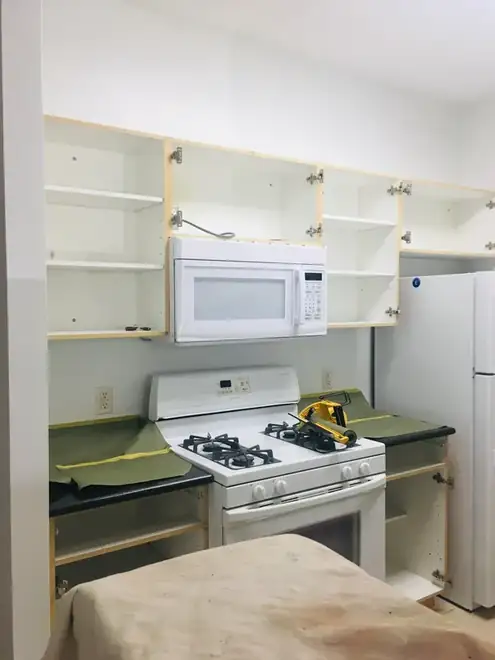
Birch or oak, and how to tell before you pick a color
Two woods cover nearly all the original cabinets in town, and they give very different results under paint.
Birch went into a lot of the fifties and early sixties kitchens here. The grain is tight and close, it is often stained darker than it looks to imitate something else, and it finishes glass smooth under paint. It is the best wood in these houses for a furniture-grade look.
Red oak shows up in the seventies and eighties, including on doors fitted to older boxes. Open, deep grain that paint sits in rather than over, so the pattern still shows through the color unless it gets filled first.
The way to tell is the back of a door, where nobody stained anything. Look at the stile end: oak shows long open pores you can catch a fingernail in, birch does not. We check that on the walk-through, because grain filling is a separate operation on every door and panel.
Sixty years of cooking in one small closed room
A small kitchen with one window and an original fan that vented into the wall cavity or nowhere at all concentrates everything. The grease film on a sixty-year-old Vienna kitchen is heavier than on a newer one, and it is worst on the upper door beside the range and on the frame above it.
There is a second problem in these houses, which is polish. Decades of spray furniture polish on old birch leaves silicone behind, and silicone makes a fresh coating crawl away from itself into small craters. It has to be cleaned off, not painted over. Degrease, rinse, dry, then sand, in that order, and it is most of the first day.
The rebuilt lots, where the kitchen is twice the size
The other half of our cabinet work in Vienna is in houses built in the last twenty years on lots that were cleared. Those kitchens are large, open to a family room, and the cabinetry runs to fifty or sixty doors and drawer fronts once you count the island, the pantry run and the panels on the refrigerator.
The fronts are usually maple or MDF under a factory conversion varnish, often already painted white. Two things come with that:
- The factory finish is harder than anything applied in the field, so deglossing has to be thorough and complete. A missed patch is where the new finish lets go first.
- The wear is concentrated. The trash pull, the dishwasher door edge and the two drawers either side of the range carry all of it, while the pantry doors look new. Those worn fronts need the old finish cut back properly rather than coated over.
People usually call about these because a white has yellowed or the island color has dated. That is a color change rather than a repair, and it runs shorter than an original kitchen half the size.
Where we stop and tell you to replace
We do not want to refinish everything. What makes us say no in an old Vienna kitchen: a sink base with a swollen bottom and a face frame gone spongy at the bottom rail, uppers on a wall that has settled far enough that the doors will not come into line, and nailed pine drawer boxes with the bottoms dropped out.
Some of that we fix, a drawer bottom or one cabinet floor. Some of it means the kitchen is past refinishing, and a finish on a failing box fails with it.
Your doors get finished at Trevor Place, not in your dining room
We work out of 8040 Trevor Place, off Beulah Road, so nothing in Vienna is more than about ten minutes away. On cabinet work that is a practical advantage rather than a slogan.
Doors and drawer fronts come off the first morning, numbered with their hardware bagged, and get finished flat on racks at the shop. They are not curing on your dining table and the sanding dust is not in your house. Boxes and face frames are done in place behind masking.
Being close also means we come back. A door that needs its hinge adjusted three weeks later is a short drive, not a scheduling problem.
Fredy Vargas counts the doors, looks at the wood, checks the grease and prices it himself. He started the company in 2002 and is on site every day a job runs. Four employees, the same crew start to finish. Virginia contractor license 2705098145, licensed, bonded and insured. Weekdays 8 to 5, weekends by appointment. No minimum job. Ten percent off for veterans and for anyone 65 and over. Call 703-869-0593.
Every service we offer
Every town we cover
More on this from Fred
- What Actually Drives the Cost of Painting a House in Northern VirginiaHomeowners want a number. What they usually need first is an understanding of why two honest painters can quote the…
- The Best Time of Year to Paint the Outside of a Virginia HomeLate spring and early fall are the sweet spots, but the reason has less to do with the daytime high…
- Refinish or Replace? How to Judge the Real Condition of Your DeckA gray, splintery deck usually looks worse than it is. A deck that looks fine can be the one with…
Ready when you are.
Fred answers his own phone. If he is up a ladder he calls back the same evening.