
Deck Refinishing in Bethesda, MD
A Bethesda deck is usually the only outdoor room the house has, which is why it gets used hard and why it wears out in the traffic lanes long before the rest of it goes. Most of them are pressure-treated pine put up in the 1990s and never properly stripped since.
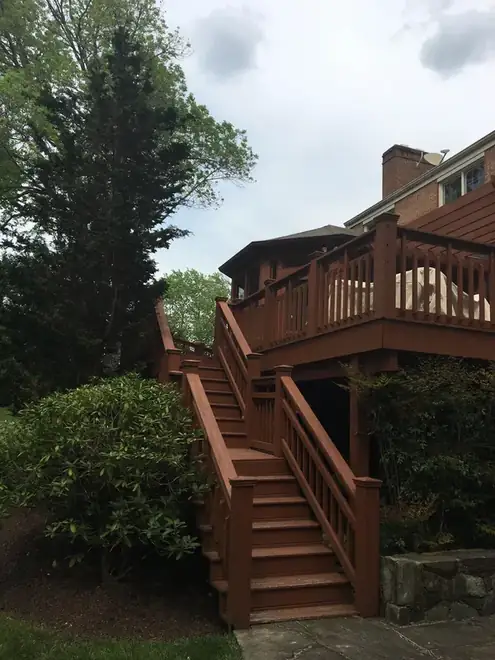
The 1990s deck, thirty years on
The deck on a house in Wyngate, Greenwich Forest or Glen Echo Heights was very often built in the same decade as the family room it opens off. That puts the structure around thirty years old, and thirty years is where pressure-treated southern yellow pine starts telling you things.
The framing is usually still fine. Pressure-treated lumber in a shaded, ventilated position under a deck lasts a long time. What goes is the parts that hold water:
- Deck boards at the ends. End grain drinks. The last four inches of every board over the rim joist is where checking and cupping start.
- The stair treads. They get the most water and the most feet, and they are usually the first boards we replace.
- The ledger connection. Not a paint issue, but we look. If the flashing where the deck meets the house has failed, the band joist behind it is wet and no finish on the surface matters.
- Rail posts at the deck line, where the post passes the framing and water sits in the joint.
We check all of that with a screwdriver before quoting, because a refinish on a deck that needs boards is money spent on the wrong problem, and we would rather say so.
Tree litter, and the mark it leaves on a small deck
Bethesda's older streets are heavily planted, and Kenwood is known well beyond the neighborhood for its cherry trees. Ornamental cherry, crabapple, holly and oak all drop something onto a deck, and on a small deck the drop concentrates rather than scattering.
Blossom and fruit are the ones people underestimate. Cherry and crabapple fruit sit on horizontal boards, break down and leave a tannin stain that a general cleaner does not lift. Oak leaves packed in the gap between boards hold water against the edges all winter, which is why the stain often fails along board edges first on an otherwise sound deck.
Two practical points. Blow the deck clear before it rains rather than after, particularly in the weeks around blossom drop. And if we are refinishing in spring, we wash close to the finish day rather than a week ahead, because a deck under trees will pick up a film again in a few days and a stain applied over that film will not bond.
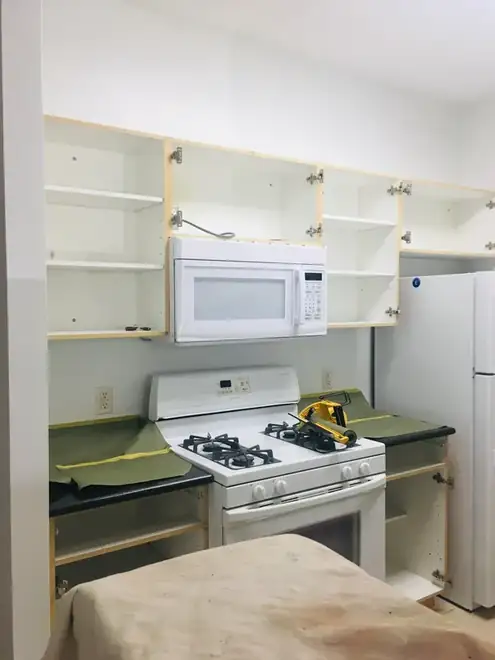
Stripping what is already on there
The usual history on these decks is four or five different products applied by four or five different people over twenty-five years. A semi-transparent one year, a solid color stain a few years later because the semi-transparent was blotchy, then a deck resurfacing coating because the solid was peeling.
Those thick resurfacing products are the hard ones. They are built to bridge splits, which means they are also built to trap water underneath, and once they let go they come up in sheets that take the failed layers below with them. Patching into that never looks right and never lasts.
So the first real decision on a Bethesda deck is whether we are washing and recoating, or stripping back to wood. A stripper, dwell time, agitation, rinse, then a brightener to correct the pH and reopen the grain, then real drying time before anything goes on. It is slow, it is most of the labor, and it is why two decks that look the same from the kitchen window are not the same price.
What we do not do is open the pressure washer up to blast a coating off. On thirty year old pine that erodes the soft spring wood, leaves a furry, ribbed surface, and guarantees a blotchy finish.
Small lots, close neighbors and where the stripper goes
On a typical Bethesda lot the deck is a short distance from a fence line and the neighbor's planting bed is on the other side of it. That matters, because deck strippers are caustic and deck brighteners are acidic, and neither belongs in somebody's hydrangeas.
We pre-wet and tarp plant material on both sides of the line, catch and direct rinse water rather than letting it sheet wherever gravity sends it, and neutralize before it leaves the work area. On the streets that drain toward Little Falls Branch and the Capital Crescent Trail corridor that is the difference between doing the job and doing damage.
Spraying a finish is generally out on these lots. Overspray carries further than people think and your neighbor's car is parked twenty feet away. We back-brush and roll, which on a deck is the better method anyway: it works the product into the grain and the checks instead of laying a film across the top of them.
Access is the other small-lot reality. Many of these back yards are reached through a gate, and a gate decides what equipment can get back there. We look at that at the estimate rather than on the morning.
Roof decks and condominium balconies downtown
The 20814 version of this job is a balcony or a roof terrace, and the constraint is everything below you.
Water and product cannot go over the edge. A balcony drains through a scupper or a deck drain that goes somewhere, and that somewhere is often a neighbor's balcony two floors down. We contain and collect wash water rather than rinsing it off the slab, we do not spray at height, and we work on windless mornings when a finish is involved.
The association controls the rest. Whether owner maintenance of the balcony surface is even permitted, what products are allowed, whether anything may be fastened to the rail, and what hours work may happen. We get that confirmed in writing by management before we schedule rather than relying on what a neighbor did last year.
Materials come up the service elevator, which gets reserved, and the corridor to your door gets covered. Certificate of insurance goes to management first. We hold Virginia contractor license 2705098145 and are licensed, bonded and insured in Virginia.
The work itself is usually the wood rail cap, a small platform or duckboard system, and any painted metal. Many of these surfaces are not wood at all, and a membrane or a coated concrete slab is a different scope entirely, so we identify the substrate first.
Choosing a finish for a deck this size
Small decks get walked on constantly and there is nowhere else to stand, so wear concentrates in the same lanes: the path from the door to the stairs, and the spot the grill lives.
A semi-transparent penetrating stain wears rather than peels, which means the next refresh is a wash and a recoat instead of a strip. A solid color stain covers more, hides mismatched replacement boards, and looks better on a deck that has been through five products already, but when it goes it goes by peeling and the next cycle is a strip. Both are defensible. It depends on what is on the deck now and how long you plan to keep doing this.
Rails and the deck floor can take different products, and often should. The rail is vertical, sheds water and holds a film far longer than the floor does, so a solid on the rails with a penetrating stain on the boards is a combination that ages well and saves you work.
How we schedule it
A stripped deck has to dry before finish goes on, and that is a weather judgment rather than a number of hours. We would rather move a day than seal moisture into pine.
Fredy looks at the deck himself and tells you which of the two jobs it is: a wash and recoat, or a strip and restore. Those are not close in price and nobody can tell them apart from a photograph. He also tells you which boards he would replace first, even if you are not doing them this year.
No minimum job size, so a single flight of stairs and a rail run is work we will take. Weekends by appointment. Call 703-869-0593.
Every service we offer
Every town we cover
More on this from Fred
- What Actually Drives the Cost of Painting a House in Northern VirginiaHomeowners want a number. What they usually need first is an understanding of why two honest painters can quote the…
- The Best Time of Year to Paint the Outside of a Virginia HomeLate spring and early fall are the sweet spots, but the reason has less to do with the daytime high…
- Refinish or Replace? How to Judge the Real Condition of Your DeckA gray, splintery deck usually looks worse than it is. A deck that looks fine can be the one with…
Ready when you are.
Fred answers his own phone. If he is up a ladder he calls back the same evening.