
Deck Refinishing in Springfield, VA
Springfield decks are usually up in the air. On a split foyer built into a slope the back of the house is two full stories, and that height decides how the deck fails and how it has to be worked on.
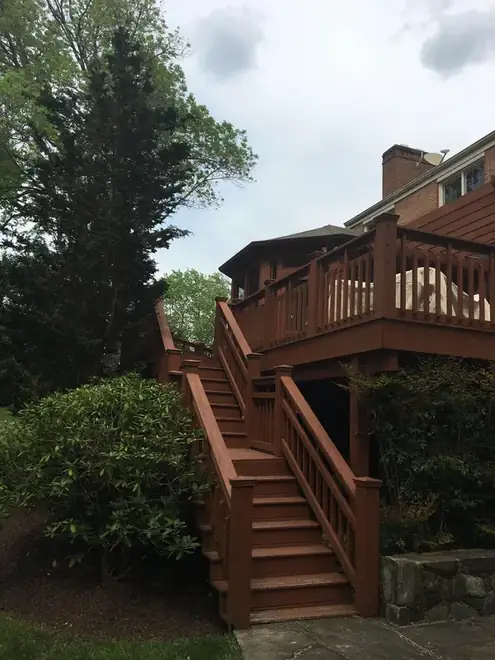
The raised deck on a split foyer, and why it is a different job
Open a Springfield front door onto a half-flight up and a half-flight down and you have a split foyer. There are thousands of them here on rolling ground, and the standard arrangement at the back is a deck off the upper level with a walkout underneath.
From the ground that deck is eight, ten, sometimes twelve feet up, and that changes the work before any product is chosen. The outer face of the rim joist, the underside of the boards, the outside of the rails and the stair skirts cannot be reached from the deck, and they are exactly what a homeowner with a roller has never touched. We stage for them and tie off where the drop needs it rather than spraying up from the yard.
The other consequence of height is the stairs. A two-story run of stairs is a lot of treads, risers and stringers, and on a per-square-foot basis it is slower work than the deck floor. We price stairs separately for that reason instead of burying them in a floor number.
Post bases, ledgers and stringers on a sloping lot
Before we wash anything we go underneath. On a thirty and forty year old Springfield deck the failures are predictable and they are all down there:
- Post bases. Posts set directly on soil, or on a footing that has settled into a dish and now holds water after every rain. This is the classic Springfield failure and we find it constantly.
- The ledger. Where the deck attaches to the house. On the rear of a split foyer this is often the least inspected connection on the property, and behind a hardboard or plywood panel wall it can be wet without anything showing on the face.
- Stair stringers. Soft at the bottom cut, where they land on a patio or on bare ground at the low end of the slope.
- Board ends over the outer beam. End grain wicking water, always the first decking to go.
If we find structural rot you hear about it before we coat anything. Staining a deck with a post base rotted through is money spent on the part of the problem that does not matter.
Pressure-treated pine is what you have
Almost all of it here is southern yellow pine, from the same building push that produced the houses. Pine is soft, it takes finish readily, and it moves: cupping, checking along the grain and splitting at board ends are normal ageing on these decks rather than defects.
Two things matter. A cupped board holds water along its whole length and fails along that channel first, so the question is whether to flip it or replace it. And a deck on a cleared Springfield lot takes ultraviolet damage rather than shade damage, which means pigment is what protects it. A clear sealer on a west-facing pine deck here does almost nothing about the gray.
The peeling deck, which is the call we get most
Someone put a solid stain on a horizontal pine surface. It looked good for a year. Now it is lifting in sheets and the homeowner has recoated it twice hoping to get ahead of it.
Solid stain is a film, and a film on a walking surface with water on top and a damp underside will let go. Coating over it gives you the same peel in a new color, in bigger sheets. The fix is a proper strip, a brightener to bring the pH back and reopen the grain, drying time, then a penetrating semi-transparent stain that wears thin instead of flaking.
We do not spend the whole job on the pressure washer either. High pressure on soft pine carves furrows and leaves wand marks that print straight through the next finish. Cleaner and dwell time, low pressure, then sanding.
Road film near the interchange
A good part of 22150 sits within earshot of the Mixing Bowl where I-95, I-395 and the Beltway meet, and the same applies along Backlick Road and the Franconia Road corridor. Elevations and horizontal surfaces facing that traffic collect a fine gray deposit of brake dust, tyre rubber and exhaust residue that rain does not rinse off.
It matters more on a deck than on a wall, because the deck is horizontal and catches it, and stain applied over that film does not bond. Near the interchange our wash uses a detergent and is doing real work rather than being a formality.
Whole streets come due in the same year
Springfield went up in one long push, so the decks went up in waves too. Cardinal Forest, Rolling Valley, Orange Hunt, Kings Park, Newington Forest: the houses on a street went up within a year or two of each other and the decks were built to the same spec. They fail together.
If three neighbors are getting deck work in the same spring, that is why. It is also worth using. Doing several decks on one street in one visit is cheaper per house than everyone booking separately, and in the townhouse rows where a set palette applies it gets you a consistent result. Several of the newer communities run color approval through an architectural committee. Start that before you book us, send us the approved color, and we match it exactly.
When replacing boards beats refinishing
If more than about a quarter of your boards are soft underfoot, cracked through or cupped badly enough to pond, refinishing is the wrong spend. On these decks the framing is often still sound, so replacing decking on the existing structure is a smaller job than people expect. We seal the cut ends of every new board before it goes down, because end grain absorbs many times more water than a face and an unsealed cut is where the next rot starts.
We do the carpentry ourselves, so board replacement, rail work and stair repair happen in the same visit with the same crew rather than you finding a second contractor and a second date.
Getting a real number on a Springfield deck
Fredy Vargas walks the deck himself, goes underneath, sounds the posts and the ledger and tells you what he finds. A wash and stain and a full strip and restore are not close in price, and nobody can tell which one you need from a photograph of the top surface.
We are on Trevor Place in Vienna, so Springfield sits at the far end of our area and our next available start there can run later than it would closer to home. That is worth knowing if you are planning around a sale. Licensed, bonded and insured, Virginia contractor license 2705098145. Ten percent off for veterans and for anyone 65 or over. Call 703-869-0593.
Every service we offer
Every town we cover
More on this from Fred
- What Actually Drives the Cost of Painting a House in Northern VirginiaHomeowners want a number. What they usually need first is an understanding of why two honest painters can quote the…
- The Best Time of Year to Paint the Outside of a Virginia HomeLate spring and early fall are the sweet spots, but the reason has less to do with the daytime high…
- Refinish or Replace? How to Judge the Real Condition of Your DeckA gray, splintery deck usually looks worse than it is. A deck that looks fine can be the one with…
Ready when you are.
Fred answers his own phone. If he is up a ladder he calls back the same evening.