
Exterior Painting in Chevy Chase, MD
Two things decide an exterior here before a brush comes out: what the wall is actually made of, and whose street you are standing in to reach it. We settle both at the estimate.
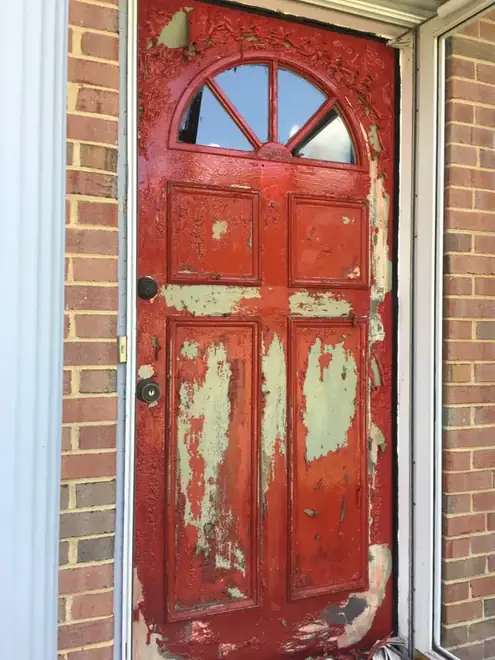
Soft stucco over frame, and the coating that kills it
A large share of the houses on these streets are stucco over wood frame, applied when the wall was expected to breathe. The original material is relatively soft and relatively permeable, and the assembly behind it dries by letting moisture move out through the face.
Put a hard, tight modern coating over that wall and you close the exit. Water still gets in, at the base where stucco meets grade, at a failed flashing, down a wall where a downspout discharges, and now it cannot leave. It pushes the coating off in plates, or it stays and quietly rots the sheathing behind.
So the first thing we do on a stucco house is establish what is already on it. A wall that has been recoated twice with something impermeable is a different job from a wall carrying a breathable mineral or acrylic finish, and the fix is not the same.
Patching is a materials-matching exercise, not a tube of caulk. The repair mix has to be no harder than the wall around it, because a stiff patch in a soft field concentrates stress and cracks the original at its edges. Texture has to be worked to match what is there, by hand, or the repair reads from the sidewalk for the next thirty years. We sound the wall first, read whether the cracking is surface shrinkage or movement behind, and price repair separately from recoating because they are different sizes of job.
Original sash, one at a time
The windows are the slowest line on any exterior here, and the reason is arithmetic: divided lights, often six over one, sometimes more, occasionally a patterned upper sash on a shingle-style house. Every muntin is another perimeter to cut and another edge to seal.
We work sash by sash rather than opening up a whole elevation. A window stripped and left open overnight takes dew into bare wood and open putty beds. Bare wood gets primed the day it is exposed, glazing gets curing time before it is coated, and the finish carries a hair onto the glass to seal the putty line. That last detail decides whether the work lasts eight years or two.
Whose curb, whose tree
This is the part of an exterior here that nobody expects, and it is the reason we ask your address before we ask about the house.
Inside the 20815 ZIP there are eight separate incorporated towns and villages, and Montgomery County lists each with its own office and phone number. Several of them require a municipal permit in addition to the county building permit, and several administer their own curb and right of way. What that governs on an exterior job is concrete: where a truck can stand and for how long, whether a dumpster or a lift in the street needs local permission, and what time in the morning work can start.
The canopy compounds it. The street trees here are old, large and protected, and an exterior of any height is staged underneath them. Rolling a lift under a mature specimen, or setting scaffold in a root zone, is a decision to make in advance with whoever has authority over that tree, not at seven in the morning with the tailgate already down.
At the estimate we establish which municipality the house sits in, ask that office directly rather than assuming the county answer covers it, and plan access on paper. Often the outcome is that we reach the gable from ladders and planks instead of bringing equipment into the street at all.
Slate above, copper at the edges, paint in between
The roofs on these houses are frequently slate, with copper flashing, copper valleys and in many cases copper gutters and downspouts. That combination changes what happens at the top of a paint job.
Copper is not a painting surface and we do not treat it as one. Left alone it patinates and performs, and most owners here want exactly that. What matters to us is the joint where copper meets wood: the fascia behind a hung gutter, the rake board beside a step flashing, the crown at the top of a porch column where a small copper cap sits. Those are the spots where water has been running for decades, and they are where the rot is.
Working around slate calls for restraint. Slate is brittle, it does not take foot traffic, and a ladder hooked over an eave breaks tiles that are expensive to match. We keep weight off the roof and use standoffs so ladders bear on the fascia, never on a copper gutter, which deforms and then leaks into the wood we just painted.
Copper also stains. Runoff from an old gutter leaves green-tinged tracking down the painted wall beneath it, and if the coating goes on without dealing with the source, the staining comes back through. We find where the runoff is coming from before we paint the wall under it.
Shingle, clapboard and the parts that go first
The houses that are not stucco are mostly wood: clapboard on four-squares and Colonial Revivals, wood shingle on the shingle-style houses, deep porches on nearly all of them.
Where they fail is predictable, and almost never in the middle of a wall.
- Shingle butts. End grain facing down, holding water at the drip line. Individual shingles come out and get replaced rather than being filled.
- Clapboard ends at the corner boards. Same problem, exposed end grain, plus a joint that opens as the boards move.
- The water table and the base of corner boards, where splash-back off a walk or a bed keeps the wood wet at the bottom few inches.
- Porch floors and column bases. The column sits on the floor, the floor holds water, the base of the column drinks it. The rot is usually well advanced before the base trim comes off.
- Sill noses and the underside of window stools, where a hundred years of runoff has had one place to go.
We do the carpentry and wood rot repair ourselves, so you are not hiring two contractors. Soft material comes out and is replaced with new stock, small sound areas take a two-part consolidant and filler, and every replacement piece is primed on all six sides before it goes up. Back-priming costs ten minutes a board and roughly doubles how long it lasts.
Twenty square feet outside, and where the chips land
The houses here were built well before 1978, essentially without exception, so the federal RRP threshold for exterior work, more than twenty square feet of painted surface disturbed, is cleared on any real scrape. Maryland is not an EPA-authorized state, so that federal rule applies directly here.
What makes it more than paperwork here is the lot width. On many of these streets the distance from your wall to the next house is a few paces, and chips do not stay on your side of the line.
So the exterior scrape is a containment operation. Plastic goes down before a scraper touches the wall and it runs out far enough to catch what carries, including over the neighbor's grass where the work is at the property edge. Debris gets collected the same day rather than left over a weekend. Nothing gets swept toward the storm inlet at the curb. Side elevations that close to another house get brushed and rolled rather than sprayed, because overspray does not respect a fence line and there is no fixing it afterwards.
Ask whoever quotes your scrape how they handle the rule on a house this age, and check the answer rather than taking it on trust. We will tell you which parts of your scope fall inside it and work like the neighbor is watching, because on these blocks they usually are.
Sequencing under a closed canopy
Shade is the scheduling problem here. A wall under mature trees holds dew later into the morning and picks it up again earlier in the evening than a wall on an open lot, so the usable window on a given day is genuinely shorter than the forecast suggests.
We work by elevation order rather than convenience: start on the side that gets the earliest sun, come back to the shaded north wall after lunch, and stop when surface temperature says stop rather than when the day does. Painting over a damp substrate is the fastest route to a coating that fails in two years, and it is invisible on the day you are handed the invoice.
The estimate names substrates by elevation, repairs before paint, the primer for each surface, coats, sheens, and how staging and any right of way question is handled. Fredy walks the whole perimeter himself, including the side yard nobody uses, because that is where the rot is.
Sherwin-Williams and Benjamin Moore. Same four-person crew every day. Call 703-869-0593.
Every service we offer
Every town we cover
More on this from Fred
- What Actually Drives the Cost of Painting a House in Northern VirginiaHomeowners want a number. What they usually need first is an understanding of why two honest painters can quote the…
- The Best Time of Year to Paint the Outside of a Virginia HomeLate spring and early fall are the sweet spots, but the reason has less to do with the daytime high…
- Refinish or Replace? How to Judge the Real Condition of Your DeckA gray, splintery deck usually looks worse than it is. A deck that looks fine can be the one with…
Ready when you are.
Fred answers his own phone. If he is up a ladder he calls back the same evening.