
Exterior Painting in McLean, VA
McLean walls are rarely made of one thing. Stone, stucco, fiber cement and painted trim on the same elevation, and the trouble always starts where two of them meet.
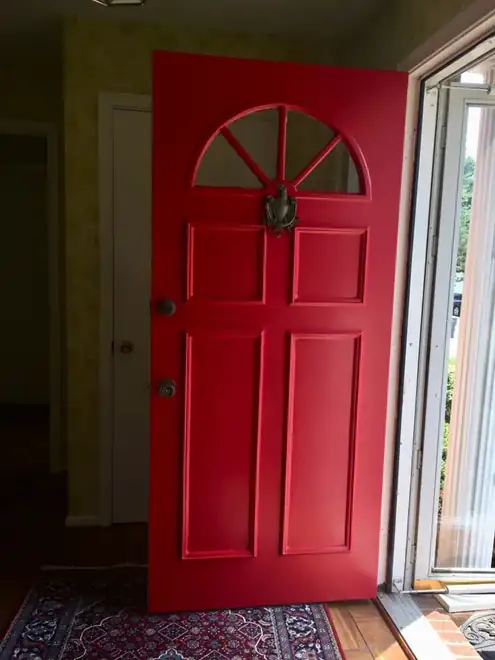
One elevation, four different substrates
Look at the front of a rebuilt house off Georgetown Pike or in Woodside Estates and count the materials. Stone water table at the bottom. Hard coat or synthetic stucco above it. Fiber cement or cedar once you turn the corner. Aluminum-clad windows, painted wood trim, a steel front door, a garage door that is neither wood nor stucco.
Each of those takes a different primer and a different topcoat. The cheapest way to paint that house is one all-purpose exterior acrylic over everything, and it is also the reason we get called back to houses that were painted four years ago.
Sheen is part of the same decision. Stucco wants a flat or low sheen, because gloss on a textured wall lights up every trowel mark and every patch. Trim, shutters and doors want satin or semi-gloss so they read as edges and can be washed. Getting that split right is most of why a house looks deliberate rather than coated.
Reading a crack before you cover it
Stucco cracks. Both kinds crack, the traditional hard coat and the synthetic systems over foam that went on through the rebuild years. Paint is where it becomes visible, but paint is not where it starts.
Hairline crazing across a field is cosmetic and gets bridged by a high-build acrylic or an elastomeric. A crack you can get a fingernail into is a different conversation: it gets cut out, cleaned, filled with a flexible patching compound and textured to match before anything is coated.
What we want to know first is the direction it runs. A crack coming down at an angle from a window corner is telling you something about movement, and covering it without asking why buys you one season. We do stucco repair as well as stucco painting, which out here is usually the same job on the same day.
Sealant at the penetrations is what actually fails
Before we price a coating we walk the wall looking at holes somebody made in it. Hose bibbs. Dryer vents. Exterior light fixtures and their boxes. Receptacles. The kickout where a roof plane runs into a wall. Under window sills at the ends. Where stucco stops at grade or meets the stone.
Those joints are cheap to redo and almost universally ignored, because nobody looks up at a light fixture and thinks about water. On synthetic stucco over foam, a failed joint is not a paint problem at all. Water gets past the skin, has no drainage path and sits in the sheathing, and the first evidence is usually a soft spot somebody finds years later.
We cut out failed sealant rather than laying new caulk over old, prime where the substrate needs it, and use a product with enough movement capability for the joint it is going in.
Painting brick is a decision you make once
The question comes up on nearly every postwar brick cape and colonial in Chesterbrook, Kent Gardens and Salona Village. Our honest answer is that it depends, and that it is not reversible. Once the brick is painted it is painted for the life of the house, and every future owner inherits the maintenance.
If you go ahead, the system has to be right: wash, dry fully, remove efflorescence, repoint failing mortar, then a masonry primer and a breathable mineral or acrylic masonry coating. A vapor-tight film on a wall that wicks moisture will blister no matter whose name is on the truck.
Limewash is the other route, and it behaves differently. It soaks into the masonry rather than sitting on it, and it weathers back gradually instead of lifting at an edge. If what you want is the softened look rather than a flat solid color, it is worth knowing about before you commit to paint.
On an unpainted brick house the job is the trim
Plenty of our McLean exteriors never touch the body of the house. Fascia, soffit, rake boards, window casings, shutters, porch ceilings, columns, garage doors and the front door. That is a smaller project than a full repaint and it runs on a shorter cycle, because the trim is wood and the brick is not.
Shutters come off the wall. They get cleaned, sanded and sprayed lying flat, then rehung. Painting them in place leaves runs behind the louvers, misses the back entirely and puts overspray on brick that will not wash off.
Thirty-year-old finger-jointed poplar
The 1990s houses out here were trimmed in finger-jointed poplar and pine. It was inexpensive, it was straight, and it is now three decades old.
It fails in a sequence we can predict. The glue lines telegraph through the paint as a row of faint horizontal marks. Then a joint opens. Then the end grain on either side of it drinks, and the board goes soft from inside. Look at corner boards behind downspouts, the bottom ends of window casings, and the outside corners of a bay, which are the wettest spots on the house.
On a house of that vintage we expect to replace some of it, and we say so at the estimate instead of raising it as a change order. Because we do the carpentry and rot repair ourselves, the discovery does not stall anything and no bare wood sits open waiting for a second trade. New stock gets primed on all six sides and both ends before it goes up.
Work rules on the 22102 side
The Tysons end of McLean is a different building type and a different set of constraints. Managed townhouse rows and mid-rise buildings come with a property manager, a certificate of insurance requirement, set working hours, rules about where material can be staged, and sometimes a service elevator you have to book.
On an attached row, find out where the association's responsibility ends. In a lot of these communities the association handles the siding and trim and the owner handles the door, the shutters and the storm door. When only your unit is being done, we match to the neighboring units as they look now, weathered, rather than to a fresh mix of the original color code.
What Fredy looks at when he walks your elevations
Not wall area. He is looking at the condition of the wood and the sealant, because that is what the price and the schedule actually turn on. A house with sound trim and good joints moves quickly. A 1990s house with failing trim adds days of replacement before a brush touches it.
You get a written scope naming the products, the number of coats and exactly what is being repaired. We are ten minutes away at 8040 Trevor Place in Vienna. Virginia contractor license 2705098145, licensed, bonded and insured, in business since 2002, four employees and the same crew every day. Monday to Friday 8 to 5, weekends by appointment. Veterans and anyone 65 or older take 10 percent off. Call 703-869-0593.
Every service we offer
Every town we cover
More on this from Fred
- What Actually Drives the Cost of Painting a House in Northern VirginiaHomeowners want a number. What they usually need first is an understanding of why two honest painters can quote the…
- The Best Time of Year to Paint the Outside of a Virginia HomeLate spring and early fall are the sweet spots, but the reason has less to do with the daytime high…
- Refinish or Replace? How to Judge the Real Condition of Your DeckA gray, splintery deck usually looks worse than it is. A deck that looks fine can be the one with…
Ready when you are.
Fred answers his own phone. If he is up a ladder he calls back the same evening.