
Exterior Painting in Oakton, VA
Almost everything in 22124 went up between 1970 and 1995, which means the town is wearing the same two siding products. Whether yours is still worth painting is the question we answer first.
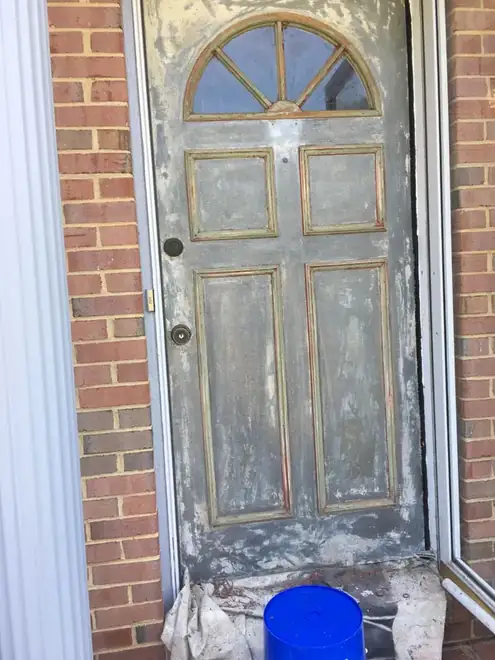
Hardboard siding, and what the bottom edge tells you
A large share of 1970s and 80s Fairfax County construction used hardboard composite lap siding, and Waples Mill Estates, Oakton Forest and the streets off Blake Lane are full of it. It repaints well right up until it does not, and the bottom edge of a course is where you find out which.
Press a thumbnail into the underside of a board, a few inches in from a butt joint. Sound hardboard is firm. Failed hardboard is soft and slightly furry, and the layers have started to separate. That board is holding water, and coating it seals the water in and speeds the rot up.
Two places go first, reliably: the vertical butt joints between panels, and any course on the wall behind a downspout. Where the siding is still sound the work is a thorough wash, spot replacement, sealing the cut edges of anything new, and a quality acrylic system. Where a wall is genuinely finished, we say so. Paint has never fixed rotten siding, and we would rather lose the job than be back in eighteen months.
T1-11 after forty summers of afternoon sun
The other Oakton siding is T1-11, the grooved plywood panel that showed up on split levels and split foyers in the same years. It ages differently. The face veneer checks into fine cracks, the plies begin to lift and cup at the panel edges, and the grooves open up. South and west walls are always the worst, because that is where the heat cycling happens.
The grooves are the detail people miss. They collect water and they are exactly where a pressure washer at full tip will drive water into the panel, which then sits behind fresh paint for the rest of the summer. So we wash T1-11 at moderate pressure and let the cleaner do the work.
Panel edges, the horizontal joint under the Z-flashing and every cut end get primed before the finish goes on. Where the veneer has delaminated across the face of a panel, that panel comes off. A single bad panel is a small job. Painting over it is not a job at all.
Rust dots, and why they keep coming back
Small brown streaks running down from an orderly grid of points are not dirt and not tannin. They are the nail heads.
Siding of this era was face-nailed, the heads were never properly coated, and once the galvanizing is gone the steel rusts and bleeds through anything you put over it. Homeowners paint the wall, the streaks are gone for a winter, and by the following August they are back in the same places.
The fix is mechanical and it is slow. Set the heads below the surface, spot prime each one with a rust-blocking primer, fill, then prime the fill. There is no finish coat that hides an uncoated nail head, and anyone who tells you otherwise is planning on being gone by next summer.
The tall gable over a split foyer entrance
The split foyer is the Oakton signature, and from outside it gives you a front gable running the full height of the house above the entry, often with a narrow walkway or a planting bed right underneath it and nothing level to stand on.
That peak, the rake boards climbing to it and the fascia returns at the bottom of each rake are the parts that get skipped. You can see it from the street: the wall below is fresh and the triangle at the top reads a little duller, because whoever painted it last did the peak from as far away as a ladder would let them.
We set levelers and standoffs so the ladder is square and off the gutter, and where the footing will not work we stage from the roof edge properly rather than reaching. It takes longer. It is the difference between a repaint and most of a repaint.
Vinyl on the later houses, and the color ceiling
The houses built here from the late eighties into the nineties are mostly vinyl sided, often with a brick front and vinyl on the other three elevations. That combination needs two systems on one house, and the corner where they meet needs a proper sealant joint rather than a smear of whatever was open.
Vinyl can be painted. It has to be washed first, because it holds an oxidized chalk film that defeats adhesion, and the color has to be at or lighter than the existing panel in a vinyl-safe formulation. Go darker and the panels absorb more heat than they were built for, and buckled vinyl does not come back.
Painting one unit in an attached row
The townhouse clusters off Chain Bridge Road and around Hunters Branch bring a problem detached houses do not have: your work has to land next to somebody else's.
A fresh mix of the original color code will not match the same color eight years weathered on the unit beside you. So we sample against the neighboring wall in daylight and adjust, rather than trusting the code on the old can. Sheen matters even more than hue here. A satin trim board butting a chalked flat one reads as a mismatch from across the street even when the colors are identical.
The farm-era houses on Hunter Mill and Vale Road
Not all of 22124 is subdivision. Hunter Mill Road, Vale Road and the lanes running toward the stream valley still hold older houses and former farm properties on larger parcels, some of them well over a century old, and there is no review board out here with an opinion about any of it.
These are real wood siding with layered paint histories. The old coats underneath are brittle and chalky, and a modern latex laid straight over them will not bond. They need hand scraping, a bonding primer chosen for what is actually under it, and enough feathering that the repaint does not look like a map of where the scraper went.
When we tell you to stop painting and start replacing
If a wall has more failed board than sound board, spending on prep and two coats is spending on the wrong thing, and we will say that in front of you with a ladder against the house. Sometimes the answer is one elevation replaced and the other three painted, which is a smaller number than people brace for.
Fredy Vargas has been doing this since 2002 and comes out himself, which on these houses means opening a butt joint and pressing on a bottom edge rather than pacing the yard. We are fifteen minutes away at 8040 Trevor Place in Vienna. Virginia contractor license 2705098145, licensed, bonded and insured. Monday to Friday 8 to 5, weekends by appointment. No job minimum. Veterans and anyone 65 or older take 10 percent off. Call 703-869-0593.
Every service we offer
Every town we cover
More on this from Fred
- What Actually Drives the Cost of Painting a House in Northern VirginiaHomeowners want a number. What they usually need first is an understanding of why two honest painters can quote the…
- The Best Time of Year to Paint the Outside of a Virginia HomeLate spring and early fall are the sweet spots, but the reason has less to do with the daytime high…
- Refinish or Replace? How to Judge the Real Condition of Your DeckA gray, splintery deck usually looks worse than it is. A deck that looks fine can be the one with…
Ready when you are.
Fred answers his own phone. If he is up a ladder he calls back the same evening.