
Exterior Painting in Reston, VA
Reston cluster palettes were written around stained wood, and most of the houses they govern are still wearing vertical cedar. Both facts decide what goes on your siding before anyone opens a fan deck.
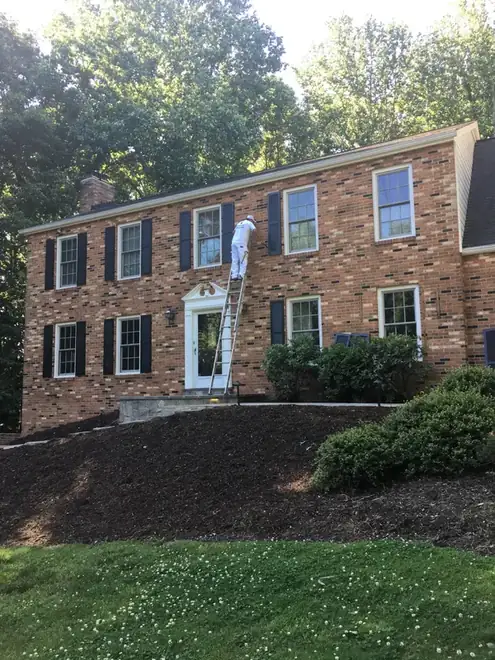
The approved palettes were built for wood
Look at a handful of cluster standards and the same range keeps appearing: bark browns, olive and moss, the gray-greens, charcoal, a dull barn red held back for doors and trim. Those are the colors that sat well on stained cedar in 1968, and they are why an approved list looks narrow next to the rack at the store.
We work from the manufacturer code in your cluster's current standard rather than the color name. Names get reused, retired and reformulated, and a standard written twenty years ago can point at a product that no longer exists in that base. Where a code is dead we get the closest current match confirmed in writing before anything is ordered, not after the first gallon is tinted.
Then we brush draw-downs on offcuts of your own siding. The same code on smooth hardboard and on rough-sawn cedar reads as two different values, because texture holds shadow.
Paint is a film, and your siding has been breathing
Reston opened in 1964, and the first generation of houses is vertical wood: cedar and redwood, board and batten, channel siding, much of it finished in stain from new. Stain soaks in and wears off the surface. Paint sits on top as a continuous film.
Put that film over fifty-year-old vertical cedar that has spent its life shedding moisture through a stain, and the water still moving through the wall has nowhere to go. It pushes the film off in sheets, usually on the elevation you notice last. We are called to that several times a year here.
On original wood we recommend a solid-body stain. Full color, meets the standards, and when it goes it goes thin rather than flaking, so the next cycle is a wash and a coat instead of a strip. If a house is already in sound paint we keep it in paint. Switching a house back and forth causes more trouble than it fixes.
Deep overhangs protect the top of the wall and nothing else
The low-slope and flat roofs on the older contemporaries come with overhangs that run well past the wall. That is good for the siding directly under them, which stays dry and can look almost new. It is misleading, because it sends every drop that lands on the roof out to one line and then down.
What we find under those overhangs is a fascia run built up from several lengths with open joints at every splice, soffit boards stained where a gutter has been overflowing behind them, and the bottom of the wall taking splash-back off a hard surface or a bed of river stone.
So we quote the fascia and the soffit as real work rather than trim to be brushed at the end of the week. On a long low-slope run those two surfaces carry most of the water on the house.
Vertical boards end at the ground, and that is where they rot
Horizontal lap siding presents a face to the weather. Vertical siding presents end grain at the bottom of every board, two or three inches above grade on a lot where the ground rarely dries out, often with mulch piled against it.
End grain drinks water many times faster than a face. The board goes soft from the cut up, the batten over it holds the wet against it, and by the time paint is failing on the face the damage is already an inch into the material.
That wood gets cut out and replaced, not filled. New stock is primed on all six sides including both cut ends before it goes up, and we back-prime the face that will never be seen again. Where a run of siding is coming out, that is a change worth identifying at the estimate rather than on day three, because it belongs in your Design Review submission along with the color.
Screens, trellises and the wood between the units
A lot of Reston exterior work is not the house. It is everything the original architects used to give a cluster privacy: entry screens, trellis work over a walk, slatted fences dividing patios, the wood panels between attached units, and the storage enclosures by the front door.
These go before the siding does, every time. They are exposed on both faces, they sit right at grade, and the post bases are usually buried in a bed that gets watered.
Slatted screens are also slow: a six-foot panel has twice the surface of a six-foot wall and every edge has to be cut in. And a screen shared with your neighbor only looks right if both sides are done at once in the same product.
North Point, Hunters Woods and the later siding
Not all of Reston is 1965. North Point went up through the eighties, South Lakes and Hunters Woods have their own generations, and there is newer infill around both Metro stations. The siding changes with the decade, and so does the prep.
- Hardboard panel and lap from the seventies and eighties. Sound boards take a coating well. Boards swollen along the bottom edge or delaminating at a nail head do not, and paint over them is a season of cover.
- Vinyl retrofits. Paintable, but only at or lighter than what is there now, because a darker shade absorbs heat and the panels distort.
- Fiber cement and PVC trim on the newer houses. Usually the easiest repaint, with the work concentrated at the sealant joints and the factory-cut ends.
Several clusters also specify which materials are acceptable, so a siding swap is a separate question from a color change and a slower one.
We cannot grade the siding until it is clean
Under this much canopy the north and northeast elevations grow a gray-green film every year, and pollen coats everything in the spring. Neither one is something a finish coat will bond through.
Every exterior here starts with a wash, and the pressure is set to the substrate rather than to the dirt. Old rough-sawn cedar gets low pressure and a cleaning solution with dwell time, because a turbo nozzle will chew the soft grain straight out of a weathered board and nobody sees the damage until the coating fails over it. Mildew gets chemistry, not force. Knocked back mechanically it grows through the new coat.
The wash is also the inspection. Only once a wall is clean can we tell you which boards are worth coating, and that is the number the estimate turns on.
Who does the work
Fredy Vargas started Fred General Painting in 2002 and still walks the house himself before pricing it. Four employees, the same crew every morning.
Virginia contractor license 2705098145, licensed, bonded and insured, with the certificate sent to your cluster association when they ask for it. Sherwin-Williams and Benjamin Moore, which covers most of the palettes the standards here are written around. Ten percent off for veterans and for anyone 65 or over. Call 703-869-0593.
Every service we offer
Every town we cover
More on this from Fred
- What Actually Drives the Cost of Painting a House in Northern VirginiaHomeowners want a number. What they usually need first is an understanding of why two honest painters can quote the…
- The Best Time of Year to Paint the Outside of a Virginia HomeLate spring and early fall are the sweet spots, but the reason has less to do with the daytime high…
- Refinish or Replace? How to Judge the Real Condition of Your DeckA gray, splintery deck usually looks worse than it is. A deck that looks fine can be the one with…
Ready when you are.
Fred answers his own phone. If he is up a ladder he calls back the same evening.