
Interior Painting in McLean, VA
Three houses on one McLean street can have three completely different interiors behind the front door. What we price is the trim, the ceiling height and the building rules, not the floor area.
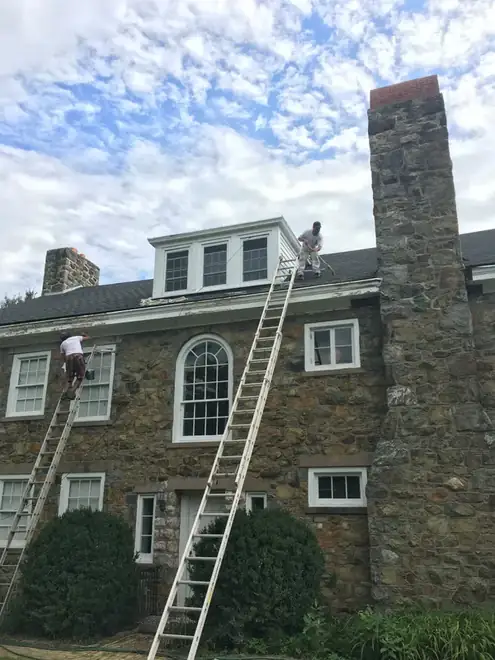
One street, three decades of construction
In Chesterbrook, Kent Gardens and Salona Village you can stand on the sidewalk and see a 1948 brick cape, a 1970s contemporary and a house rebuilt five years ago. Inside, they have almost nothing in common.
The cape has plaster, eight-foot ceilings, small rooms and trim that has been painted since before most paint companies existed. The contemporary has drywall, exposed beams and often cedar or fir ceilings that were never intended to be painted. The rebuild has flat drywall, twelve-foot first floor ceilings, and a trim package with more linear feet of millwork in the entry than the cape has in the whole house.
Those are three different quantities of labor per square foot, and quoting them from a spreadsheet is how contractors get the price wrong in both directions. Fredy walks the rooms and counts the trim.
The trim package is where the hours go
On a newer McLean interior, walls are the quick part. The trim is the job: crown built up in two or three pieces, paneled wainscot, window casings with backband, deep base with shoe, French doors, a paneled study, built-in bookcases either side of a fireplace.
All of it has to be cleaned, filled, caulked and cut by hand. A paneled wainscot wall is dozens of inside corners. A built-in bookcase is every shelf edge, both faces, plus the back.
We brush and roll most of it in an occupied house rather than spraying. Spraying is faster and it is the right answer in an empty new build, but masking an occupied family room with rugs, art and electronics to a spray standard costs more time than it saves, and any overspray is permanent.
Doors get sanded between coats. That is what separates a door that feels like furniture from one you can feel with your hand.
Tall entry walls and the stairwell nobody wants to touch
Two-story foyers and open stairwells are standard here and they are the surface that shows bad work from the front door.
It is a staging problem first. We set planks and towers so a painter is standing level with the wall, pad every leg, wrap the newel and balusters, and cover treads properly rather than draping cloth over them. A cut line at the top of an eighteen-foot wall cannot be held straight by somebody stretching off a ladder.
Chandelier drops, landing walls and the underside of an open stair all get reached in the same setup. Building staging twice for one entry is the expensive way to do it, so we plan the entry, the landing and the upper hallway as one piece of work.
On those long open walls, sheen does more work than color. A flat with real scrub resistance hides drywall movement across a twenty-foot run that an eggshell would put a spotlight on.
Stained millwork, and the decision to paint it
Cherry, oak and mahogany show up constantly in McLean interiors: a paneled library, a stained stair rail, a wet bar, kitchen boxes, a dining room with a chair rail and paneling below it.
Two things to settle before starting. First, the existing finish. Old lacquer and oil varnish will not hold waterborne paint without deglossing and a bonding primer, and no finish coat rescues a bad bond. Second, grain. Open-grain oak reads through a white finish unless the pores are filled, so if you want the flat modern look the doors and panels need grain filling first. We put a sample panel in front of you rather than describing it.
Cherry is the one to think hardest about. It darkens unevenly as it ages, so a partial refinish rarely matches and the honest answer is usually to do the whole run.
Condos and stacked units on the 22102 side
Near Tysons the work changes shape. Mid-rise and high-rise buildings, newer townhouse communities, and a management office that decides how the day runs.
- A certificate of insurance goes to management before we schedule. We are licensed, bonded and insured under Virginia contractor license 2705098145, and we send it directly.
- The service elevator gets reserved, and materials come up through it, not through the lobby.
- Permitted work hours are the building rules, not ours. We start when they say we can start.
- Floors in common corridors get protected between the elevator and your door, because that is where a drip is somebody else's problem.
Inside a unit the common work is a full repaint between tenants or before listing, popcorn removal in the older buildings, and wallpaper coming out of a powder room. Ventilation deserves a thought in a sealed building, so we use low odor lines and keep air moving. There is no job minimum here, which matters because plenty of contractors sized for estate work will not take a single condo.
Working around a household that is not going anywhere
Most of our McLean interiors happen with the family in the house. That is a sequencing discipline more than a painting one.
We tell you which rooms are out of service on which days, and Fredy checks that schedule daily instead of setting it once and hoping. Bedrooms and baths are done so nobody loses their own bathroom for a night. Kitchens get scheduled in a stretch you have agreed to.
Dust gets contained: doorways sealed with plastic on the larger jobs, sanding done with a vacuum where the work allows, and cleanup at the end of every day rather than the end of the week. Art, electronics and anything with sentimental value should come off the walls before we start. We move the furniture ourselves and slide the heavy pieces on pads.
What Fred writes down before you get a number
The estimate on a McLean interior is a scope, not a figure on its own. It names the products, the number of coats, the sheens by room, and what is being repaired before any paint goes on.
What drives that number is the count of trim, the ceiling height, whether existing finishes need bonding primer, and whether the building imposes hours and access rules. Square footage is the smallest factor of the four.
Fred General Painting is ten minutes away at 8040 Trevor Place in Vienna. Fredy Vargas founded it in 2002 and is on site daily with the same four-person crew. Monday to Friday 8 to 5, weekends by arrangement. Sherwin-Williams and Benjamin Moore. Veterans and anyone 65 or older take ten percent off. Call 703-869-0593.
Every service we offer
Every town we cover
More on this from Fred
- What Actually Drives the Cost of Painting a House in Northern VirginiaHomeowners want a number. What they usually need first is an understanding of why two honest painters can quote the…
- The Best Time of Year to Paint the Outside of a Virginia HomeLate spring and early fall are the sweet spots, but the reason has less to do with the daytime high…
- Refinish or Replace? How to Judge the Real Condition of Your DeckA gray, splintery deck usually looks worse than it is. A deck that looks fine can be the one with…
Ready when you are.
Fred answers his own phone. If he is up a ladder he calls back the same evening.