
Interior Painting in Springfield, VA
Springfield is split foyer country, and the two-story entry wall above the stairs is the wall everybody skips. Below it, the half-buried lower level has its own problems that paint alone will not solve.
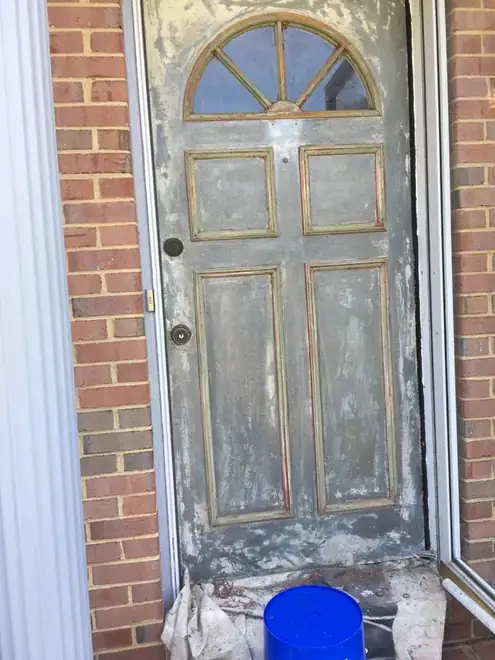
The entry wall above the stairs
Open a Springfield front door and you are usually standing on a landing with a half flight going up and a half flight going down. The wall beside you runs the full height of both levels. There is no floor under most of it.
That is why it gets skipped. We walk into houses off Rolling Road and Old Keene Mill where every bedroom has been repainted twice and the foyer is still builder color, because nobody could work out how to reach it.
A ladder footed on stair treads is not the answer. It is unsafe and it puts the person painting at an angle where the cut line at the ceiling wanders. We build staging: legs of different lengths on the treads, a level platform across, and a working height that lets someone stand still and cut a straight line. The setup takes longer than the painting.
While we are up there we do the rest of what nobody reaches: the ceiling over the stairwell, the top of the front door casing, and the return wall above the coat closet.
Stair rails, balusters and the two half flights
The stairs are their own job and the most handled surfaces in the house. Handrail, balusters, newel posts, skirt board, riser faces.
Most were finished in oil when the house was built. A waterborne enamel straight onto forty-year-old oil gloss peels off a handrail in strips within a year, because hands are on it every day. Everything gets deglossed and bonding primed first.
Balusters are slow. There is no fast way to do thirty of them properly, and anyone quoting a stairwell as an afternoon has not counted them.
Risers take shoe scuffs, so they get the same enamel as the trim rather than wall paint. Treads we leave alone unless you ask, and mostly we advise against it.
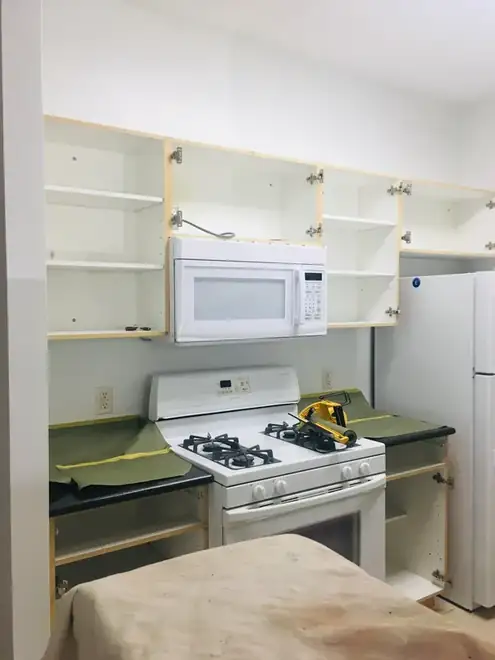
Lower level walls that sit below grade
The bottom half of a split foyer is banked into the ground on at least two sides. Those walls have soil against the outside of them, and soil holds water.
What that looks like inside: a chalky white bloom on block or concrete, which is efflorescence, salts carried through by moisture. A soft patch of drywall low on one wall. Paint that lifts along the bottom eight inches and nowhere else. A musty smell in one corner of the family room.
Painting over any of that buys you a season. We look for where the water is coming from first, and it is usually a short list: a downspout discharging against the foundation, a window well with no drainage, grading that has settled back toward the house, or a failed seal at a below-grade window frame.
Those are not paint problems and we say so rather than sell you a coating. Once the outside is fixed and the wall has dried, we prime block with a masonry sealer, patch drywall where the face has gone, and finish. If a homeowner insists on painting a wall that is still wet, we decline that part of the work.
The paneling in the rec room
Nearly every split foyer built here through the seventies has a lower level lined in wood paneling, four by eight sheets with vertical grooves, in a dark tone that makes an already low room feel lower.
It paints well, and it is one of the best value jobs in the house. The process:
- Wash it. Paneling in a rec room has decades of hands, furniture polish and, in plenty of these houses, tobacco on it.
- Scuff the factory finish, which is often a sealed vinyl-faced print rather than real wood.
- Stain-blocking primer, because both real wood veneer and printed paneling bleed through a waterborne topcoat.
- Then decide about the grooves. Filling them and skimming gives you a flat wall. Leaving them keeps a shadow line every sixteen inches. We show you both and let you pick.
Filling grooves adds real days to the schedule, so it is worth deciding before the estimate rather than halfway through.
Popcorn ceilings and eight-foot lower levels
Sprayed ceiling texture is standard across the West Springfield and Newington build-out. It collects dust, it cannot be touched up, and on a lower level with an eight-foot ceiling it eats what little light the room gets.
We scrape wet rather than dry, skim the ceiling flat, sand, prime and finish in a dead flat white. The room is sealed off and the debris is bagged rather than swept.
One honest note on texture in a pre-1978 house. It may contain lead in the paint over it, and older ceiling products carried other things too. We handle it wet and contained for that reason. If a homeowner wants the material tested before we start, that is a reasonable thing to do and we will work around the result.
Hollow core doors and the builder trim package
These houses came with a small, repeated set of parts: hollow core doors, ranch casing, a two-piece base, and bifolds on every closet. Across a four bedroom it is more surface than the walls.
Bifolds are the item people forget to count. They come off their tracks, get laid flat and sprayed, and go back with the pivots checked, because half of them have been jumping the track for years anyway.
Edges matter more than faces. The latch and hinge edges take the wear, and a door painted only on its two faces looks unfinished the first time it swings open. We pull the pins, do the edges, and rehang. If a door has been painted five times and no longer closes, another coat is not the answer and we will say so.
What a Springfield interior estimate covers
Fredy Vargas comes out and walks the house himself. On a split foyer he is looking at four things in particular: how the entry wall can be staged, whether the lower level is dry, what is behind the paneling, and how many doors and bifolds are actually in the house.
You get a written scope naming the prep, the primer, the number of coats and the product. Two coats over primed patches is our standard and we do not quote one coat work. We work room by room so you keep the rest of the house, and we clean up every evening. Same four people start to finish.
Virginia contractor license 2705098145, licensed, bonded and insured. No minimum job: one bedroom, one stairwell, one set of doors. Ten percent off for veterans and for anyone 65 and over. We are based on Trevor Place in Vienna, so Springfield sits at the far end of our run and our next start there can be a little later than closer to home. Call 703-869-0593 and we will give you a real date.
Every service we offer
Every town we cover
More on this from Fred
- What Actually Drives the Cost of Painting a House in Northern VirginiaHomeowners want a number. What they usually need first is an understanding of why two honest painters can quote the…
- The Best Time of Year to Paint the Outside of a Virginia HomeLate spring and early fall are the sweet spots, but the reason has less to do with the daytime high…
- Refinish or Replace? How to Judge the Real Condition of Your DeckA gray, splintery deck usually looks worse than it is. A deck that looks fine can be the one with…
Ready when you are.
Fred answers his own phone. If he is up a ladder he calls back the same evening.