
Power Washing in Burke, VA
Burke is built out of the two sidings a pressure washer ruins fastest. Getting a house here clean is mostly a question of how little pressure we can get away with.
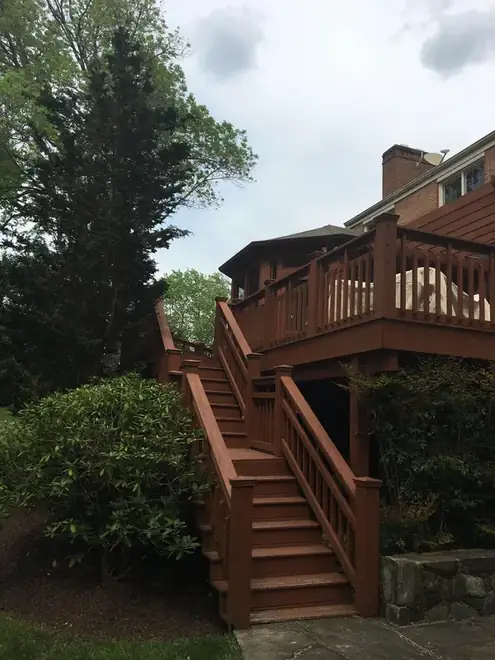
The two sidings here that a wand will wreck
The houses went up in the 1970s and 80s, and the exteriors are what builders were using then.
T1-11 plywood. Those vertical grooves are channels. Water driven into a groove at pressure sits against the plies, and where the paint film has already opened it gets between them. The face veneer then lifts in flakes that look like bad peeling paint and are actually the panel coming apart. A wand makes that worse in minutes.
Hardboard lap. Compressed wood fiber swells when it takes on water and never shrinks back. The bottom course on a lot of these houses is already thick and spongy, with dark rings around dished nail heads. Put a tip near that and you will take material off, not dirt.
Both get cleaned the same way: solution, dwell time, a wide fan held well back, rinsed downward. No exceptions, and no shortcuts because the house is large.
A wash is maintenance, and maintenance skips the Board
People in Burke Centre ask us whether they need to file for it. Cleaning a surface and putting it back the color it already was is maintenance rather than an exterior architectural change, so it is not the kind of thing the Conservancy's Architectural Review Board sits on. That is the one piece of exterior work here you can usually book without waiting for a meeting, and the ARB office will confirm it in a minute if you want to be sure.
Two things still worth sorting out first. Know where your responsibility ends: in a lot of clusters the walkway, the parking area and the fence along the common land are maintained by the cluster, not by you, and we would rather ask than clean something twice. And if the reason you are calling is a note from your cluster about mildewed siding, say so, because it usually tells us which elevation to look at before we arrive.
Gable ends and chases, cleaned from the ground up
Cedar and board-and-batten on these houses is usually on the gable ends and the sided chimney chase, which means the dirtiest wood is the hardest to reach. A chase on a three-story elevation is often thirty-five feet up with a sloped, planted bed at the bottom of the ladder.
Height is where people get hurt and where siding gets damaged, because a wand held overhead at full stretch cannot be controlled, and anything angled upward goes straight under a batten or a lap. We reach those walls with a low-pressure applicator and a telescoping rinse from a stable position, or we stage properly, and we accept that the top of a chase takes longer than the rest of the house.
Bare cedar is the other reason to keep pressure off. Weathered softwood furrows under a tip, and wand marks on a gable are permanent.
Board fences backing onto the trail
The Conservancy trail system runs behind a great many of these yards, and the wood fence between the two is the surface that gets worst fastest.
- The trail side is the green side. It faces tree cover and gets no sun and no airflow, so algae is heavier there than on the side you see from your kitchen.
- The bottom rail and the posts. Leaf pack piles against a fence on the woods side and keeps it wet year round. That is where boards go soft, and soft boards do not get washed.
- Access. Reaching the far side often means standing on common land. We keep gear off the trail itself and out of the way of people walking it.
- Both sides or neither. Cleaning one face of a board fence makes the other face look worse than it did.
Sheds, playsets and pergolas are the same wood in the same shade and are quick to add while we are already there.
No driveway, a shared lot, and a hose across it
A Burke Centre townhouse commonly parks in a cluster lot with a common walkway to the door and no private drive at all. That changes the logistics of a wash more than it changes the washing.
The nearest spigot may be at the back of the unit while the work is at the front, so the hose runs around or through. We lay it flat, flag it where it crosses a walkway, and keep the machine out of a travel lane so nobody comes home to a blocked space. On a middle unit we cover and rinse the neighbors' patios and siding on both sides as a matter of course, since the run of wall is continuous and water does not stop at a property line you cannot see.
On the single-family streets it is simpler: a real driveway, an apron and often a garage floor worth doing with a degreaser in the same visit.
A patio at the bottom of a slope, and the door behind it
Burke houses sit on grade that falls away from the road, so the patio is frequently at the lowest point of the lot with a walkout door or a lower-level slider right behind it.
Washing a slab in that position means pushing a large volume of water toward the only door in the house that sits below grade. We look at where the slab pitches before we start, work away from the threshold, and if the patio pitches back at the house we tell you, because that is why the bottom of the frame keeps rotting and no cleaning changes it. Area drains in these patios are usually full of leaf pack and need clearing first or the water has nowhere to go.
Landscape timbers and block walls holding the grade above a patio get chemistry and low pressure. Old timbers will shed material under a tip and that is not worth doing for a cleaner look.
What it will not fix, and when to get on the list
Honest limits first.
- Swollen hardboard. Water will not firm it back up. A soft bottom course wants cutting out, and washing it beforehand only tells you how far the damage runs.
- Delaminated T1-11. Same answer. Once the plies have opened, getting it clean and wet is the opposite of helpful.
- Chalky aluminum. The powder rinses away and the panel still looks dull, because the finish on it is worn out rather than dirty.
- The green coming back. Under this much canopy it will, eventually. Killing the growth with chemistry rather than knocking it off with force is what makes the difference between two summers and two months.
Most people here are gone before we arrive and back after we pack up, which suits a wash fine. We work from a key or a code, leave the site tidy, and the same crew is at your house each day. Fredy Vargas looks at the property himself before pricing it. Virginia contractor license 2705098145, licensed, bonded and insured. Call 703-869-0593.
Every service we offer
Every town we cover
More on this from Fred
- What Actually Drives the Cost of Painting a House in Northern VirginiaHomeowners want a number. What they usually need first is an understanding of why two honest painters can quote the…
- The Best Time of Year to Paint the Outside of a Virginia HomeLate spring and early fall are the sweet spots, but the reason has less to do with the daytime high…
- Refinish or Replace? How to Judge the Real Condition of Your DeckA gray, splintery deck usually looks worse than it is. A deck that looks fine can be the one with…
Ready when you are.
Fred answers his own phone. If he is up a ladder he calls back the same evening.