
Power Washing in Vienna, VA
Our shop is on Trevor Place, so a wash in this town can be two visits instead of one: clean it, then come back and look at it dry, which is the only honest way to judge masonry. Under this much tree cover the job is almost never dirt.
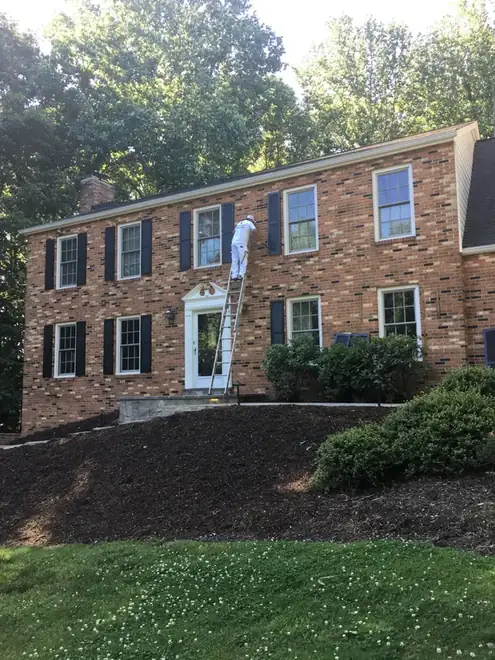
Judging a wash dry, the morning after
Everything looks clean wet. A brick walk, a flagstone patio and an aggregate drive all darken under water and hide the places a wash missed. That is why people are happy with a washing job on the day and unhappy with it that weekend.
Because we are a few minutes away we can do what a crew driving in from another county cannot afford to. We finish, we leave, and one of us comes back the next morning to look at the surface dry. What shows up then is the band along a shaded edge that needed more dwell time and the spot on a walk where the clean stops. That return visit is short and nobody argues about it.
Brick walks, patios and the mortar that will not take pressure
Vienna has a great many brick front walks, stoops, piers and low garden walls, a good share laid in the fifties and sixties. The brick is fine. The mortar is the problem.
Older mortar was mixed soft on purpose so it would move with the wall rather than crack the brick. Soft mortar washes out. A narrow tip held close takes a sixty-year-old joint back behind the face of the brick in one pass, and you are looking at repointing rather than cleaning. We have quoted walks ruined in an afternoon with a rented machine.
So on old masonry the pressure stays moderate, the fan wide, the wand traveling across the joints rather than down them, with a masonry cleaner doing the work on the growth. We test out of the sightline and look at it dry first.
Brick laid in sand is the other version. It cleans more freely, and the joint sand then has to be replaced, which is part of the job.
Patios follow the same logic by material. Flagstone is soft in places, so the wand keeps moving. Stamped and sealed concrete wants the gentlest treatment, because the sealer is what you are looking at. On a pool surround the runoff cannot go in the water, so we stage the work in sections.
Driveways: concrete, asphalt, and which one you have
Drives here run to both, sometimes on one property after an addition, and they are not washed the same way.
Concrete takes a surface cleaner at real pressure and comes up evenly. Tannin staining under a mature oak or tulip poplar, the usual complaint on a shaded drive here, is not soil and does not answer to pressure: it wants the right cleaner and dwell time, and deep old tannin lightens more reliably than it disappears.
Asphalt is the one to be careful with. A worn drive has lost binder at the surface, and pressure strips the fines and leaves it rougher and grayer. We clean asphalt at low pressure with a cleaner, which takes off the algae and leaf mold and will not make a twenty-five year old drive look new.
Exposed aggregate, common on the sixties and seventies houses, sits in between. It cleans well and sheds stones under a tight tip.
Shade, and why the back of the house is the job
Tree cover is why people live on these streets and why they call us. A wall that never sees sun stays damp long enough for algae to establish, and mildew follows it.
That growth has a hold in the surface, so pressure takes off what you can see and leaves what you cannot, which is why a blast-only wash looks right for two months and then goes gray-green again. Soft washing, a cleaning solution at low pressure with enough dwell time to kill it, lasts noticeably longer on the same wall.
On a typical lot that puts the money at the back and the north side. We will quote a whole house, and we will also tell you when two elevations are clean and you would be paying us to rinse them.
Soffits are the part nobody mentions. Under a deep overhang in permanent shade they grow film the walls do not. Those get washed from below at low pressure, with nothing angled up into a vent.
Board fences, and what a clean fence actually looks like
Six foot board fence is standard here and it is the most improved surface on most jobs: vertical, shaded on one side, and never washed.
Treated pine and cedar both furr under pressure and the wand arc prints permanently in the grain. So a fence gets a wood cleaner with dwell time at low pressure, and the result is an even, lighter, genuinely clean fence. It is not a new fence. Weathered gray is damaged surface fiber, and getting real wood tone back takes a brightener and usually sanding, which is refinishing work.
A fence has two sides and one faces a neighbor, so settle that before we start. The bottom rail and post bases at grade are where we find soft wood, which we point out rather than discover with the wand.
Timing it around the pollen drop
From late March into May the town turns yellow-green and everything outside carries a film. The common mistake is booking a wash in the middle of it. Wait until the drop has finished: late May through June is the clean window, early fall is the quiet one. Washing during the heaviest week buys four days.
The other timing item is cold. Cleaning solutions lose their bite as the temperature drops, and water left on a shaded brick walk in late fall turns to ice overnight. We schedule around that rather than leave you with a slick stoop.
Annual suits most houses here. Shaded elevations and fences under canopy want it more often.
Three things people expect a wash to repair
All three look like soiling. None are.
Faded paint and faded stain. Ultraviolet light breaks the resin down and the pigment chalks off. Washing removes the chalk and the color that has gone is gone. That is a repainting conversation.
Streaking down the face of the gutters. Those dark vertical runs are different soiling from the siding and do not come off with the house wash. They need a gutter cleaner worked along the face by hand, and on a gutter streaked for fifteen years some of it only lightens. We quote it separately because it is slow.
The white bloom on a brick pier or block wall. Mineral salt arriving at the surface as moisture moves through the masonry. It can be treated and it comes back while the water keeps coming, so the real question is where the water gets in.
Fredy Vargas prices it himself and tells you which surfaces are worth the money. We are at 8040 Trevor Place, so coming back to check something dry costs nobody anything. Virginia contractor license 2705098145, licensed, bonded and insured. No job minimum. Ten percent off for veterans and for anyone 65 or over. Call 703-869-0593.
Every service we offer
Every town we cover
More on this from Fred
- What Actually Drives the Cost of Painting a House in Northern VirginiaHomeowners want a number. What they usually need first is an understanding of why two honest painters can quote the…
- The Best Time of Year to Paint the Outside of a Virginia HomeLate spring and early fall are the sweet spots, but the reason has less to do with the daytime high…
- Refinish or Replace? How to Judge the Real Condition of Your DeckA gray, splintery deck usually looks worse than it is. A deck that looks fine can be the one with…
Ready when you are.
Fred answers his own phone. If he is up a ladder he calls back the same evening.