
Esta página tiene el resumen en español. El texto largo todavía está en inglés. Fredy habla español, así que para cualquier pregunta llame al 703-869-0593 y le atiende directamente.
Cabinet Refinishing in Chevy Chase, MD
Most kitchens here are two kitchens. There is original built-in casework from when the house went up, and there is a rebuilt kitchen beside it from some later decade. Making those read as one finish is the whole exercise.
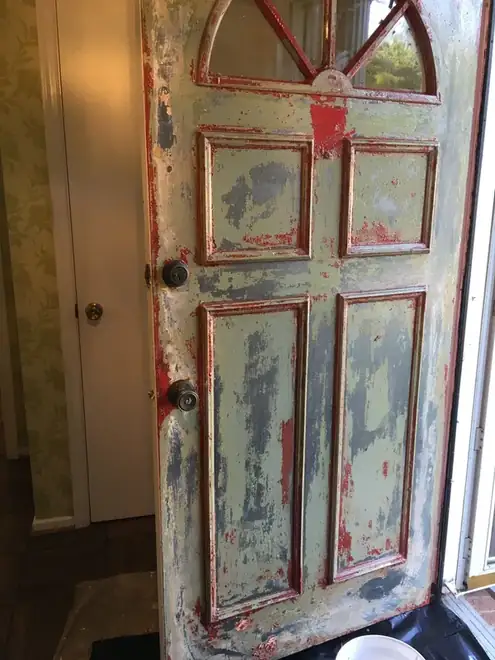
Two generations of casework in one room
Houses built here between 1900 and 1930 put the kitchen at the back with a pantry between it and the dining room. The pantry casework was built on site by a carpenter: floor to ceiling, beaded face frames, glass upper doors, a counter with drawers under it, and sometimes a pass-through.
Almost every one of those kitchens has since been rebuilt, often more than once. So you open the door and find factory cabinetry from the 1990s or 2000s, in a room that still has the original pantry standing at the end of it, and the two have nothing in common. Different wood, different door profile, different frame reveal, different existing finish, and in most cases the pantry has ten coats on it while the newer run has a sprayed factory catalyzed finish under one repaint.
Refinishing them to a single color is not a matter of using the same can. Each side needs its own preparation and its own bonding strategy, and the sheen has to be chosen so the two read alike under the same light. We sort out which is which at the estimate rather than after the doors are already off.
Color and sheen in a back-of-house room
Kitchens in this housing stock sit at the back of the house, frequently face north or east, and take whatever light gets through a mature canopy. That is a genuinely different lighting condition from a modern kitchen with a wall of glass, and it changes what a color does.
Two practical consequences. First, a white that looks crisp in a showroom often goes gray or slightly green in one of these rooms under the trees, so we put a sample on the actual doors in the actual room and look at it in the morning and again at four. Second, sheen carries more weight than color here. In low light a satin gives back enough to keep the casework from going flat and dead, while a high gloss will throw every ripple in a hundred-year-old face frame.
Where original casework and newer cabinetry share a room, sheen is also the tool that makes the match. Identical color in two sheens reads as two colors. We match sheen as carefully as we match the tint.
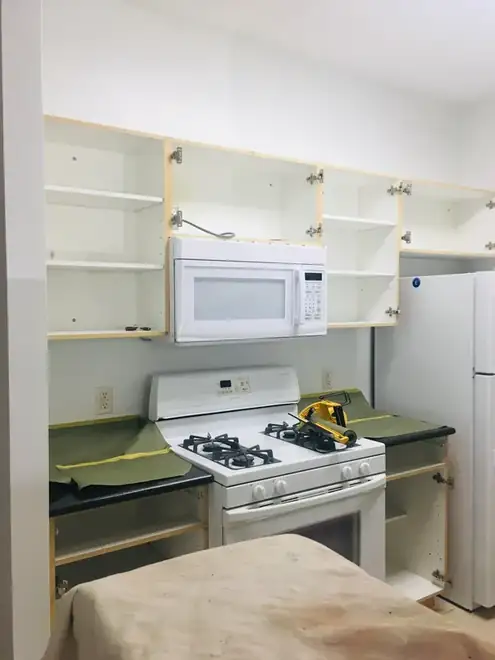
What the original pantry actually needs
The old casework is usually the best woodwork in the house and it is nearly always the part that has been treated worst.
Common findings, and what we do about them:
- Doors painted shut. Decades of coats have closed the gap between door and frame. The door gets cut free, the edges taken back where the build causes the bind, and the edges primed before the finish goes on.
- Original latches and hinges painted over. Cabinet latches from this era are worth keeping. They come off, get cleaned, and go back on. Painted hardware is the single fastest way to make old casework look neglected.
- Glass upper doors. Often original glass, sometimes with visible waviness, and the glazing or the stop holding it may be as old as the house. We mask and cut rather than run tape and hope, and where a stop has to come out it is labeled and goes back where it came from.
- Beaded face frames and inside corners. Far more perimeter than a modern flat frame. This is brush work, and it is where the hours are.
- Interiors and shelf edges. If the pantry is glass fronted, the inside is part of the finished job, including the back panel and every shelf edge.
The newer run beside it is a different problem. Factory finishes shed adhesion unless they are deglossed and primed with something rated to bond, and that step is invisible to anyone looking at the finished door, which is exactly why it gets skipped.
Sanding painted casework in a pre-1978 house
The pantry cabinetry is original to a house built well before 1978, so the paint on it is old paint, and sanding it falls squarely into the federal RRP question. The interior threshold is more than six square feet of painted surface disturbed in a room. A single floor to ceiling pantry run clears that several times over. Maryland is not an EPA-authorized state, so the federal rule applies directly here.
In practice that shapes the set-up in the room: the kitchen isolated at the doorway rather than draped, counters and appliances covered and sealed rather than sheeted loosely, sanding done with vacuum extraction at the tool or wet where the work allows, debris collected the same day, and no heat guns.
It also shapes the scope conversation. There is a version of this job where the old casework is taken back toward bare wood and a version where the build is knocked down, filled honestly and recoated. On pre-1978 painted cabinetry the second is usually the right answer, and we will say which one your pantry needs instead of quoting the cheap version and discovering the truth in week two.
Ask any contractor quoting pre-1978 cabinetry how they handle the rule, and check the answer rather than taking it on trust. What we will do is tell you what the rule covers on your scope and work clean in an occupied kitchen.
What leaves the house, and how it leaves
Doors and drawer fronts come off, get labeled by opening, and are cleaned, degreased, sanded and sprayed at our shop in Vienna. A sprayed door in a controlled space is a better finish than anything achievable in a kitchen with a family in it. Boxes, face frames, the pantry casework and any island paneling get finished in place, in a fully masked room.
Getting the doors out is where this neighborhood is different. Many of these houses have no usable driveway, a detached garage on a rear lane, or nothing but the curb. Loading twenty or thirty doors onto a truck means the truck standing on the street for a stretch of the morning, and on these blocks the street may belong to the municipality rather than the county. Several of the towns and villages inside 20815 administer their own curb and right of way, and several have their own start time rules.
So we establish which one you are in before we schedule, and we plan the load. Doors go out in one trip, wrapped, through a route we have covered: hall floor, threshold and stair if the pantry serves an upper landing. They come back in one trip. Nobody carries a door past your dining room twice.
The other built-ins these houses came with
Kitchens are not the only fitted woodwork in a house of this age, and the rest of it refinishes the same way.
Bookcases flanking a parlor fireplace. A window seat with a lift lid under a bay. A linen press or a built-in cupboard on an upper landing. Boxed radiator enclosures somebody added later. A mudroom or back hall with hooks and a bench built into it. Bathroom casework and a medicine cabinet recessed into plaster.
All of it can be refinished, and refinishing a built-in changes a room more than wall color does. It is also the work most often left out of a quote because nobody thought to count it. Fredy counts it.
Keeping a kitchen while we work
You lose the cabinet doors for a stretch, not the kitchen. Boxes stay usable, the sink stays connected, and we agree in advance on which days the room is genuinely out of service for the in-place spraying and coating of face frames.
Drawers come out with their contents intact where you want them to. Hardware is bagged by opening, not thrown in one box. Every door goes back on the hinge it came off, which matters more on original casework than on factory cabinetry, because nothing in a hundred-year-old pantry is interchangeable.
Sherwin-Williams and Benjamin Moore. Same four-person crew every day since 2002, background checked, no minimum job size, so a single pantry run is a job we will take. Call 703-869-0593.
Todos nuestros servicios
Todas las ciudades que cubrimos
Más sobre esto, de Fredy
Estos artículos están en inglés
- What Actually Drives the Cost of Painting a House in Northern VirginiaHomeowners want a number. What they usually need first is an understanding of why two honest painters can quote the…
- The Best Time of Year to Paint the Outside of a Virginia HomeLate spring and early fall are the sweet spots, but the reason has less to do with the daytime high…
- Refinish or Replace? How to Judge the Real Condition of Your DeckA gray, splintery deck usually looks worse than it is. A deck that looks fine can be the one with…
Cuando usted diga.
Fredy contesta su propio teléfono. Si está en una escalera, le devuelve la llamada esa misma tarde.