
Esta página tiene el resumen en español. El texto largo todavía está en inglés. Fredy habla español, así que para cualquier pregunta llame al 703-869-0593 y le atiende directamente.
Cabinet Refinishing in Fairfax, VA
Half the kitchens in this city came out of a 1990s renovation, and the cabinets are better than the color they are wearing. The work is sorting out which ones are worth refinishing.
Maple from a 1994 renovation, and why it went orange
The commonest kitchen we refinish at a Fairfax address came out of a renovation between the late eighties and the early two thousands, in a Mosby Woods colonial, a Cobbdale rambler or a Little River Hills split. Maple or oak fronts, plywood boxes, overlay doors on cup hinges, nothing wrong with any of it except the color.
Maple under a clear factory lacquer ambers with light exposure and with age in the coating itself, so a kitchen that went in pale now reads orange, worst on the run nearest the window. People call it the cabinets going yellow, which is roughly what happened.
Maple is the best news on this page. It is tight grained, sands smooth and takes a sprayed finish flat with no grain filling, so a furniture-grade white is reachable without the extra days oak needs. What it does do is bleed tannin at bare spots and old water damage, so anywhere we sand through gets a stain blocking primer.
Glazed cherry, and the factory varnish under it
Farrcroft, Great Oaks and the later builds run to custom cherry and stained maple with a glaze, pigment wiped into the corners and the bead to make a door look older than it is.
Two things about them. Cherry darkens on its own under UV, so the doors are a deeper red than they started and the inside faces no longer match the outside. And the factory finish is usually a conversion varnish or catalyzed lacquer, a far harder film than a 1990s builder kitchen is wearing. Scuffing that with a fine pad and calling it ready is how a finish lifts at the pulls inside a year. Every face and edge needs real abrasion and a bonding primer made for slick factory films.
The glaze is the other trap. Pigment sitting in a corner can bleed into a light topcoat and show as a brown shadow weeks later. We seal the glazed areas before color, and on a heavily glazed door we test one front and wait rather than doing the kitchen and finding out.
The island, and the two-tone decision
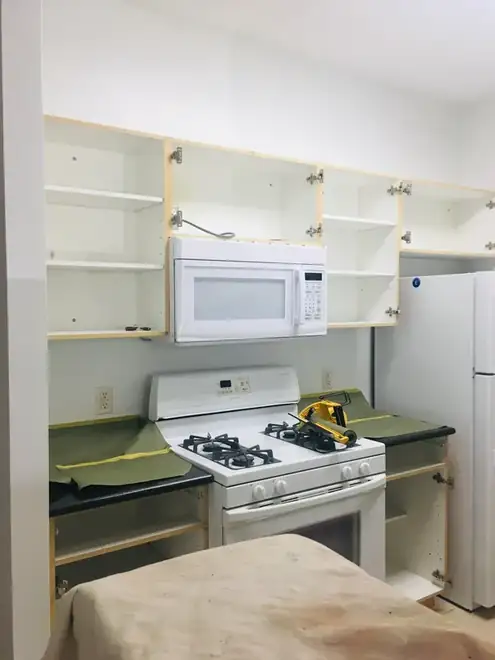
The later Fairfax kitchens are built around an island, seven or eight feet long with a prep sink, end panels, corbels under an overhang and a bank of drawers. It is the most looked-at cabinetry in the house, read from the family room and the breakfast area.
It is also finished differently. An island does not come apart, so the box, panels and corbels are worked in place and only the fronts come off. Matching those two surfaces is the craft of this job.
Two-tone is the request we get most here, a darker island with lighter perimeter cabinets. It works, and it hides wear where feet and stools go. What has to be settled first is where the darker color stops, because in an open plan it is judged against the wall color in the next room. We put samples on a door and an end panel and look from the family room, at night as well as by day.
Turnovers near George Mason, on a fixed date
George Mason sits against the southern side of the city and a good share of the housing there is rental. Those kitchens are builder grade, often laminate or melamine fronts on particle board boxes, and the work happens in the gap between leases. Tell us the date at the estimate. Being four people rather than forty is why we can commit to a short window.
We will also say when the cabinets are not the right spend. Laminate and melamine coat well with the right bonding primer while the surface is intact, and a sprayed finish on a flat slab door looks good. What it will not do is rescue a swollen sink base, a door with the laminate lifting along a bottom edge, or a box whose back panel has separated. Replacing four failed doors and coating the rest beats coating all of them and hoping.
Why we will not finish your doors in the basement
People offer the basement, and on paper it makes sense: out of the way, plenty of floor for racks. We turn it down most of the time, and the reason is moisture. Fairfax basements run humid, particularly finished lower levels with a damp odor or efflorescence on the block. Coatings cure by releasing solvent and water into the air, and in a cool space with no air exchange that slows badly. The film stays soft and prints a permanent mark the first time a jar sits on it. A humid basement at 62 degrees turns a three-day schedule into a week and still gives a worse result.
Where there is a dry attached garage we rack doors on site, season allowing. Otherwise the fronts go to our shop, which is the usual answer in the city.
Kitchens fitted into an older frame house
The frame houses near Main Street, around Van Dyck Park and toward Daniels Run are a different job. The kitchen in one was fitted into a room that was not a kitchen, sometimes twice, and the cabinetry is painted woodwork carrying a lot of coats.
What we find: openings that are not square, so doors were planed to fit and only fit where they came from. A pantry built in place and not removable. A floor sloped enough that the toe kick was scribed to it.
Those coats are usually oil or varnish down the stack, and nothing water based grips them until they are deglossed, sanded and given a bonding primer. Houses this age predate 1978, so the practice matters: no open power sanding in the room, sanding wet or with a vacuum at the tool, the kitchen sheeted and doorways sealed, debris bagged, and the area cleaned daily.
Where the temporary kitchen goes, and getting a date
Most Fairfax kitchens from a nineties renovation have somewhere to retreat to: a breakfast room, a butler run to the dining room, or an island that holds a microwave while the perimeter cabinets are open. The older frame houses have none of that, so the temporary kitchen is a table in another room and a few nights of not cooking. Either way the fridge, sink and range stay working, and you pull out what you use daily first.
The coating is dry to the touch quickly and not cured for a couple of weeks, so leave doors slightly ajar the first few days and keep degreaser off the finish for a month.
Fredy Vargas comes out, opens every door, counts the fronts, works out the material, checks whether a factory finish will fight us and looks under the sink for leak damage. Fairfax is straight up Chain Bridge Road from our shop in Vienna. Working since 2002, Virginia contractor license 2705098145, licensed, bonded and insured. No minimum job. Ten percent off for veterans and anyone 65 or over. Call 703-869-0593.
Todos nuestros servicios
Todas las ciudades que cubrimos
Más sobre esto, de Fredy
Estos artículos están en inglés
- What Actually Drives the Cost of Painting a House in Northern VirginiaHomeowners want a number. What they usually need first is an understanding of why two honest painters can quote the…
- The Best Time of Year to Paint the Outside of a Virginia HomeLate spring and early fall are the sweet spots, but the reason has less to do with the daytime high…
- Refinish or Replace? How to Judge the Real Condition of Your DeckA gray, splintery deck usually looks worse than it is. A deck that looks fine can be the one with…
Cuando usted diga.
Fredy contesta su propio teléfono. Si está en una escalera, le devuelve la llamada esa misma tarde.