
Esta página tiene el resumen en español. El texto largo todavía está en inglés. Fredy habla español, así que para cualquier pregunta llame al 703-869-0593 y le atiende directamente.
Deck Refinishing in Annandale, VA
Hardly a house in 22003 was built with a deck on it. The streets went up between about 1950 and 1968 and the decks arrived decades later, which changes what we check before we put any finish on one.
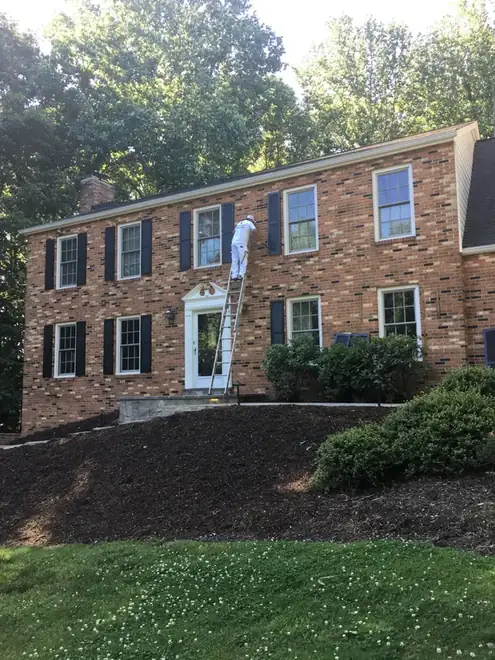
A retrofitted deck on a house that never expected one
Annandale is one era repeated. Broyhill Crest was finished by 1954, Holmes Run Acres ran from 1951 to 1960, Sleepy Hollow Woods from 1959 to 1961, and Canterbury Woods, Ravenwood Park, Camelot and Woodburn belong to the same stretch. Almost none of those houses had a deck when it was handed over. What is on the back now went up in the eighties or nineties.
So we start underneath. The ledger is the board that ties the deck to a house framed without one in mind. On a retrofit we want to see how it was fastened, whether there is flashing over it, and what the band joist behind it looks like. Nails instead of through-bolts, no flashing, and forty years of water running down behind it is a common combination here. If the ledger is failing, the finish is not your problem, and we say so before you have spent anything on stain.
Ramblers sit low, and the deck sits lower
The rambler is the shape of this town and it sits close to grade. The deck off the back is often a step or two down from the kitchen door, which puts the joists a foot or so off wet soil with almost no air moving under them.
A deck like that takes on moisture from below all year. The top can look dry while the underside of the same board is damp, and any finish laid over that is fighting the wood. It shows up as cupping, as early peeling on the board edges, and as black spotting that returns a season after it was cleaned off.
What helps: clearing the leaf pack and old mulch out from under the deck so air can move, extending a downspout so water is not pooling under the joists, and pulling planters and storage bins off the boards. What does not help is a heavier coat of stain. On a low deck we use a penetrating finish rather than a film, because a film over a board that is wet underneath lets go from the back.
Oak, tulip poplar and the brown streaks people mistake for rot
The canopy along Holmes Run and Accotink Creek sits over most of these back yards, and it lands on the deck. Three different marks get called the same thing:
- Tannin staining. Brown weeping streaks from oak and poplar litter left on the boards. Cosmetic. A wood brightener after the cleaner pulls most of it out.
- Mildew and algae. Black speckling and green film on the shaded half of the deck, worst under a limb. It has to be killed and washed off, not coated over.
- Iron tannate. The black halo around every screw head, the wood's tannin reacting with the fastener. That one does not fully come out, and anyone promising otherwise has not done many of these.
Pollen matters too. April and May put a yellow film on everything in 22003, and stain laid over pollen does not bond. In a heavy week we rewash the morning we coat, or we move the deck to June.
Split level decks and the tall gable behind them
The split levels and bi-levels put the main floor half a story up, so the deck off the back stands eight or ten feet in the air on posts with a run of stairs down to the yard.
Those fail in a different order than the low rambler decks. The walking surface and rail tops go first from sun. The stair stringers go at the bottom where they meet a wet patio or bare ground. The post bases rot upward from the footing while the top of the post looks new.
They need staging rather than a ladder leaned against a rail, because the rails, the skirt and the underside all have to be reached properly instead of sprayed from below and called finished. While we are set up, the tall gable end above the deck is usually the most weathered wall on the house, and it is worth doing in the same visit.
The cement shingle siding behind the ledger
Plenty of Annandale houses still wear their original cementitious or asbestos-cement shingle siding, and on a retrofitted deck that siding sits directly behind the ledger and the rail returns.
It is stable if left alone. What it does not tolerate is sanding, grinding, blasting or a pressure washer tip held close to it, which rules out the fast way of cleaning a deck against the house wall. We wash low, keep the wand off the shingles entirely, and mask that wall before any stripper goes on.
If your house has it, say so when you call. It changes how we set the job up.
Nobody here is going to tell you which stain to use
There is no county-wide architectural board over ordinary Annandale streets and no dominant association across 22003. For most people the color of the deck is their own decision, which is not true in half the towns we work in.
The exceptions are worth knowing. Sleepy Hollow Woods runs an architectural committee working from covenants written in 1959 and it does review plans. Broyhill Crest has a community association taking in Annagrove, Beverly Manor Park and Oliver Park. Holmes Run Acres has its own historic district, which is a point of pride rather than a hurdle for refinishing a deck.
Everywhere else the only thing limiting you is the wood. We brush out real samples on your boards, in your light, because a stain that reads warm brown in the store reads gray under an oak canopy.
Holmes Run Acres, where the deck is part of the house
The early Holmes Run Acres phases were designed by Nicholas Satterlee and Francis Lethbridge and show their post and beam frame on purpose: flat roofs, wide plank siding, exposed beam ends, and decks that read as part of the floor plan rather than an addition.
Those beam ends are end grain and they drink water, so they are usually the first thing we replace or seal. The deck often runs straight out from a wall of glass, which means no spraying and a cut line visible from the sofa. And because the roofs are flat, the water off them lands on the deck in one place rather than spread along an eave. Wherever that falls is where the boards have gone soft.
What a walk-through actually settles
If more than about a quarter of the boards dent under a thumbnail, you have a material problem rather than a finish problem. The framing on these retrofits is often still sound, so replacing the decking on the existing structure is a smaller job than people assume.
Fredy Vargas walks the deck himself before quoting. He sounds the posts and the ledger and tells you whether this is a wash and stain or a full strip and restore. Those are not close in price and neither can be judged from a photograph. Call 703-869-0593.
Todos nuestros servicios
Todas las ciudades que cubrimos
Más sobre esto, de Fredy
Estos artículos están en inglés
- What Actually Drives the Cost of Painting a House in Northern VirginiaHomeowners want a number. What they usually need first is an understanding of why two honest painters can quote the…
- The Best Time of Year to Paint the Outside of a Virginia HomeLate spring and early fall are the sweet spots, but the reason has less to do with the daytime high…
- Refinish or Replace? How to Judge the Real Condition of Your DeckA gray, splintery deck usually looks worse than it is. A deck that looks fine can be the one with…
Cuando usted diga.
Fredy contesta su propio teléfono. Si está en una escalera, le devuelve la llamada esa misma tarde.