
Esta página tiene el resumen en español. El texto largo todavía está en inglés. Fredy habla español, así que para cualquier pregunta llame al 703-869-0593 y le atiende directamente.
Exterior Painting in Potomac, MD
Most exteriors here are three or four different materials stacked up one elevation, and two of them look the same from the driveway. What we price is the identification, the joints and the staging, not the square footage.
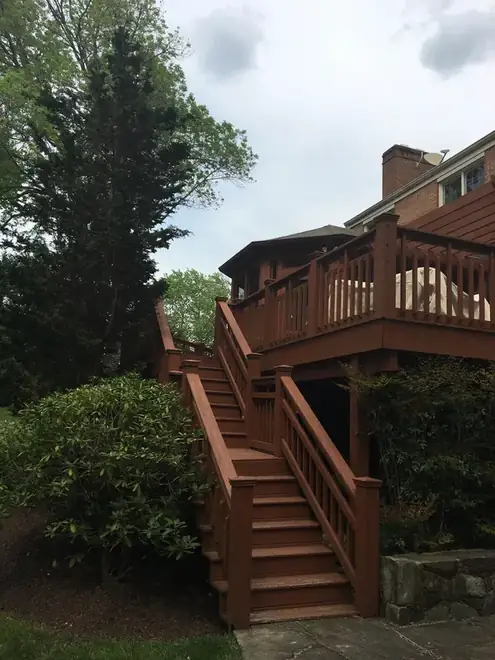
First question: what are the walls actually made of?
Hard-coat stucco is portland cement plaster applied in coats over metal lath. Synthetic stucco, normally called EIFS, is a thin acrylic finish troweled over a foam insulation board. On the estate stock built here from the 1980s through the 2000s, both are everywhere, and from twenty feet away they are indistinguishable.
How we tell them apart on site:
- Sound. A firm knuckle on cement plaster rings hard against the lath. Foam gives a dull, hollow return.
- Edges. Look where the finish stops: at a window return, at a soffit, at the base of the wall. Hard-coat terminates at a thin metal stop bead. Synthetic usually shows a thicker, rounded edge where the board was wrapped in mesh and base coat.
- The bottom of the field. A drainage type EIFS wall has a track and weeps at the bottom. A barrier wall has nothing, which tells us water that gets in has nowhere to leave.
- Thickness at a penetration. A hose bib or light block gives away how deep the material is.
If it is still genuinely ambiguous, we say so rather than guessing, and we settle it before a number goes on paper.
Sealant joints, and where a stucco wall really lets water in
On a stucco house, the field of the wall is rarely the failure. The perimeter is.
We work along every window and door head, jamb and sill, every penetration for a light, a hose bib, a dryer vent or a gas line, every control joint, and the line where stucco meets the stone or brick water table. Sealant that has gone hard, cracked at the edge or pulled away from one face is doing nothing, and it is directly above the sheathing.
Old sealant comes out rather than getting a fresh bead laid on top of it. A joint that is over-filled or bonded on three sides splits again in the first cold snap, so the geometry of the joint matters as much as the product.
We also look up. Where a roof edge dies into a wall, a kick-out at the bottom of the step flashing is what throws water into the gutter instead of down behind the stucco. A missing one leaves a stain, then a soft spot, always in the same place. We point it out even though flashing is roofing work, because painting that wall without fixing it is money wasted.
Why that answer changes the coating, not just the conversation
Both wall types sit on houses of the same age, often on the same street in the same 20854 subdivision, which is why the question gets skipped and why we ask it on every house out here. Cement plaster is mineral and alkaline, and it tolerates a masonry primer and a breathable acrylic masonry finish. A synthetic wall is already a coating system, and what we are putting on is a maintenance coat over an acrylic film, which means adhesion and flexibility matter more than build.
The mistake worth avoiding is reaching for the thickest elastomeric in the store and rolling it over everything. Heavy elastomeric on a wall that needs to dry outward does not solve a moisture problem, it locks it in. On a barrier type synthetic wall with no drainage path, a film that seals the face can turn a paint job into a sheathing repair a few years later.
So the coating gets chosen after the wall is identified, not before. On hard-coat we are usually looking at correcting cracks and recoating with a breathable masonry product. On synthetic we are usually looking at cleaning, spot repair of the finish coat, sealant renewal and a flexible acrylic that stays with the movement of the panel.
We put the actual product names in the estimate. Sherwin-Williams and Benjamin Moore, and the specific line, so you can look it up rather than take our word for it.
Four substrates on one elevation
Stone or brick at the base. Stucco above. Wood, PVC or fiber cement trim around the openings. Sometimes a run of composite siding on a gable or a metal roof over a bay window.
Each one needs its own preparation, its own primer and in some cases its own sheen, and they still have to look like one house when it is finished:
- Painted brick wants a masonry primer and a coating that passes vapor. Unpainted stone is usually best left as stone, and we will tell you that rather than sell you a coating.
- PVC and composite trim will not hold ordinary wood primer. It needs a bonding primer and, on dark colors, a product rated for heat build, because dark paint on PVC moves.
- Wood trim gets the rot cut out first. We do the carpentry ourselves, and replacement stock is primed on all six sides before it goes up.
- Galvanized and prefinished metal need degreasing and a metal primer, not a quick scuff.
Most callbacks on houses like these trace back to one substrate being treated as if it were its neighbor.
Staging a building this tall on a lot this big
Three stories at the back over a walkout, a two-story entry mass, dormers, and a driveway that leaves the truck two hundred feet from the work. That is a logistics job before it is a painting job.
We decide early what gets reached by lift, what gets pipe staging and what genuinely can be laddered. Lift access on a large lot means checking the route across the lawn, checking the ground will carry the machine after rain, and agreeing where it parks overnight. On the gorge side of town the grade behind the house frequently rules a lift out entirely and staging goes up instead.
We set a materials point near the house rather than at the top of the drive, so nobody burns half a day walking. Paint deliveries come in with us where a supplier truck cannot turn around.
And we sequence by elevation. One face at a time, prepped, primed and finished before we move the setup, so the property is never fully surrounded by equipment and you keep normal use of at least part of the house.
The bottom band: deer, trimmers and splash
The lowest three feet of a house here take a beating that the rest of the elevation does not. Deer browse keeps foundation planting chewed back, which exposes siding and trim that spent years behind shrubs and was never finished to the same standard. Bucks rub posts, pergola legs and fence boards down to bare wood in late summer. Add winter splash off gravel and mulch and a string trimmer working the same line every two weeks.
On stucco that band shows up as chipping and impact damage at the base coat. On trim it is bare wood and lifted paint. We prep it harder, spot prime everything bare, and on posts and rails choose a coating for abrasion rather than for how it looks at eye level.
Where the finish coat of a stucco wall has been knocked off at grade, that is a patch before it is a paint job, and patching stucco so the texture matches is slow work. We flag it at the estimate so it is not a surprise mid-job.
Scheduling a multi-week exterior honestly
An exterior on a house this size runs into weeks. We would rather say that than promise a finish date we have to walk back.
Season matters in a specific way here. Properties down toward the canal, Carderock and Bells Mill sit low and shaded and hold dew well into the morning, so on those houses we start later in the day rather than coating a damp wall. Masonry coatings also want surface temperature, not air temperature, which in spring and autumn is the number people forget to check. Near the flood plain we confirm what restrictions apply before staging anything heavy.
You get a written sequence: which elevation in which week, what prep happens before paint, how weather days move the schedule, and what we need from you on access. Fredy Vargas walks every house himself before quoting it. Call 703-869-0593.
Todos nuestros servicios
Todas las ciudades que cubrimos
Más sobre esto, de Fredy
Estos artículos están en inglés
- What Actually Drives the Cost of Painting a House in Northern VirginiaHomeowners want a number. What they usually need first is an understanding of why two honest painters can quote the…
- The Best Time of Year to Paint the Outside of a Virginia HomeLate spring and early fall are the sweet spots, but the reason has less to do with the daytime high…
- Refinish or Replace? How to Judge the Real Condition of Your DeckA gray, splintery deck usually looks worse than it is. A deck that looks fine can be the one with…
Cuando usted diga.
Fredy contesta su propio teléfono. Si está en una escalera, le devuelve la llamada esa misma tarde.