
Esta página tiene el resumen en español. El texto largo todavía está en inglés. Fredy habla español, así que para cualquier pregunta llame al 703-869-0593 y le atiende directamente.
Exterior Painting in Springfield, VA
Springfield went up in one long push between 1950 and 1970, and what that left behind is a raised front elevation on thousands of houses and four different siding materials within a few blocks. Both change how the outside gets painted.
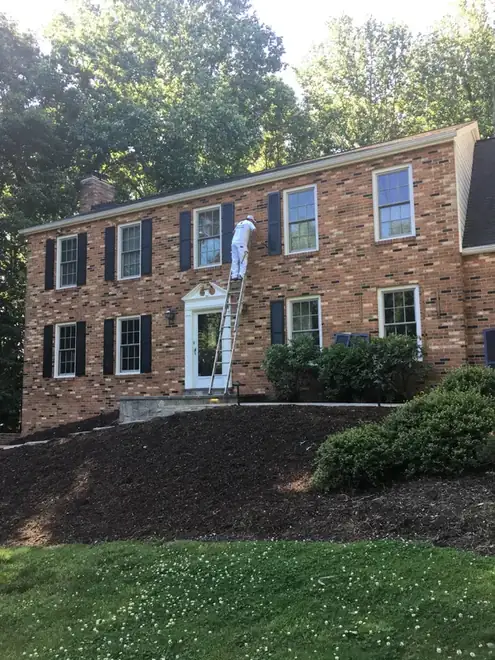
A raised front elevation is taller and busier than it looks
On a split foyer the living floor sits half a story up, so the front door is at the top of an exterior flight and the facade above it runs a full extra course of siding. From the street it reads as a small house. From a ladder it is not.
The work is in the count of small items rather than the square footage. Steps and risers, a handrail, the platform and its skirt, a storm door frame, the trim around a raised entry, and a garage door and jambs at the low end of the same wall.
None of it is quick and all of it takes hands, rain and salt. Handrails and step edges want a satin or semi-gloss that can be washed, not the body flat, and the steel rails on these houses need degreasing and a rust-blocking primer at every weld and cut end first.
Chalky aluminum decides how long the job takes
Painted aluminum is all over the fifties and sixties stock through 22150 and 22151. The test is your hand: rub the siding and if it comes away white, the finish has oxidized and turned to chalk.
Aluminum repaints beautifully, and it is one of the better substrates we work on once it is clean. The whole job hinges on getting that chalk off, which means a detergent wash with agitation rather than a rinse, then a bonding primer over the field. Skip either step and the new coat is sitting on loose powder. It will let go in sheets inside two years, usually starting on the elevation that gets the afternoon sun.
Dents and old fastener holes get addressed while the wall is bare, and we check the seams at the corner posts, because water tracking behind aluminum shows up inside the wall long before it shows on the face.
Booking a Springfield exterior
Fred walks the house with you from a ladder rather than the driveway, and you get a written scope: what is washed, what is scraped, what is replaced, how many coats and which product.
Virginia contractor license 2705098145, licensed, bonded and insured. Several of the newer communities here run color approval through an architectural committee, so start that before you book us and send us the approved code. Ten percent off for veterans and for anyone 65 or over. Call 703-869-0593.
Hardboard, plywood panel and T1-11 west of the Beltway
Push out Old Keene Mill Road and Rolling Road into Cardinal Forest, Monticello Woods, Rolling Valley and Orange Hunt and the seventies siding takes over. Hardboard lap, plywood panel and T1-11 with its grooves.
These materials are fine when they are sound and finished, and they fail in a specific pattern:
- Swelling along the bottom edge of a panel or a lap course, where the cut edge has been drinking splash for years. That edge is furry and thicker than the rest of the board.
- Delamination around a nail head, where the face has lifted into a small blister.
- Open grooves on T1-11 that were never primed inside, holding water down the length of the wall.
Sound boards we clean, spot prime and coat, and they last. Swollen or delaminated boards do not come back, and paint over them is money on a surface that is already finished. We say which is which at the estimate and replace what needs replacing ourselves.
Vinyl has a color ceiling
Plenty of houses here have been resided in vinyl, or have vinyl on the gable ends and the rear. It takes paint with the right primer and an acrylic rated for it.
The constraint is heat, not adhesion. Vinyl expands with temperature, and a shade meaningfully darker than what is on the wall now absorbs more sun than the panel was designed to take. It can buckle, and it does not come back. You can go the same depth or lighter, and vinyl-safe formulations extend the range a little. We will tell you where that line is rather than taking the order and hoping for a cool summer.
On the colonials, the joints fail before the paint does
The two-story colonials through Kings Park, Hunt Valley and Pohick Hills have hundreds of feet of sealed joint: siding to corner board, trim to brick, window casing to sill, garage jamb to the opening. Caulk fails quietly. The bead splits at the back where you cannot see it, water runs behind the trim, and the paint on the face still looks respectable while the wood behind it goes.
We cut out dead sealant and replace it rather than running a fresh bead over a hard one, which is the most common shortcut on an exterior and the reason some houses need doing again in four years.
The other standing problem on this era is finger-jointed pine. Fascia, corner boards, window sills and garage jambs were built up from short lengths, and every finger joint eventually opens. Filler does not hold a moving joint. Those sections get replaced.
One thing we do not seal: the bottom horizontal edge of lap siding. That gap is how a wall drains.
The elevations facing the interchange need a real wash
Where I-95, I-395 and the Beltway meet is close enough to a good part of town to matter, and so is the Backlick Road and Franconia Road corridor.
The walls facing that traffic carry a fine gray deposit of brake dust, tire rubber and exhaust residue. It is not loose dirt and rain does not take it off. Coating over it is an adhesion problem waiting to appear, so on those houses we wash with detergent and enough contact time to break the film, then rinse and let the wall dry properly before anything else happens.
The same deposit is why white trim on a house near the corridor looks tired years before the coating has actually failed. Sometimes the right recommendation is a wash and a trim repaint rather than a whole exterior, and we would rather say that than quote you the big number.
Ramblers, Cape Cods and the low eaves in the older core
Closer to Backlick Road and the old rail line the houses are ranchers, ramblers and Cape Cods, usually brick or partial brick with painted wood on the rest. The painted area is small and almost all of it is awkward.
A rambler has a shallow overhang, so the frieze board and the top course of siding get weather a colonial never sees. The house also sits low, which puts the bottom course, the carport posts and any wood skirting in the splash line off the beds and the drive. On the Cape Cods the dormer cheeks are the worst paint on the house, because they are above the gutter, too small to reach from a stepladder and consistently skipped.
Some still have their original steel windows. They paint well, but only after degreasing and a metal-suitable primer.
Todos nuestros servicios
Todas las ciudades que cubrimos
Más sobre esto, de Fredy
Estos artículos están en inglés
- What Actually Drives the Cost of Painting a House in Northern VirginiaHomeowners want a number. What they usually need first is an understanding of why two honest painters can quote the…
- The Best Time of Year to Paint the Outside of a Virginia HomeLate spring and early fall are the sweet spots, but the reason has less to do with the daytime high…
- Refinish or Replace? How to Judge the Real Condition of Your DeckA gray, splintery deck usually looks worse than it is. A deck that looks fine can be the one with…
Cuando usted diga.
Fredy contesta su propio teléfono. Si está en una escalera, le devuelve la llamada esa misma tarde.