
Esta página tiene el resumen en español. El texto largo todavía está en inglés. Fredy habla español, así que para cualquier pregunta llame al 703-869-0593 y le atiende directamente.
Interior Painting in Burke, VA
Burke houses were built within about fifteen years of each other, so the inside of one tells us what to expect in the next: tall foyers, sprayed ceilings, builder trim and a lot of wallpaper that has outlived its decade.
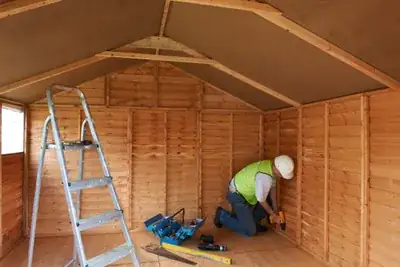
The Conservancy reviews the outside, not the inside
If you are in a Burke Centre cluster you have probably dealt with the Architectural Review Board over a door color or a deck, and you know it sits roughly twice a month and sets your calendar.
None of that applies indoors. Wall color, ceilings, trim, the foyer, the stairs: nobody reviews it. We mention it because Burke Centre owners call asking what to submit and are startled to hear the answer is nothing.
So an interior project books on our schedule rather than the Board's. If you are doing inside and outside the same year, submit the exterior application first and have us do the interior while you wait on the decision.
A two-story foyer is scaffold work, not ladder work
The later Burke colonials almost all have one: an entry opening to the second floor ceiling, a stair turning up one side of it, a window or a half-round above the door, and a chandelier hanging in the middle of the space.
That is eighteen to twenty feet of wall standing over stair treads and a hard tile or hardwood floor. There is no honest way to do it off a ladder. We set rolling scaffold with leveling legs so the crew works standing square, and we set it up once rather than moving a ladder thirty times.
The light is the other issue. A foyer window pours raking daylight down the tallest wall in the house, so any lap mark or restarted roller pass is visible from the front door for as long as you own the place. Those walls get cut and rolled top to bottom in continuous passes with a wet edge the whole way. The chandelier comes down or gets boxed and dropped, the ceiling above it is part of the job, and so is the upstairs hall railing overlooking the space.
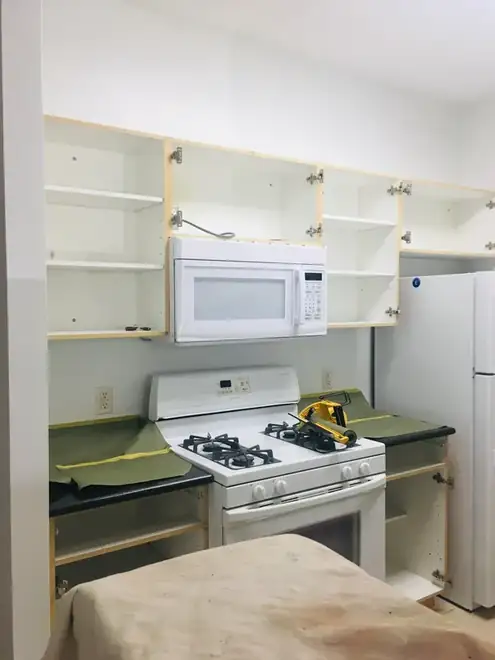
Sprayed ceilings and knockdown walls from the same build
Texture is nearly universal here. Sprayed acoustic on the ceilings in the seventies and early eighties stock, and in some houses a knockdown or orange peel on the walls too.
Ceiling texture removal is one of our steadiest jobs here. Room sheeted in plastic, texture off, the drywall underneath repaired and skimmed because nobody finished a surface a texture was going to hide, then sanded, primed and coated flat. Debris bagged and carried out.
Wall texture is a separate decision. Skim it flat, which is a couple of extra days a room, or leave it and paint, knowing texture holds shadow and a deeper color reads darker on it than the chip suggests.
On age: the earliest Burke Centre houses predate 1978 and the rest do not, so it varies street to street. If there is any question about what is in a ceiling texture, the right move is testing before disturbing it rather than assuming either way. Tell us the build year when you call.
Builder casing after forty-five years of movement
The trim package in a Burke house is builder grade and always was: simple colonial casing, a three-piece base in the better houses and a plain one elsewhere, and a lot of hollow-core doors. It is still wearing its original semi-gloss in plenty of houses, chipped along the hallway and behind every door handle.
Forty-five years of movement has opened the joints. Miters at the top corners of the casing have split and the caulk where casing meets wall has cracked in most rooms. A fresh bead over a split one gives you a painted split. We cut it out, refill, sand the run and lay a hard enamel that a backpack does not mark.
Hollow-core doors are not worth replacing just for being hollow, and they take enamel well once deglossed and sanded. What they do not survive is a hole punched through the skin, and we patch that as carpentry before painting.
The wallpaper that is still in the powder room
There is a great deal of 1980s wallpaper left in Burke, mostly in powder rooms, kitchens, dining rooms and the occasional main bedroom. Some of it is vinyl and comes off in sheets. Some of it is a paper that has fused to unprimed drywall and fights the whole way.
We do not paint over it. Paint traps moisture in the paste, the seams telegraph through within a year, and then it lifts and takes the paint with it. What we do is score where needed, steam or soak, pull the face, wash every trace of adhesive off the wall, skim where the drywall face paper tore, then seal with an oil or shellac based primer before any color.
The sealer is the step that matters. Residual paste reactivates under water based paint and shows as gloss patches or ridges months later. In a powder room with a border at the ceiling, expect the wall under it to be in worse shape than the rest.
Middle units, where light only comes from two ends
Plenty of Burke is townhouse rows, and an interior unit has no side windows at all. Daylight enters front and back and the middle of the house runs on lamps.
That changes color completely. A soft gray that looks right in an end unit with a side window goes flat and cold in the middle of a row. Warm off-whites hold up better in artificial light than cool ones. And a stairwell in the center of a townhouse, with no window on it anywhere, will read two shades darker than the same paint in the front room.
So we brush out samples in the actual spot, at night under your own bulbs as well as by day. A sample judged in a bright kitchen and then rolled onto a windowless hallway is how people end up repainting. Party walls carry sound too, so the noisy part of the day happens at a reasonable hour, and where there is no driveway we load in and out rather than staging on the walk.
Walkout basements, and paint below grade
Most Burke houses sit on a slope with a walkout or daylight lower level, and most of those were finished at some point: a rec room, an office, a fourth bedroom, a bar.
Two things to settle before we prime. If a wall is bare masonry below grade, it needs a masonry primer and a coating that can handle it, not standard wall paint. And if there is any active moisture coming through, paint is not the fix. We would rather tell you to sort the grading or the downspout first than take your money for a wall that bubbles by March.
Where the lower level is framed and drywalled, the usual find is a damp odor, a patch over an old leak and base trim that has swelled. We replace what has swelled, seal any stain, and use a satin rather than a flat down there because that level takes more traffic than people think.
Todos nuestros servicios
Todas las ciudades que cubrimos
Más sobre esto, de Fredy
Estos artículos están en inglés
- What Actually Drives the Cost of Painting a House in Northern VirginiaHomeowners want a number. What they usually need first is an understanding of why two honest painters can quote the…
- The Best Time of Year to Paint the Outside of a Virginia HomeLate spring and early fall are the sweet spots, but the reason has less to do with the daytime high…
- Refinish or Replace? How to Judge the Real Condition of Your DeckA gray, splintery deck usually looks worse than it is. A deck that looks fine can be the one with…
Cuando usted diga.
Fredy contesta su propio teléfono. Si está en una escalera, le devuelve la llamada esa misma tarde.