
Esta página tiene el resumen en español. El texto largo todavía está en inglés. Fredy habla español, así que para cualquier pregunta llame al 703-869-0593 y le atiende directamente.
Interior Painting in Vienna, VA
Our shop is on Trevor Place, so Vienna is the town we are in most days. The houses here are mostly small postwar rooms with textured ceilings, plus a handful of genuinely old ones with plaster walls.
Rooms built to 1957 dimensions
The ranchers and split levels off Nutley Street and Cedar Lane were built with small rooms and eight foot ceilings. A bedroom is eleven by twelve, the hall is three feet wide, and there is one window.
That changes what a color does. In a small room with one window, every wall bounces light onto the next, so a color reads two or three steps stronger than it does on the chip. People pick a mid-tone gray-green in the store and end up with a room that feels like a cave.
We brush out samples on the actual walls and look at them with the door shut and the light on. In these houses the ceiling color matters as much as the walls, because it is low enough to sit in your field of view.
The other consequence is the cut line. You are never more than eight feet from a corner, so a wandering line at the ceiling or a fat caulk bead at the base shows from everywhere. Small rooms are less forgiving than big ones, not more.
Popcorn ceilings in the ranchers and split levels
Sprayed ceiling texture is on almost every Vienna house of that generation, and taking it off is the single change that stops an interior reading as sixty years old. It also makes a low ceiling feel lower, because the shadow under the texture eats light.
We scrape it wet, skim the ceiling flat, sand, prime, and finish in a dead flat white. The room gets sealed off and the material comes out bagged.
Two things to know before booking it. First, the ceiling underneath is rarely in good shape. Texture was often sprayed to cover poor taping, so there is skim work behind it and we allow for that rather than pretending the scrape is the job. Second, a house built before 1978 may have lead paint in it, including coatings over ceiling texture, which is why we work wet and contained. We are painters, not a certified lead abatement contractor, and if testing calls for one we will say so.
Plaster walls near Church Street
Vienna still has real turn-of-the-century houses on Lewis Street and the blocks around Windover Avenue, and they are not drywall inside. They are lime plaster over wood lath, and it behaves nothing like a modern wall.
What we find in them:
- Hairline cracking that follows the lath, usually in long horizontal runs. Filling it with compound and painting over it puts the crack back within a year. It has to be opened, bridged with tape or mesh and floated wide.
- Loose keys. Press a wall and it moves slightly. The plaster has let go of the lath behind it. That gets re-anchored with plaster washers before anything else happens, or the repair comes off with it.
- Calcimine. Old ceilings in these houses were sometimes finished in a chalky distemper that nothing modern will stick to. It has to come off wet. Painting over it is the classic mistake and the finish sheets off in a year.
- A century of paint layers, the oldest of them oil and brittle, which want a bonding primer rather than a fresh latex straight on.
On these houses we say at the estimate that the plaster repair is most of the cost, not the painting.
Trim that was finished in oil
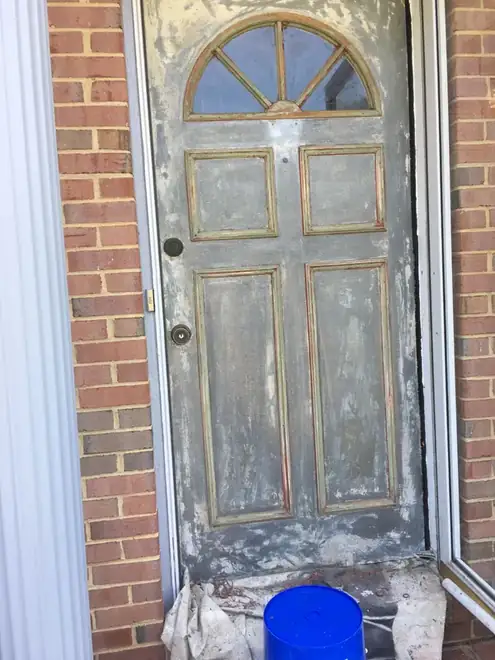
Almost all the original trim here went on in oil enamel and a lot of it has never been touched since. It has ambered to a warm yellow that homeowners read as dirty when it is just old.
You cannot put a waterborne enamel straight onto that. It sits on the gloss without gripping and peels off a baseboard the first time a vacuum hits it. Degloss, bonding primer, two coats, light sand between.
The other thing is the profile. Colonial casing and a three-piece base carry sixty years of paint in the corners and the detail is half filled already. If the profile has gone soft we say so, because two more coats bury it and the honest answer on a piece or two is to strip or replace.
Window sash is its own conversation. Painting a double-hung shut is easy to do and annoying to undo, so we cut the line and work the sash before it sets.
Split level stairwells and the half walls
Vienna split levels put a stairwell in the middle of the house, a wall running past two landings with a half wall and cap rail alongside it.
The tall side gets staged off the treads so someone can stand level and cut a straight line at the ceiling. The half wall and its cap take more wear than anything else in the house, because everyone runs a hand along it, so those go in trim enamel rather than wall paint.
These stairwells are where the house shows its settlement. Cracks open over the door openings at the landings and come back every few years. We cut them out and tape them properly rather than smearing compound into a live joint, and we will tell you a crack in a sixty year old house may reopen anyway.
The shop is four minutes away
Fred General Painting works out of 8040 Trevor Place, off Beulah Road. Vienna is about four and a half square miles, so almost nothing in town is more than ten minutes from our door.
That has practical effects. If you see something at four in the afternoon we come back that day rather than putting you on a list. If a color needs a second sample board, you have it the same evening. If a room needs one more hour, we stay, because nobody is driving home to another county.
It also means we take small work. One hallway. One nursery. A stairwell skipped when the rest of the house was painted. There is no minimum job, and plenty of our long-running clients started with a powder room.
Living in the house while it happens
Almost all our Vienna interior work is in houses people are staying in rather than flipping, and that sets how we run the day.
We work room by room so you keep the rest of the house. We move and cover the furniture, run canvas taped at the base, and clean up every evening so the kitchen is usable that night. Low-odor waterborne enamels on trim and doors let you put a room back the next day instead of the next week.
Fredy Vargas walks the rooms with you, prices it himself, and is on site checking it every day the job runs. Four employees, the same faces from the first morning to the last. Virginia contractor license 2705098145, licensed, bonded and insured. Ten percent off for veterans and for anyone 65 and over. Call 703-869-0593.
Todos nuestros servicios
Todas las ciudades que cubrimos
Más sobre esto, de Fredy
Estos artículos están en inglés
- What Actually Drives the Cost of Painting a House in Northern VirginiaHomeowners want a number. What they usually need first is an understanding of why two honest painters can quote the…
- The Best Time of Year to Paint the Outside of a Virginia HomeLate spring and early fall are the sweet spots, but the reason has less to do with the daytime high…
- Refinish or Replace? How to Judge the Real Condition of Your DeckA gray, splintery deck usually looks worse than it is. A deck that looks fine can be the one with…
Cuando usted diga.
Fredy contesta su propio teléfono. Si está en una escalera, le devuelve la llamada esa misma tarde.