
Esta página tiene el resumen en español. El texto largo todavía está en inglés. Fredy habla español, así que para cualquier pregunta llame al 703-869-0593 y le atiende directamente.
Power Washing in Annandale, VA
Annandale is one building era repeated across 22003, which means we usually know what your siding is made of before we pull in. On some of it the answer to dirt is chemistry and almost no pressure at all.
One siding here sets the ceiling on pressure
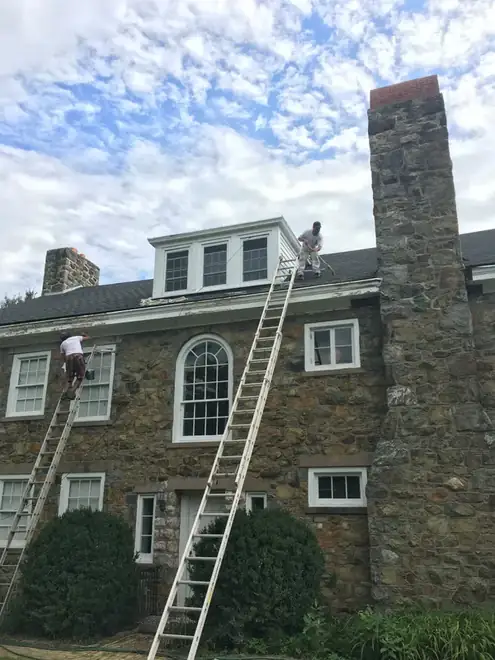
A good number of houses from the original Broyhill Crest, Sleepy Hollow Woods and Canterbury Woods builds still wear their cementitious or asbestos-cement shingle siding. It is stable while it is left alone and it washes up well. What it will not tolerate is anything abrasive: no sanding, no grinding, no wire wheel, and no pressure washer tip held close to it.
That rules out the fast way of cleaning a wall. On those houses we wet the shingles, apply a cleaner at low pressure, give it time to work, and rinse with a wide fan held well back. It takes longer than blasting a vinyl house and we price it that way. If you are not sure what you have, tell us the neighborhood and the build year and we will look at an edge before the machine comes off the truck.
Green growth is alive, and force does not kill it
Oak and tulip poplar spared in the fifties are now sixty feet over these lots, and Holmes Run and Accotink Creek keep the low ground damp. The result is a north or east wall wearing a green and black film that a homeowner reads as dirt.
It is not dirt. It is algae and mildew with roots into the surface, and a pressure-only wash takes the visible layer off and leaves the organism in place. That is why a blasted wall looks right in June and is green again by August. The job that lasts is a cleaning solution applied at low pressure with enough dwell time to kill the growth, then a gentle rinse. Same chemistry, less force, and the difference is measured in years rather than weeks.
Carport slabs, breezeways and the splash line
The rambler and split level carport is the dirtiest concrete on most Annandale properties and the surface people are most surprised by, because nobody looks at it closely until it is clean.
- Drip and oil. Forty years of one car parked in the same spot. That is a degreaser job with dwell time, not a pressure job, and an old stain will lighten rather than vanish.
- Tire marks and rubber. These come off with heat and a cleaner, not with a narrower tip.
- The splash band. These houses sit low, so the bottom courses of siding and any wood skirting carry a gray-brown band thrown up off the beds by every storm. That band is the first thing a wash fixes and the thing owners notice most.
- Post bases. Carport posts rot from the bottom up. We keep pressure off a soft base rather than opening it up.
Wide driveways, leaf litter and rust rings
Lots here are generous by Northern Virginia standards, which means a full-width driveway, a real front walk and usually a back patio. All of it sits under trees.
Three stains repeat on that concrete. Tannin from oak and poplar litter left to sit over a winter, which is the dark brown blotching people mistake for ground-in dirt and which lifts chemically. Algae in the shaded half of the driveway, which is slick and is the reason we get called after somebody slips. And rust, in rings and arcs from a fertilizer spreader or the feet of metal furniture, which is a chemical problem: force will never move it. Flatwork gets a surface cleaner rather than a bare wand so the slab comes out even instead of striped, and we keep runoff out of the street inlets, which here run down to Holmes Run and Accotink Creek.
Holmes Run Acres, flat roofs and walls of glass
The post-and-beam contemporaries need their own plan. Wide unbroken plank siding, exposed beam ends, low-slope roofs and whole walls of fixed glass.
Beam ends are end grain pointed outward. Driving water into soft end grain is how you turn a stain into a repair, so those get cleaned by hand. The glazing is the other caution: original fixed lights in wood stops have sixty-year-old seals and putty, and a wand aimed at a seal finds every weak point. We wash that glass low and level rather than pushing water at the stops.
On the roof we will be plain. Algae streaking on a low-slope or shingled roof is a soft wash question, and a pressure washer on asphalt shingles strips the granules that are doing the work. If your roof is near the end of its life, the honest answer is a roofer rather than a cleaning.
Pool decks, coping and a sixty-year-old hose bib
Plenty of these lots got an in-ground pool in the sixties or seventies, and the concrete deck around it is usually the oldest flatwork on the property. Broom-finished concrete holds algae in its texture, coping holds it in the joint, and the shaded end by the fence is always worse than the open end. We wash it toward the lawn rather than into the water, keep cleaner out of the pool, and tell you honestly that a deck with calcium bloom or a failing coping joint is a masonry repair with a cleaning attached.
One practical matter on houses this age: there may be a single hose bib on the back of the house, fed by original galvanized pipe, and it will not deliver what a machine wants. We check flow at the start. Where the supply is marginal we stage the work or bring water rather than running a pump dry.
What a yearly wash does not solve here
Most of 22003 has no association writing letters about dirty siding, so people here wash when they decide to rather than when they are told to. Worth knowing what you are buying.
- Tannin streaks on light siding. Washing takes most of it. Brown weeping from oak above the wall will come back every year the litter sits there.
- Chalky aluminum. The powder rinses off and the panel still looks tired, because the finish on it is spent. That is a coating decision, not a cleaning one.
- Soft wood. A fence rail or a sill you can press a thumbnail into does not get better wet. We work around it and point it out.
- Artillery fungus. Black specks on the lower siding of a house with hardwood mulch beds. Some comes off. Some does not.
Fredy Vargas has been working on houses of this era since 2002 and walks the property himself before quoting. Virginia contractor license 2705098145, licensed, bonded and insured. Call 703-869-0593.
Todos nuestros servicios
Todas las ciudades que cubrimos
Más sobre esto, de Fredy
Estos artículos están en inglés
- What Actually Drives the Cost of Painting a House in Northern VirginiaHomeowners want a number. What they usually need first is an understanding of why two honest painters can quote the…
- The Best Time of Year to Paint the Outside of a Virginia HomeLate spring and early fall are the sweet spots, but the reason has less to do with the daytime high…
- Refinish or Replace? How to Judge the Real Condition of Your DeckA gray, splintery deck usually looks worse than it is. A deck that looks fine can be the one with…
Cuando usted diga.
Fredy contesta su propio teléfono. Si está en una escalera, le devuelve la llamada esa misma tarde.