
Esta página tiene el resumen en español. El texto largo todavía está en inglés. Fredy habla español, así que para cualquier pregunta llame al 703-869-0593 y le atiende directamente.
Power Washing in Arlington, VA
On an Arlington lot the wall you are cleaning is close enough to the next house that the job has to be planned around somebody else's property. The surfaces are different here too: more brick, more iron, more steps than driveway.
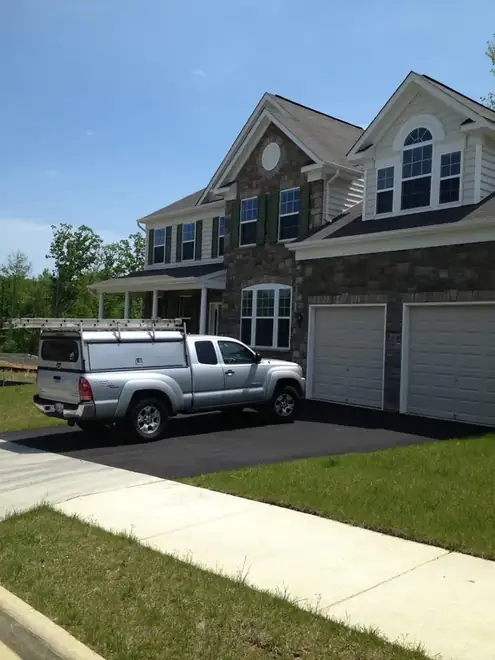
Cleaning solution drifts, and the car is right there
In Ashton Heights, Lyon Park, Cherrydale or Westover your side wall may be twelve feet from the next one. Nobody thinks about that until a fine mist of cleaner settles on a dark car parked in the next driveway and dries into spots.
So we work out the order before anything is mixed. Cars get moved or covered. We knock on the door and ask about open windows and window air conditioners, which are everywhere here in summer and which will take water and solution straight into a room. Boxwood and hydrangea get soaked with clean water first and rinsed properly after. And with no driveway to work from, the machine usually sits at the curb and the hose crosses a public sidewalk, so it gets flagged and kept flat rather than left in a loop for somebody to trip over.
Painted brick, and what a wash finds in it
The postwar capes, ramblers and small colonials across Arlington Forest, Bluemont and the 22205 streets are brick, and a lot of that brick has been painted or has a coated foundation band at the bottom.
A wash is honest about that coating in a way a homeowner may not enjoy. Where the film has already lost its grip, water at any working pressure will lift it, and you end up with bare patches instead of a clean wall. We test a small area first and tell you what we expect to happen. If the paint is letting go in sheets, cleaning it is not the job you need.
On unpainted brick the pressure is moderate at most and stays off the joints. Seventy years of freeze and thaw opens mortar, and a wand run down an open joint puts water inside the wall rather than on it.
Iron, and the rust running down everything under it
Almost every 1950s brick cape in the county came with wrought iron: porch supports, stair railings, basement window grilles, a gate. Those are the reason the concrete steps and the brick below them are streaked orange.
Two things worth knowing. Rust staining is chemical, so pressure will not move it. It takes a rust remover suited to the surface underneath, and on brick that is a careful, tested application rather than a broad one. Second, water driven into the joints and the hollow bottom of an iron post has nowhere to drain and it speeds up what is already happening inside. We keep the tip off the welds and base plates, wash down rather than up, and dry what we can reach.
If the rail is flaking scale rather than just stained, say so when you call, because that is a preparation and coating conversation instead.
Stone walls, steps and a lot that steps down to the street
Arlington lots slope, and the way builders handled that was with walls and stairs. Most properties we wash here have a retaining wall of stone, block or cast concrete, a flight of steps from the public sidewalk, and a short front walk.
- Shaded walls. A north-facing retaining wall under a street tree holds moss and algae in the texture. Chemistry and dwell time, then a low-pressure rinse.
- Caps and joints. Loose cap stones and open joints come apart under pressure. We find those first and work around them.
- Weep holes. A wall with water behind it drains somewhere. Blocking or blasting those holes is how a wall starts to lean.
- Steps. Treads get a surface cleaner or a brush, not a wand held at the nose of the step, which erodes the edge you stand on.
A wall that is already bulging or cracked through is a masonry job. Cleaning it makes the problem easier to photograph, nothing more.
Telling road film apart from algae
Two different kinds of dirty turn up on Arlington houses and they want different treatment, so the first thing we do is work out which one you have. The test is which walls are affected.
Growth follows shade. If the film is green or black, sits on the north and east elevations and is worst behind a shrub, it is alive, and chemistry with dwell time is the answer. Film that is flat and evenly gray, on the elevation facing Columbia Pike or Glebe Road or the blocks backing onto 395, is brake and tire dust with soot in it. That one is greasy rather than biological, so it wants a detergent with real surfactant and a top-down rinse, and it does not respond to a mildew cleaner at all. Plenty of houses here have both, on different sides, and we mix for each wall rather than for the house.
Balconies, patio slabs and the unit below yours
A large share of Arlington households are in garden apartments, converted condominium units, townhouse rows and mid-rise buildings, and in most of them the exterior envelope is not yours to clean. Ask the management office before you book anything, and get it in writing if the building is particular.
What is normally yours is the private side: a balcony slab, a patio, a fenced entry court, a private walk, a storage door. Balconies have one trap in them. Water you put on a slab leaves through a scupper or over the edge, which means it lands on the railing, the furniture and the planters of the home underneath. We wash those with a controlled volume and a wet vacuum or squeegee rather than flooding the slab, and we tell the neighbor below we are there. We can send a certificate of insurance to the management company.
The limits, including one about lap siding
Some of this is about restraint, so here is what we avoid and what cleaning will not change.
- Never up under lap siding. Wood, vinyl or fiber cement, a wand angled upward drives water behind the course, and behind the course it has nowhere to go. The whole wall gets washed level or downward.
- Old double-hung sash. The pre-war blocks are full of original windows with worn putty and loose stops. Water pushed at a sash ends up on plaster inside. We wash those gently and check the sill afterward.
- Shared fences. Washing one side of a board fence makes the other side look worse. Ask your neighbor before we start and we will do both.
- Chalky vinyl and faded paint. Both rinse cleaner and still look tired, because the finish is spent rather than dirty.
Fredy Vargas has been working on Arlington houses since 2002 and looks at the property himself before pricing it. Virginia contractor license 2705098145, licensed, bonded and insured. Call 703-869-0593.
Todos nuestros servicios
Todas las ciudades que cubrimos
Más sobre esto, de Fredy
Estos artículos están en inglés
- What Actually Drives the Cost of Painting a House in Northern VirginiaHomeowners want a number. What they usually need first is an understanding of why two honest painters can quote the…
- The Best Time of Year to Paint the Outside of a Virginia HomeLate spring and early fall are the sweet spots, but the reason has less to do with the daytime high…
- Refinish or Replace? How to Judge the Real Condition of Your DeckA gray, splintery deck usually looks worse than it is. A deck that looks fine can be the one with…
Cuando usted diga.
Fredy contesta su propio teléfono. Si está en una escalera, le devuelve la llamada esa misma tarde.