
Esta página tiene el resumen en español. El texto largo todavía está en inglés. Fredy habla español, así que para cualquier pregunta llame al 703-869-0593 y le atiende directamente.
Power Washing in Chevy Chase, MD
On a house built in 1915 the pressure washer is the problem, not the tool. Almost every surface on these streets gets washed with chemistry and dwell time at low pressure, and the part that takes real planning is where the water goes afterwards.
Why we keep the pressure down
What most people picture as power washing is a wand held close and a trigger held open. On the housing stock here that removes material, not dirt.
These houses are a hundred years old and more. The stucco is soft and lime-rich by design. The siding is old growth wood carrying decades of coats, some of them holding on by not much. The glazing putty in the window sash is original or nearly so. A tip that would be fine on a 2005 vinyl elevation will open joints, drive water into the wall, and take out putty beds that cost real money to replace.
So what we actually do on a house like this is a soft wash. A cleaning solution is applied at low pressure, given enough dwell time to kill the mildew and algae and release the dirt chemically, then rinsed at a pressure closer to a garden hose than a wand. The work is done by chemistry and patience instead of force.
It takes longer than blasting it. It is also the difference between a house that is clean and a house that needs repairs it did not need last week.
Sash, putty and the parts that let water in
The divided-light wood windows on these houses are the surface a wand ruins fastest and the failure does not show up until later.
Glazing putty holds the glass and seals the joint between glass and wood. Old putty is already shrunken and cracked in places. Directing pressure at a sash strips those weak sections out and pushes water straight past the glass onto the bottom rail, where it sits inside a joint you cannot see and rots the sash from within.
Around windows we wash by hand or at very low pressure, keep the stream off the glazing line entirely, and we rinse downward rather than up under lap joints and sills. Same discipline at door casings, at the joint where a porch roof meets the wall, and under the butt ends of shingle courses. Anywhere water can get behind something and stay, we do not aim at it.
If a wash reveals open putty or soft wood, we tell you then rather than painting over it. That is often how these problems get found.
Stucco walls and what pressure does behind them
A stucco over wood frame wall is the surface we are most careful with, and it is everywhere here.
Old stucco is permeable on purpose. It sheds bulk water and lets what gets past it dry back out through the face. Hit that wall with pressure and you do two things at once: you erode the surface, exposing more aggregate and making it hold dirt faster next time, and you push water through hairline cracks into the frame behind, where it has no route out and nobody sees it until the sheathing goes.
Hairline cracking in old stucco is normal. It is not an invitation to force water through it. We wash these walls with solution and dwell, rinse gently from the top down, and stop at any area where the stucco sounds hollow or drummy, because a section that has already lost its bond to the lath behind will come off in your hand.
We also look before we wash. If there is staining in one place and not another, something above it is doing that: a failed flashing, a downspout discharging against the wall, copper runoff tracking down from a gutter. Washing it clean without finding the source means washing it again next year.
Slate, copper and the roofline
The roofs here are commonly slate with copper flashing and copper gutters, and none of that gets washed the way people assume.
We do not pressure wash a slate roof and we will talk you out of hiring anyone who offers to. Slate is brittle, it does not take foot traffic, and water forced up a slate course goes under it rather than off it. Moss and algae on slate are a specialist conversation, not a wash-day add-on.
Copper gutters are worth clearing and worth treating gently. They are soft, a ladder leaned against one will deform it, and once deformed it holds water at the low spot and drips into the fascia. We set ladders on standoffs bearing on the fascia, clear the gutters by hand, and flush rather than blast. While we are there we check the seams and the downspout connections, because a gutter that has been overflowing for two seasons is usually the reason the wall below it is stained in the first place.
Where the water goes on a lot this narrow
This is the part of the job that is genuinely specific to these blocks. On many of these streets the gap between your wall and the neighbor's is a few paces. Wash water and rinse do not stop at a property line, and neither does drift off a side elevation.
What we plan before the hose comes out:
- The neighbor. Cars moved or covered, windows closed, and a knock on the door to say which day we will be at that edge. Drop cloths and tarps go on their side of the line when the work is at the boundary.
- Plantings. Beds get pre-wet and tarped on both sides. Pre-wetting dilutes anything that lands, and it matters more here because the beds are close enough that all of them are downhill of something.
- The storm inlet at the curb. Nothing gets rinsed toward it. Water gets directed to soil and lawn where it can soak in instead of running straight off pavement.
- Tree root zones. The street canopy here is old and protected, and the root zones run right under the strip where a rig would naturally sit. We keep equipment and concentrated runoff off them.
- The mildest chemistry that works. Not the strongest product available. A cleaner with enough dwell time does the job at a strength that will not burn a neighbor's boxwood.
Old paint, and what comes off in the wash
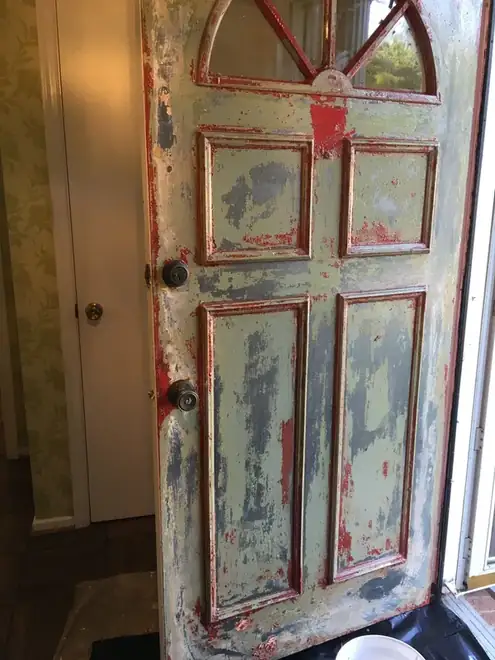
Essentially every house in this ZIP predates 1978, so a wash on a painted exterior will loosen and bring down some old paint wherever the film has already failed. That is not something to be casual about on a narrow lot.
We control it rather than hosing it into the yard. Sheeting goes down under the elevation being washed and runs out far enough to catch what carries, debris is collected the same day rather than left over a weekend, and nothing is swept or flushed toward the curb.
Where a wash is prep for painting, the two get planned together, because a wash that dislodges material is doing part of the prep and the scrape that follows is where the federal RRP threshold, more than twenty square feet of exterior painted surface disturbed, comes into play. Maryland is not an EPA-authorized state, so that federal rule applies directly here. It is a fair question to put to any company quoting a wash on a house this age, and worth checking the answer. What we do is tell you what the rule covers on your scope and keep the site clean.
Setting up on a street that may not be the county's
The practical staging question here is one most contractors never ask. Inside 20815 there are eight separate towns and villages, Montgomery County lists them each with their own office, and several of them administer their own curb, right of way and start times. Where a rig stands, how long it can stand there, and what hour it can start running are local answers, not one answer.
We establish which municipality your house is in at the estimate and ask that office directly rather than assuming. On a narrow lot with no driveway that is not a formality, because the truck and the hose reel have to be somewhere and the alternative is finding out on the morning.
Water comes from your spigot on public supply, and we confirm that flow is adequate before the day rather than discovering it is not. Walks, steps, brick, flagstone, patios and the porch floor all get washed at pressures chosen for each one, because old brick and soft mortar joints are no tougher than the stucco.
No minimum job size, so a single porch and a set of steps is work we will take. Fred General Painting has been at this since 2002 out of 8040 Trevor Place in Vienna, same four-person crew every day. Call 703-869-0593.
Todos nuestros servicios
Todas las ciudades que cubrimos
Más sobre esto, de Fredy
Estos artículos están en inglés
- What Actually Drives the Cost of Painting a House in Northern VirginiaHomeowners want a number. What they usually need first is an understanding of why two honest painters can quote the…
- The Best Time of Year to Paint the Outside of a Virginia HomeLate spring and early fall are the sweet spots, but the reason has less to do with the daytime high…
- Refinish or Replace? How to Judge the Real Condition of Your DeckA gray, splintery deck usually looks worse than it is. A deck that looks fine can be the one with…
Cuando usted diga.
Fredy contesta su propio teléfono. Si está en una escalera, le devuelve la llamada esa misma tarde.