
Kitchen Cabinet Painting and Refinishing in Vienna, VA
A cabinet repaint costs a fraction of new boxes and takes days instead of weeks. The finish depends almost entirely on degreasing and sanding.
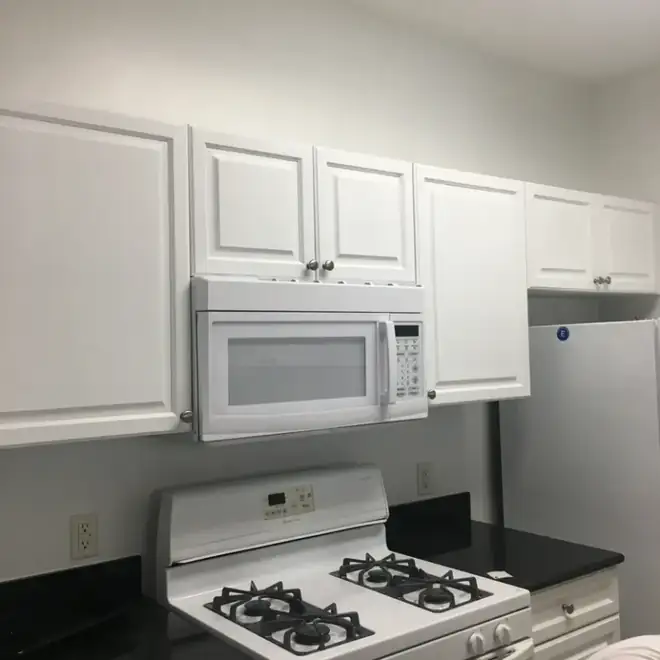
Why people refinish instead of replace
Most kitchens in Vienna, Oakton and Fairfax have cabinet boxes that are perfectly sound. Solid frames, doors that still hang square, drawers that still run. What has aged is the finish: honey oak that dates the room, a white that has yellowed near the range, a maple that has gone orange in ten years of sunlight through a bay window.
Refinishing keeps your layout and your storage and changes the whole look of the room. It also puts your kitchen back together in days rather than weeks. There is no demolition, no countertop removal, no plumbing disconnect, no waiting on a delivery date that slips twice.
Fred has been doing this work since 2002 and he is on the job himself, with the same four-person crew each day. Cabinets are unforgiving in a way that walls are not. They sit at eye level, they get touched constantly, and light rakes across a flat door and shows every flaw. It is fine work, and it is why we do it in your kitchen personally rather than handing it off.
Step one is degreasing, and it is not optional
Kitchen cabinets carry an invisible film. Years of aerosolized cooking oil settles on every surface, heaviest above and beside the range and around the handles where hands go. You cannot see it and you can barely feel it. Paint will not stick to it.
So the first thing we do is wash everything with a degreasing cleaner, rinse it, and let it dry. Doors, drawer fronts, face frames, the inside edges, the panel recesses where grease pools in the corner. On a heavily used kitchen this takes real time and it is the step that separates a finish that lasts from one that starts chipping at the handles in six months.
Here is something worth knowing: silicone from furniture polish is the other invisible enemy. If cabinets have been polished with a spray product over the years, that residue causes fisheye, little craters where the coating pulls away from itself. It has to be cleaned off, and if we see it in the first coat we deal with it rather than burying it.
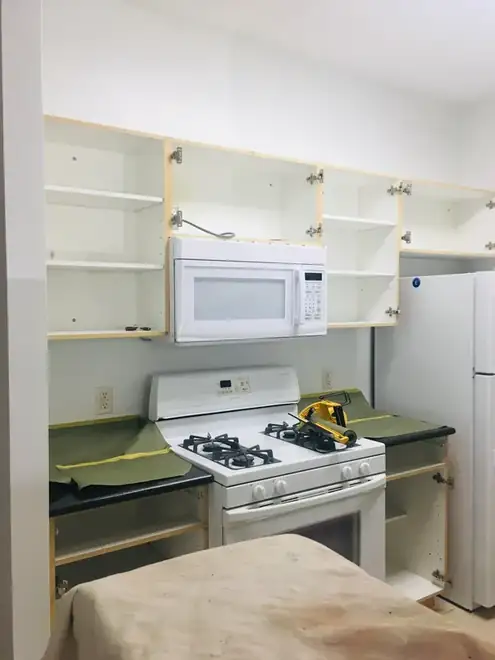
How the job actually runs
The sequence is the same in every kitchen. What changes is how many doors you have.
- Doors and drawer fronts come off and get numbered. Hinges, screws and pulls go into labeled bags mapped to the same numbers, so every door returns to the opening it was fitted to.
- Everything gets degreased, rinsed and dried.
- Full sanding by hand and with a sander where the shape allows. We are not removing the old finish, we are cutting the sheen so the primer has tooth.
- Dents, chips and any open joints get filled and sanded flush.
- Bonding primer on everything, doors and boxes both, then a light sand of the primer.
- Multiple finish coats, sanded between, applied so they lay out flat rather than showing brush texture.
- Boxes and face frames are done in place, with the kitchen masked off and openings protected.
- Doors and drawers go back on with the original or new hardware, hinges adjusted so the reveals line up, and fresh bumpers on the corners.
Sanding, and what it can and cannot do
Sanding cabinets is about adhesion first and smoothness second. A factory cabinet finish is a hard, closed, glossy surface, and nothing bonds to it until it is scuffed. We sand every face, every edge, every profile in a raised panel door, including the inside of the frame where the panel meets it. That detail work is why a proper cabinet job is slower than people expect.
What sanding will not do is remove wood grain. This is the thing that surprises homeowners most. If you have red oak cabinets, the grain is deep and open, and painting them does not hide it. A painted oak door looks like a painted oak door: smooth to the touch in the flat, with the grain texture still visible under the color. Some people like it. Others want a modern slab-smooth look, which requires filling the grain first, a real added step that we will quote honestly rather than pretending sanding alone gets there.
Maple, poplar, birch and MDF doors go smooth easily and are the best candidates for a furniture-grade look.
Cabinets we will tell you not to paint
Not every cabinet takes paint well, and we would rather say so at the estimate than take the job and hope.
Thermofoil is a vinyl film heat-wrapped over MDF. It is common in kitchens built in the nineties and two thousands. If the film is peeling at a corner near the oven, paint will not reattach it, and coatings over intact thermofoil need a specialized bonding approach. We will look at yours and be straight about the risk.
Laminate and melamine can be coated with the right bonding primer, but the edges and any delaminated corner will still be edges and delaminated corners underneath.
Boxes that are failing structurally, particle board bottoms sagging under a sink from an old leak, doors that no longer hang square because the frame has racked, are a replacement conversation, not a paint conversation.
Interior cabinet boxes are usually left alone. Most people want the outside faces and frames done, since that is what you see, and painting shelf interiors adds cost and a surface that dishes will scuff. If you want the insides done, we will do it, we just tell you what to expect first.
Sheen and color for cabinets
Cabinets want a harder film than walls. Satin and semi-gloss are where nearly every kitchen lands. Semi-gloss cleans up best and reflects the most light, which suits traditional raised panel doors. Satin is softer and more current, and it hides minor surface variation better on a large flat slab door. We stay away from flat and matte on kitchen cabinets no matter how good it looks in a photograph, because it will not survive being wiped.
We use Sherwin-Williams and Benjamin Moore cabinet and trim lines, which are formulated to level out and to harden into something that can take a fingernail. Wall paint on a cabinet door stays soft and will print, meaning objects pressed against it leave a permanent mark.
On color: white and off white still dominate, but the two-tone kitchen has been the most common request for a few years now. Darker perimeter or island, lighter uppers. It reads custom and it hides wear at the base cabinets, which is where the abuse happens. Interior lighting matters enormously here. Warm bulbs pull a cool gray toward taupe. We put samples on a door and look at them under your actual kitchen lights, at night as well as in daylight.
How the coating goes on, and why doors come off
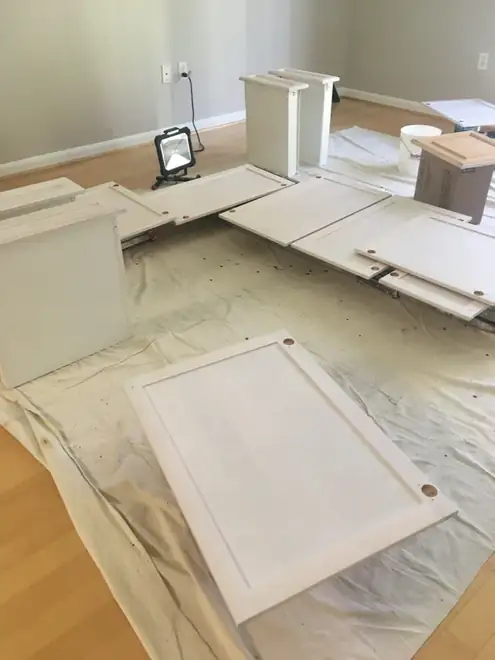
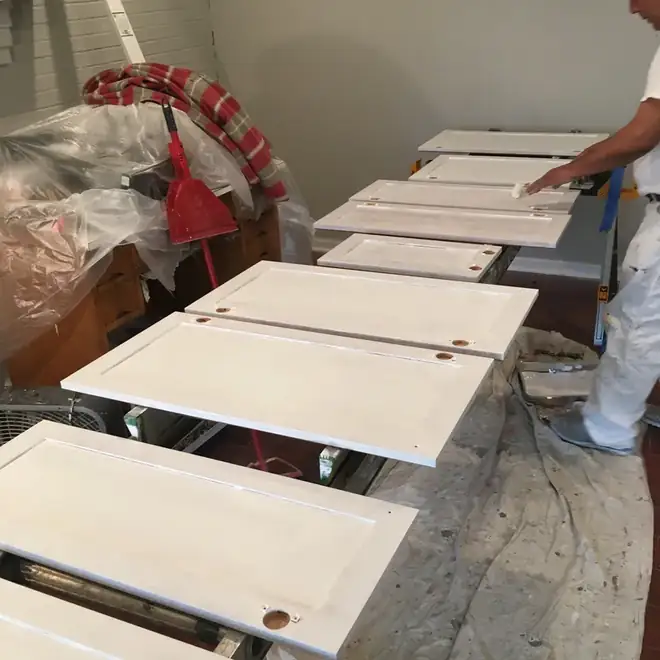
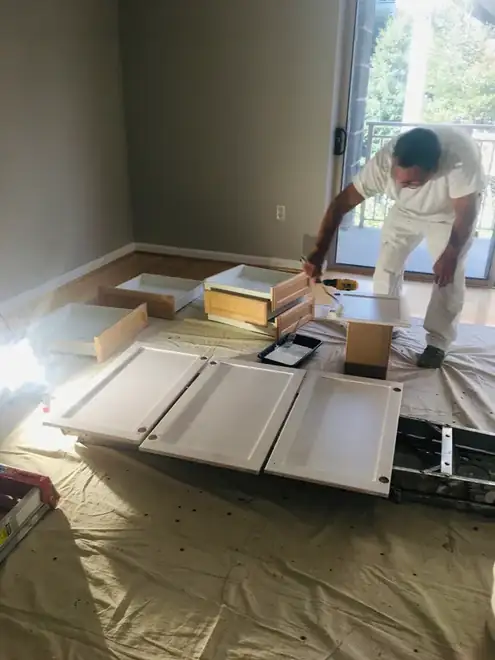
Doors and drawer fronts get taken off and finished flat, horizontally, on racks. That is not for our convenience. A coating applied to a horizontal surface has time to flow out and level before it sets, so the finish lays down flat. The same material brushed onto a vertical door still hanging on its hinges wants to sag and run in the panel corners, and every run has to be sanded out and recoated.
Face frames and the box sides stay in place, because they are attached to your kitchen. Those get masked carefully, with the counters, backsplash, appliances and floor protected, and they get worked by hand and by fine roller and brush so the texture matches the doors as closely as possible. Matching those two surfaces is the craft part of cabinet work.
We put on multiple finish coats, with a light sand between them, and we let each one flash off properly before the next. Rushing recoat time on a cabinet finish is how you get a soft film that never fully hardens and prints a permanent mark the first time something sits on it.
Something homeowners rarely think about: hinge adjustment. Once doors come back on, the reveals almost never line up perfectly, because they had been living with whatever settling happened over the years. European cup hinges adjust in three directions, and going around a kitchen aligning every door and drawer front so the gaps are even is a proper hour of work at the end of the job. It is also the difference between a kitchen that looks refinished and one that looks new.
Living with a wet kitchen
Plan on your kitchen being partly out of service for a few days. You keep the fridge, the sink and usually the range. What you lose is access to what is behind the doors, so we ask you to pull out what you use daily before we start: coffee, plates, a pan, medications.
Cabinet coatings are dry to the touch quickly and recoatable the same day. They are not cured for two to three weeks, and cabinets are the surface where that distinction bites hardest. Two freshly painted surfaces pressed against each other while still curing will bond and tear when separated. Painters call it blocking. It is the reason a door sticks to its frame and pulls a patch of finish off the first time you open it after a repaint.
So we hand you a short set of rules when we leave.
- Leave doors slightly ajar for the first few days where you can, especially in a humid kitchen.
- Wait about a week before putting dishes back on painted shelf surfaces, and put felt pads under anything heavy.
- Do not tape anything to the finish, including child locks and note paper.
- Clean with a damp cloth only for the first month. No degreaser, no scrubbing sponge, no spray cleaner on a fresh film.
- Humidity slows curing. If the job runs in August, give it the longer end of the window.
Getting a quote
Cabinet pricing follows door and drawer count more than kitchen size, because the doors are the labor. A galley kitchen with thirty doors is more work than an open kitchen with eighteen. Grain filling, interior boxes, new hardware, and any repair work each add to it. Fred comes out, counts the doors, looks at what the cabinets are made of, checks how heavy the grease is around the range, and gives you a number based on the actual kitchen.
We take cabinet work in Vienna, Oakton, McLean, Great Falls, Tysons, Falls Church, Arlington, Fairfax, Burke, Annandale, Reston, Herndon, Alexandria and Springfield. Our hours are 8 to 5 on weekdays, with weekend appointments if that is the only way to get into your kitchen. There is no minimum, so a bathroom vanity or a single built-in is a real job to us, not a favor. There is a 10 percent discount for veterans and for customers 65 and over.
We are licensed, bonded and insured, Virginia contractor license 2705098145, background checked, rated 5.0 on Google across 40 reviews and a Thumbtack Top Pro five years running. Call 703-869-0593.
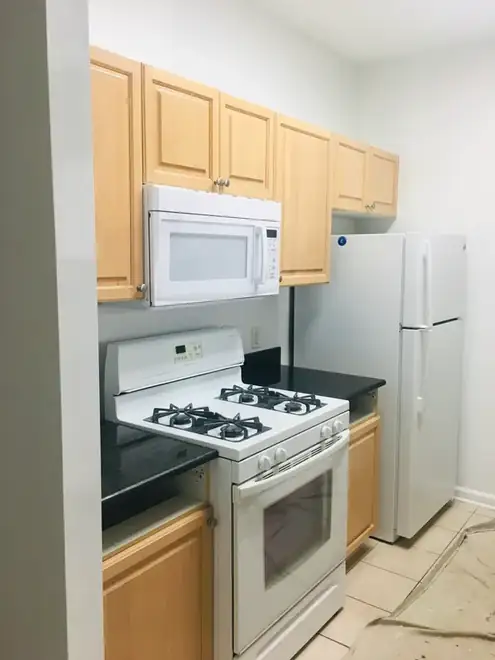
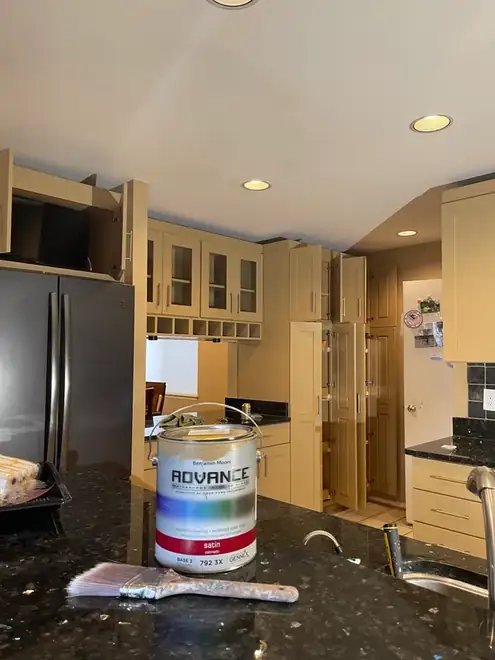
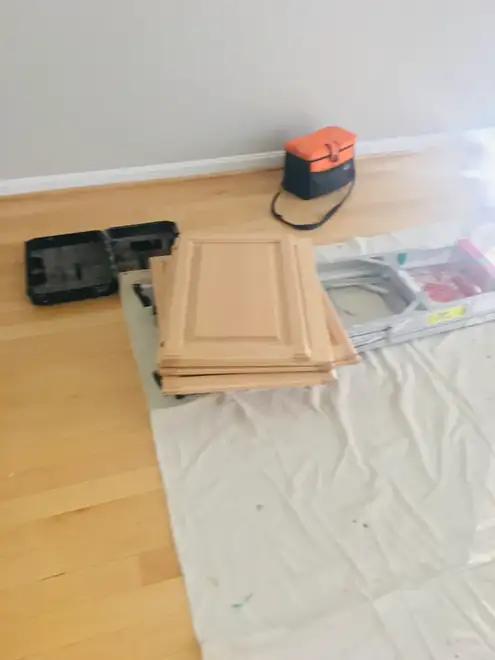
Recent cabinet refinishing work
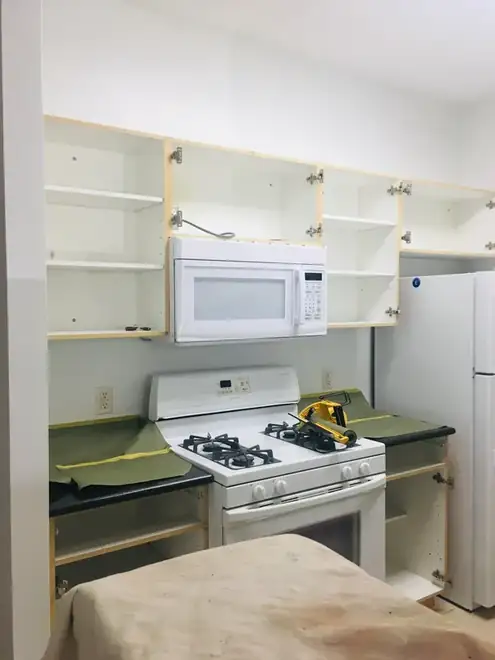
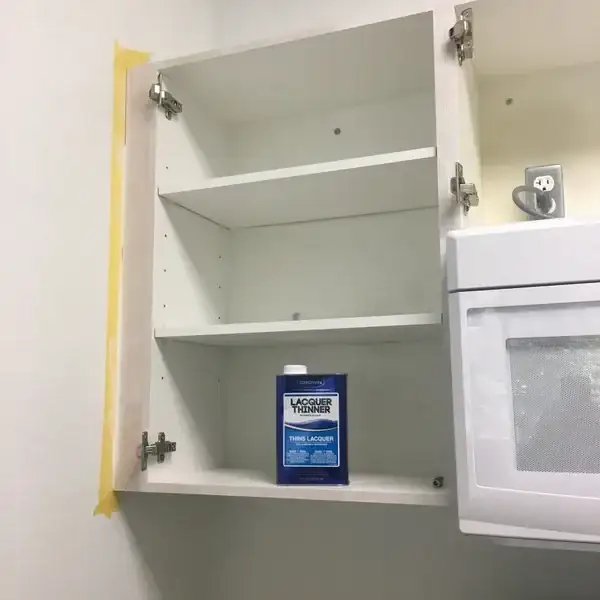
Our own photographs, from jobs around Northern Virginia.
Questions about cabinet refinishing
How long does a kitchen cabinet job take?
Most kitchens run a few days rather than weeks. The variables are door count, how much grease has to come off, and how many finish coats the color needs. Doors come off on day one and go back on at the end. You keep your sink, fridge and range the whole time. We tell you the expected schedule at the estimate and Fred checks in each day so you know where it stands.
Will the wood grain still show after painting?
On oak, yes. Red and white oak have deep open grain that sanding does not remove, so a painted oak door will be smooth to the touch but the grain texture stays visible under the color. Maple, poplar, birch and MDF go smooth easily. If you want oak to look like a modern slab-smooth door, the grain has to be filled first, which is an extra step we will price separately.
Can you paint thermofoil or laminate cabinets?
Sometimes. Laminate and melamine can be coated with the right bonding primer if the surface is intact. Thermofoil is a vinyl film over MDF, and if it is already peeling near the oven, paint will not reattach it. We look at your specific cabinets and tell you honestly whether it is a good candidate, because a coating over a failing substrate fails with it.
Do you paint the inside of the cabinets too?
Only if you ask for it. Most people do the door fronts, drawer fronts and face frames, since that is everything you actually see with the doors closed. Painting shelf interiors adds meaningful labor and creates a painted surface that dishes and cans will scuff over time. If you want it done we will do it, we just want you to know the tradeoff first.
How soon can I put my dishes back?
Load the cabinets lightly after a couple of days and give painted shelf surfaces about a week before you stack heavy plates on them. The film is dry within hours but cures over two to three weeks. Put felt pads under anything heavy. Leave doors slightly ajar for the first few days so freshly coated surfaces are not pressed together while they harden.
Do you replace the hardware?
We can install hardware you have bought, and we reuse the original if you like it. If you are moving from knobs to pulls, or from one pull size to another, the old holes have to be filled and the new ones drilled on a jig so they line up across the run. That is worth doing while the doors are off and being finished, not afterward.
Will the finish chip like the original factory finish?
A properly prepped cabinet finish is durable, but a field-applied coating is not identical to a factory conversion varnish baked on before the doors were assembled. Realistically the wear points are the same either way: around handles, at the base cabinet fronts near feet, and beside the range. Degreasing, sanding and a bonding primer are what determine how it holds, far more than the color you pick.
Can you do just a bathroom vanity or one built-in?
Yes. We have no minimum job size and we mean that. A single vanity, a laundry room cabinet, a built-in bookcase or a fireplace surround is a normal job for us. Small work gets scheduled around larger projects so you are not waiting a month for a two day job. Call 703-869-0593 and Fred will come look at it.
Cabinet refinishing near you
Every town below has its own page with what we run into on those houses.
Our other services
More on this from Fred
- Painting Your Kitchen Cabinets vs Replacing ThemRefinishing is the cheaper path most of the time. But there are kitchens where it is the wrong answer, and…
- What Actually Drives the Cost of Painting a House in Northern VirginiaHomeowners want a number. What they usually need first is an understanding of why two honest painters can quote the…
- The Best Time of Year to Paint the Outside of a Virginia HomeLate spring and early fall are the sweet spots, but the reason has less to do with the daytime high…
Ready when you are.
Fred answers his own phone. If he is up a ladder he calls back the same evening.